Worst Week in Months: Sensex Sheds 2,091 Points as Oil Tops $100 on Red Sea Attacks
Sensex's worst week in months: the index shed 2,091 points to close at 76,059.77 on 24 July 2026 as Brent crude topped $100 after Red Sea tanker attacks and the rupee neared its record low.
Commentary & Analysis ·

Key facts
- Sensex closed at 76,059.77 on Friday 24 July 2026, down 331.62 points (0.43%); the Nifty ended at 23,767.45, down 102.15 points, a fifth straight losing session
- The Sensex lost roughly 2,091 points, about 2.7%, over the week, reported as its steepest weekly fall in around two months
- Brent crude settled at $100.69 a barrel on 23 July, up about 7%, crossing $100 for the first time since late May after Houthi attacks on two Saudi tankers in the Red Sea
- The rupee slipped towards 96.5 per dollar, near its record low of 96.965; Bloomberg reported the RBI sold dollars in both onshore and offshore markets
- ICICI Bank raised $1 billion via a five-year dollar bond at 100 bps over US Treasuries, reported as the largest such issue by an Indian private lender in almost 14 years
From a 900-Point Surge to a 2,091-Point Slide
The arithmetic of the past five sessions is stark. On 17 July, the Sensex had surged past 78,150, adding more than 900 points in a single day as strong first-quarter earnings from information technology majors powered a rally that defied a global sell-off. One week later, the index closed at 76,059.77 on Friday 24 July, down 331.62 points, or 0.43 per cent, on the day, its fifth consecutive losing session, and roughly 2,091 points, or about 2.7 per cent, lower for the week. Reports described it as the steepest weekly fall in around two months.
The Nifty settled at 23,767.45, down 102.15 points on Friday and about 567 points, or 2.3 per cent, over the week. The speed of the reversal matters as much as its size. The same market that shrugged off a semiconductor rout and weak global cues a week ago found it had no answer to a single number: the price of a barrel of Brent crude.
The Trigger: Brent Crosses $100 After Red Sea Attacks
The proximate cause lies thousands of kilometres west of Dalal Street. On Thursday 23 July, Yemen's Houthi forces said they had attacked two Saudi oil tankers, identified in reports as the Encelia and the Layla, in the Red Sea. A fire broke out aboard one vessel, though the crews were reported safe, and reports said one of the struck tankers was carrying crude bound for India. Brent futures jumped $6.59, or about 7 per cent, to settle at $100.69 a barrel, crossing $100 for the first time since late May.
The attacks hit a market that was already stretched. The interim truce between Washington and Tehran, signed in mid-June, has effectively collapsed; the United States has resumed strikes on Iran, and Tehran has claimed hits on tankers near the Strait of Hormuz. Brent is now up roughly 40 per cent in July alone. The Houthis have also threatened to blockade the Bab al-Mandeb Strait, the chokepoint linking the Red Sea to the Gulf of Aden, which is the very route tankers use to avoid Hormuz.
Why $100 Oil Is an India Problem
India imports more than 85 per cent of the crude it consumes, which makes the oil price less a market variable than a macroeconomic tax. The chain of consequences is well rehearsed but no less painful for being familiar. A higher import bill widens the current account deficit; costlier fuel feeds into freight, food and headline inflation; and pressure on the trade balance drags the rupee lower, which in turn makes every subsequent barrel more expensive in rupee terms.
The bill is already swelling. India paid about 60 per cent more for crude imports in the April-June quarter than a year earlier, according to trade data cited in reports, even as volumes stayed broadly flat. Roughly 40 per cent of the country's crude imports transit the Strait of Hormuz. Rating agency ICRA has estimated that a sustained disruption there could add 15 to 25 dollars a barrel to India's landed cost, an outcome the market is now being forced to price, at least in part.
The Rupee Feels It First
The currency market registered the strain before equities did. The rupee slipped to around 96.46 per dollar during the week, within touching distance of its record low of 96.965 set in late May, and is down about 2 per cent in July. Bloomberg reported on 20 July that the Reserve Bank of India sold dollars in both offshore and onshore markets to slow the slide, even as officials reportedly debated how aggressively the central bank should defend any particular level.
A weakening rupee and rising crude are a combination foreign institutional investors rarely stay to watch. FIIs remained net sellers through the week, according to exchange data cited in reports, compounding the pressure on banking and other index heavyweights. The selling was not indiscriminate, and flows chased earnings where they found them, but the aggregate direction was unmistakably outward.
Sector Scoreboard: Banks and Realty Bleed, FMCG Holds
Over the week, banking and realty stocks led the losses, the two sectors most sensitive to interest rate expectations and risk appetite. FMCG and auto names outperformed, supported by first-quarter earnings that suggested domestic consumption is holding up better than the headline indices imply. Friday's session added its own nuance: IT was the strongest performer on the day, with HCLTech, Wipro and Cipla attracting buyers, while Bajaj Finance, Eternal and Mahindra & Mahindra bore the brunt of the selling.
The India VIX, the market's fear gauge, rose more than 4 per cent on Friday to around 14, elevated but far from panic levels. That reading captures the week accurately: this was an orderly repricing of an oil shock, not a rout. Whether it stays orderly depends almost entirely on headlines the Indian market cannot control.
ICICI's $1-Billion Counterpoint
Amid the gloom, one transaction cut the other way. ICICI Bank priced a $1 billion five-year dollar bond at 100 basis points over US Treasuries, sharply inside initial guidance of about 130 basis points, with a coupon working out to roughly 5.46 per cent. Reports called it the largest dollar issue by an Indian private-sector lender in almost 14 years, and the order book was reported at about $3 billion against a base size of $500 million.
The signal is worth pausing on. Global debt investors oversubscribed an Indian bank's paper six times over in the same week that equity investors were selling Indian bank shares. Credit markets, in other words, are treating India's macro stress as cyclical rather than structural, a vote of confidence the equity market may eventually catch up with, if oil allows.
What to Watch Next
The coming week will be decided less on Dalal Street than in the Red Sea and the Gulf. Several markers deserve attention.
None of this is destiny. Oil shocks of recent years have faded as quickly as they arrived, and India's macro buffers, from foreign exchange reserves to a credible central bank and resilient domestic earnings, remain intact. But at $100 crude, the margin for error narrows with every session, and the market spent this week saying exactly that.
- Shipping traffic through the Bab al-Mandeb Strait and any fresh attacks on tankers; Goldman Sachs has warned Brent could exceed $120 a barrel by the fourth quarter if disruption persists.
- The rupee's behaviour around the 97-per-dollar mark, and whether the RBI's intervention turns more forceful or steps back.
- FII flow data and the remainder of the first-quarter earnings season, which has so far cushioned FMCG, auto and IT names.
- Whether the Nifty holds the 23,700 zone; a decisive break below it would suggest the correction has further to run.
Sources
- The Week - Worst market week in months: Sensex sheds 2,091 points (24 July 2026)
- Business Standard - Stock market live: Sensex drops, Nifty below 23,700 as Brent crude tops $100 (24 July 2026)
- HDFC Sky Market Close Report - Sensex, Nifty decline for fifth day as elevated oil and Iran war hurt stocks (24 July 2026)
- Reuters via TradingView - ICICI Bank prices $1 billion debt in largest dollar issue by an Indian private lender (23 July 2026)
- Bloomberg - RBI intervenes to support rupee as currency nears record low (20 July 2026)
This article is original news analysis and commentary by The NE Times, based on reporting from the sources listed above.
You may also like to read
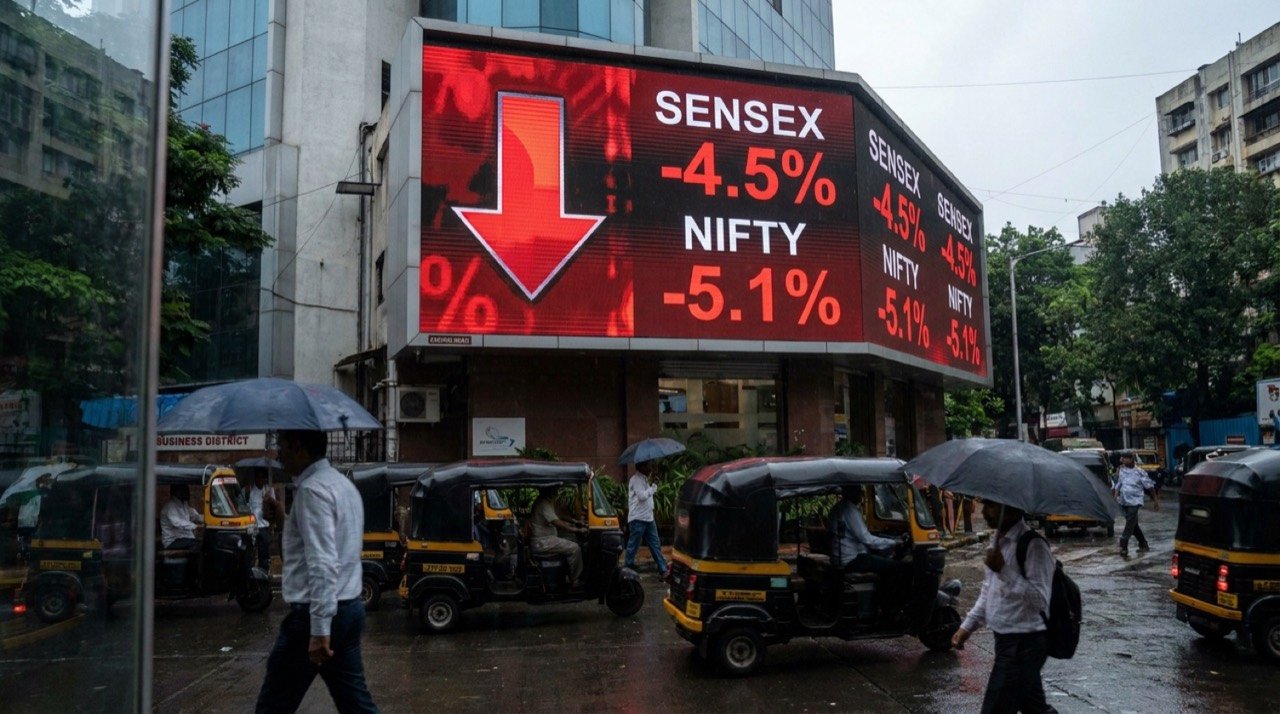
Sensex Sheds 893 Points as Global Risk and West Asia Tensions Weigh on Indian Equities
Indian benchmark indices closed sharply lower on June 23 as weak global cues and West Asian uncertainty dragged the Sensex below 76,300 and the Nifty under 23,850.
Sensex Jumps 1,695 Points as Oil Slides on Peace-Deal Hopes
Indian equities staged one of their strongest sessions of the year after crude prices fell on reports of a possible US-Iran agreement, easing pressure on the oil-importing economy.

Sensex Surges About 800 Points as IT and Banking Stocks Defy Weak Global Cues
An intraday gain of about 800 points in the Sensex is large enough to dominate financial headlines, yet one session cannot establish a durable bull market.

Sensex Climbs Around 291 Points, Nifty Closes Above 24,100 as IT and Pharma Shares Lift Market
Indian equities rebounded on June 22, 2026, with the Sensex gaining about 291 points and the Nifty closing above 24,100, led by IT and pharmaceutical stocks despite lingering Middle East tensions.
More from this section
More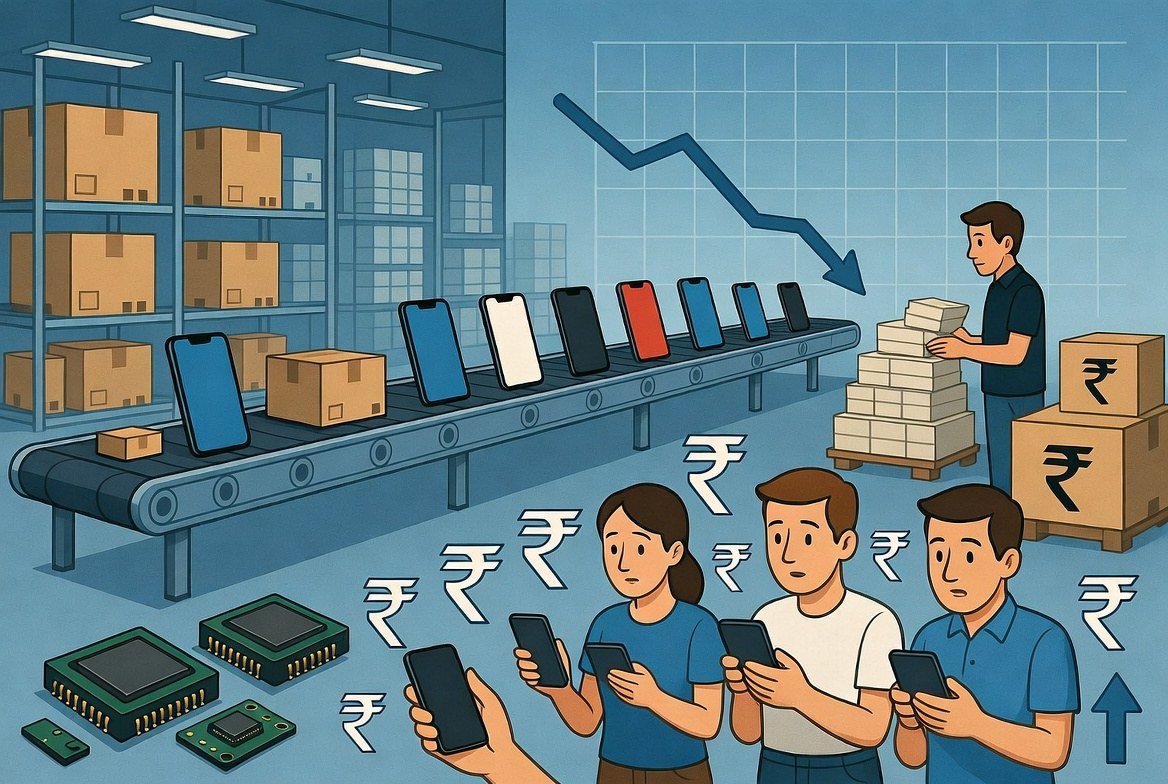
India Smartphone Shipments Fall 10 Percent in Q2 2026 as Rising Prices Hit Affordable Demand
India remains one of the world's largest smartphone markets, so a double-digit quarterly shipment decline is a significant signal for manufacturers, retailers, app businesses and telecom operators.
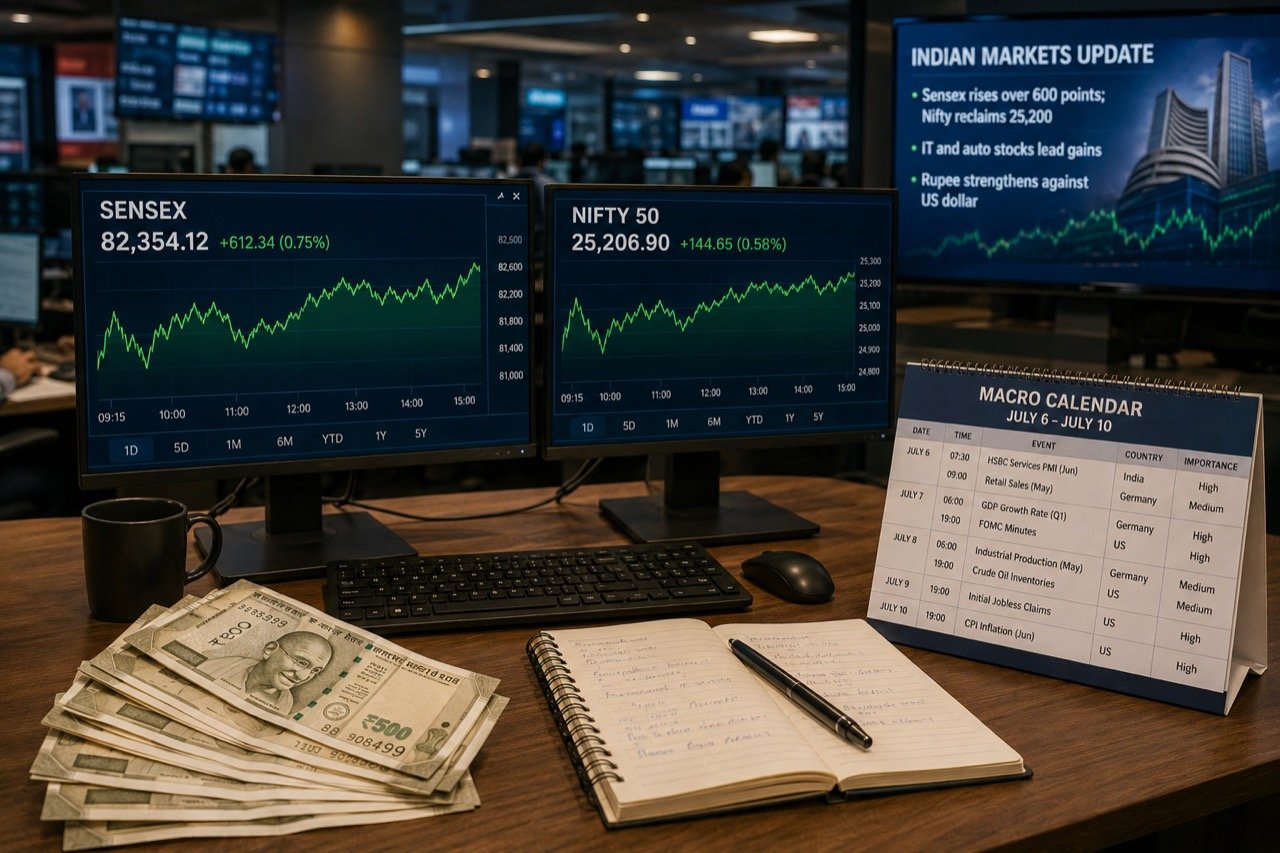
Sensex, Nifty Week Ahead: Trade Deal Hopes and Q1 Earnings in Focus
Indian equities enter a news-heavy week with trade-deal expectations, quarterly earnings, foreign flows and global cues all converging to set the direction for the Sensex and Nifty.

Sensex Drops 372 Points, Nifty Slips Below 24,000 On IT, Auto Drag
Indian benchmarks closed lower on June 29 as the Sensex fell 372 points to 76,728 and the Nifty ended at 23,946, with IT, auto and oil and gas stocks dragging while pharma outperformed.