Murshidabad School Van-Train Collision Kills Three and Renews Level-Crossing Safety Questions
The Murshidabad collision is devastating because it involved children travelling on an ordinary school morning.
Commentary & Analysis ·
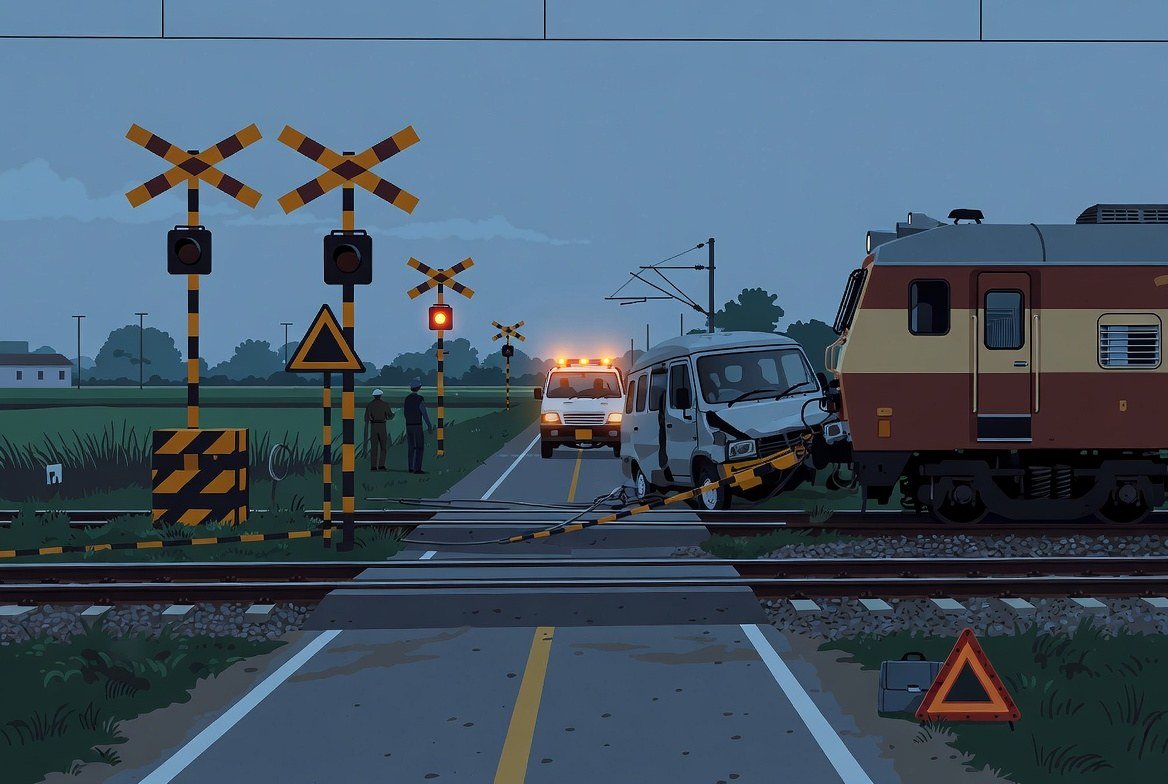
Key facts
- A school van and a train collided on the Azimganj-Katwa section near Karnasubarna in Murshidabad district on Friday morning.
- Initial reports varied on the identities of the three people killed; later accounts described two students and a local resident among the fatalities, while several children were injured and some were reported critical.
- The collision occurred at or near an open level crossing between Karnasubarna station and the Gobindapur rail-gate area.
- Railway and local authorities began inquiries; casualty and condition updates should be checked against official statements because early figures changed across reports.
A morning journey turns into a local tragedy
The Murshidabad collision is devastating because it involved children travelling on an ordinary school morning. A van entered or crossed the railway path near Karnasubarna and was struck by a train on the Azimganj-Katwa section. Three deaths were reported, along with multiple injuries. Early coverage differed over whether all those killed were students, illustrating why casualty descriptions must remain cautious until authorities complete identification and family notification. The human impact extends far beyond the numbers. Parents, teachers, classmates, railway staff and residents will carry the shock, while injured children may need prolonged medical and psychological support. News coverage should centre that reality without publishing graphic images or intrusive footage from hospitals and grieving homes.
The recurring danger of open crossings
Level crossings concentrate several risks into a small space. Road users must judge the speed and distance of a train that cannot swerve and may require a long distance to stop. At an open or inadequately controlled crossing, a moment of impatience, poor visibility or misunderstanding can become fatal. Rural roads may lack barriers, warning lights or trained gatekeepers, and local familiarity can create false confidence. Drivers who cross daily may treat the tracks as part of the road rather than a high-risk boundary. The accident should lead to a route-specific investigation: signage, sight lines, train horn use, road condition, driver conduct and any available surveillance must all be examined rather than assuming one simple cause.
School transport carries a higher duty of care
Vehicles carrying children require stricter safety standards because passengers cannot evaluate risk or choose another route. Operators should be licensed, trained and subject to background and fitness checks. Vehicles need functional doors, seat capacity controls, emergency contacts and route planning that avoids unnecessary hazards. Schools and parents also need clarity about whether a van is officially contracted or privately arranged, because responsibility can become blurred after an incident. A railway crossing on a school route should be mapped and assessed in advance. Where an open crossing cannot be avoided, drivers must follow a stop-look-listen procedure every time, regardless of schedule pressure. Safety cannot depend on local habit or the assumption that trains run at predictable moments.
Why early casualty reports can conflict
Breaking news often reaches the public through local witnesses, police messages, hospital staff and railway sources at different times. Names may be withheld, injured people may later die and reporters may misunderstand who was inside the vehicle. The Murshidabad coverage showed those pressures, with some headlines initially describing three student deaths while other reports identified two students and one local resident. This is not a minor editorial detail. Accuracy protects families from learning false information and prevents incorrect claims from becoming permanent in search results. Newsrooms should timestamp updates, correct headlines clearly and avoid presenting the first figure as final. Readers should favour official district, police, hospital and railway updates when details conflict.
What the inquiry must establish
A credible inquiry should reconstruct the sequence second by second. Investigators need the train's speed, braking data, horn record and crew statements; the van's condition, passenger load and driver history; the crossing's design, warning systems and maintenance record; and witness accounts from both sides. They should also examine whether vegetation, buildings, parked vehicles or road angles obstructed visibility. Responsibility may involve individual error, infrastructure weakness or both. The purpose cannot be only to identify someone to punish. It must produce preventive recommendations with deadlines and named agencies. Too many transport inquiries fade after public attention moves on. Publishing findings and completion status would help ensure that lessons reach other districts with similar crossings.
Engineering solutions are available
The safest long-term approach is to eliminate road-rail conflict through overbridges, underpasses or closure of low-use crossings with alternative routes. Where that is not immediately possible, barriers, lights, alarms, rumble strips, reflective signs and improved lighting can reduce risk. Technology can warn authorised school vehicles when a train is approaching, but systems must be reliable and maintained. Low-cost measures such as clearing sight lines and repainting road markings should not wait for a major capital project. Prioritisation can be based on traffic volume, train frequency, school-route use and accident history. The Murshidabad site should be assessed quickly, but the same criteria should be applied across the network rather than only after fatalities.
Community behaviour and enforcement
Infrastructure is essential, yet behaviour remains part of the safety chain. Drivers may try to beat a train because waiting feels inconvenient or because they underestimate its speed. Public campaigns should explain that a train can appear farther away and move faster than expected. Enforcement against dangerous crossing should be consistent, especially for commercial and school vehicles. Local residents can help by reporting broken signals, blocked views or repeated near misses. Railway staff and district administrations should hold periodic safety sessions with schools and transport operators. The message must be practical rather than generic: stop at a safe distance, confirm both directions and never enter unless the exit side is clear.
From mourning to measurable prevention
Public attention will be intense for a few days, but meaningful accountability requires a longer timeline. Authorities should release the final casualty record, support injured families, publish the inquiry outcome and state exactly what will change at the crossing. If a bridge or barrier is promised, progress should be tracked. Schools in the district should review transport routes immediately rather than waiting for the investigation. The tragedy cannot be undone, but it can expose a risk that may exist at many other crossings. Prevention is measurable: fewer open crossings, better compliance, documented inspections and transparent near-miss data. Those outcomes would be a more respectful response than symbolic announcements that disappear after the news cycle.
Sources
- The Indian Express, India Today, The Times of India and NDTV reports on the Murshidabad collision, July 17, 2026.
- Official railway, district and hospital updates should be used for final casualty identification and inquiry findings because early reports differed.
This article is original news analysis and commentary by The NE Times, based on reporting from the sources listed above.
You may also like to read

Supreme Court Questions Patna High Court Reasoning in Attempt-to-Rape Ruling, Renewing Focus on Judicial Sensitivity
The Supreme Court's criticism of reasoning used in a Patna High Court judgment has become a major legal and public debate.
Madurai Bus Collision Leaves Six Dead and 41 Injured, Renewing Questions About Tamil Nadu Road Safety
A deadly collision near Kottampatti has brought grief to families and placed intercity bus safety, driver fatigue and emergency response back under scrutiny.
Anakapalle Plant Fire Kills Two Workers, Renews Industrial-Safety Concerns
A major fire at the Dakshin Energy plant in Andhra Pradesh's Anakapalle district has killed two workers and trapped others, reviving urgent questions over factory fire controls and inspections.
Parbhani Temple Roof Collapse Kills Several, Reigniting Questions Over Construction Safety at Religious Sites
A roof section at an under-construction temple in Maharashtra's Parbhani district collapsed during a gathering, killing at least five to six devotees and injuring many more, exposing gaps in construction oversight.
More from this section
More
Gujarat Anti-Radicalisation SOP Faces Profiling Questions Over Beard, Niqab and Arabic-Language Indicators
The controversy around Gujarat's anti-radicalisation standard operating procedure turns on a basic distinction.
Bombay High Court Tests Maharashtra's Maratha Quota Against Political Power and the 50 Percent Ceiling
The Bombay High Court is not merely deciding whether a 10 percent figure is politically popular or administratively convenient.

CBSE Class 10 Second Board Result Delay Drives Search Surge as Students Wait for an Official Date
The CBSE Class 10 second board result has become one of the day's most searched education topics as students wait for an official announcement.