Indian Study Links Everyday Vitamin Gaps to Higher Dementia Risk
Researchers at the ICMR-National Institute of Nutrition found that adults with poorer vitamin status carried a markedly higher predicted risk of dementia, pointing to diet as a lever for healthy ageing.
Commentary & Analysis ·
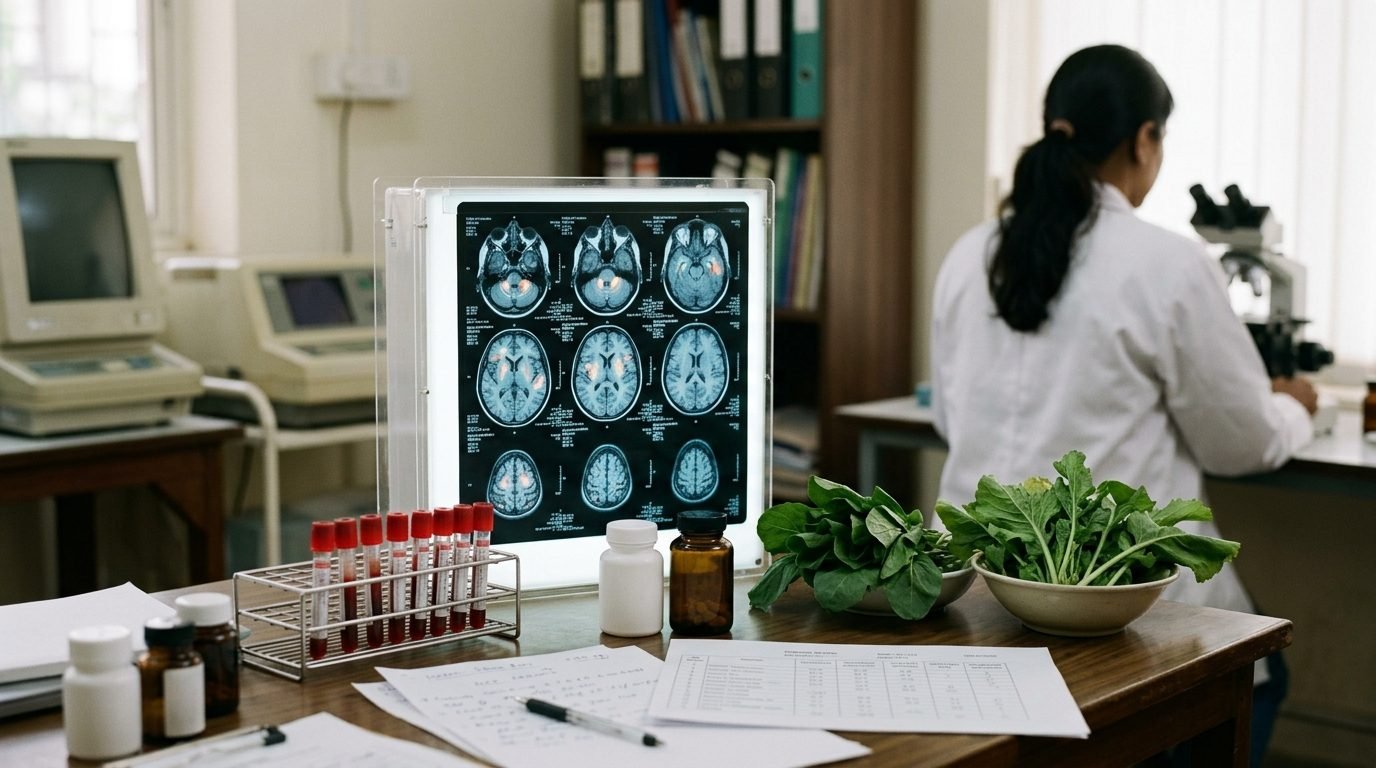
A new study from the ICMR-National Institute of Nutrition has found a clear association between micronutrient deficiencies and a higher risk of dementia among Indian adults, adding weight to the idea that what people eat through midlife may shape how their brains age. The finding places diet alongside the better-known risk factors for cognitive decline and suggests a lever that ordinary people can actually pull.
Published in The Lancet Regional Health - Southeast Asia, the community-based study followed 570 adults aged 40 to 80 across rural and urban settings in Telangana, drawing in researchers from Stanford and the Karolinska Institute. The spread across both rural and urban participants matters, because it captures a range of diets and living conditions rather than a single, narrow population.
The vitamins that stood out
Participants placed in the high-risk category had notably poorer nutritional status, with shortfalls of vitamins D, B2, B6 and B12 far more common among them. These particular vitamins play roles in nerve function and brain metabolism, which helps explain why researchers were drawn to them, though the study itself focuses on the statistical link rather than the biological mechanism.
Nearly 40 percent of those studied fell into the higher predicted-risk group, a striking proportion that underlines how widespread such vitamin gaps may be in the population the study examined.
- A community-based study of 570 adults aged 40 to 80 in Telangana
- Coverage of both rural and urban settings
- Collaboration with researchers from Stanford and the Karolinska Institute
- Shortfalls of vitamins D, B2, B6 and B12 more common in the high-risk group
- Nearly 40 percent of participants in the higher predicted-risk category
Association, not proof
The researchers are careful to note that the study shows an association, not proof that deficiencies directly cause cognitive decline. Observational research of this kind can reveal that two things tend to occur together, but it cannot, on its own, establish that one causes the other; other factors common to people with poor nutrition could also be at play.
That caution is important because it guards against the temptation to treat vitamin supplements as a guaranteed shield against dementia. The honest reading is that the study identifies a promising signal worth pursuing through further, more rigorous research.
Why it matters
Even so, the authors argue the finding is encouraging precisely because diet is modifiable, and correcting common vitamin gaps could be a practical part of protecting the ageing brain. Unlike age or genetics, what people eat can be changed, which makes nutrition an appealing target for public health efforts aimed at healthy ageing in a country with a rapidly growing older population.
The outlook points toward larger, longer studies to test whether closing these vitamin gaps actually lowers dementia risk over time. In the meantime, the work strengthens the broader case for balanced, nutrient-rich diets through midlife, framing good nutrition not only as a guard against physical illness but potentially as an investment in long-term brain health.
The NE Times View
Linking everyday vitamin gaps to dementia risk reframes nutrition as a public-health investment in healthy ageing, not merely individual choice. The finding lands in a country where deficiency is widespread and ageing is accelerating, making diet a rare lever that is cheap and scalable. The caution is causation - predicted risk is not destiny - but the policy direction, toward fortified staples and better diets, is sound regardless.
This article is original commentary and analysis by The NE Times. Background facts were referenced from DD India, Telangana Today.
You may also like to read
India Bets on AI to Catch the Next Outbreak Under One Health Mission in 2026
Drawing on the hard lessons of COVID-19, the ICMR is inviting proposals for AI systems to detect emerging pathogens across people, animals and the environment, in a bid to predict outbreaks rather than react to them.

Jharkhand Teen Dies During Fracture Treatment; CM Orders Probe
The death of a Jharkhand teenager during treatment for a reported fracture has led to family allegations of medical negligence and an official probe ordered by the Chief Minister into what went wrong.
Aarogya Setu 2.0 Returns as India's Personal Health Record App
The pandemic-era contact tracing app has been relaunched as a personal health record platform, betting that portable medical data can find a place in India's growing digital health ecosystem.
Maharashtra Orders Statewide Blood Centre Checks After FDA Shutdowns
After the Food and Drug Administration shut two blood centres, Maharashtra has ordered inspections of every facility in the state, putting blood-bank safety, licensing and public trust in health infrastructure under fresh scrutiny.
More from this section
More
Health Insurance: Why Hospital Cashless Status Matters Before You Buy
Whether a hospital sits inside an insurer's cashless network can decide if a family pays lakhs upfront during an emergency or walks in with paperwork alone, making it a first-order question for policy buyers.
Jharkhand Teen Dies During Fracture Treatment; CM Orders Probe
The death of a Jharkhand teenager during treatment for a reported fracture has led to family allegations of medical negligence and an official probe ordered by the Chief Minister into what went wrong.
Aarogya Setu 2.0 Returns as India's Personal Health Record App
The pandemic-era contact tracing app has been relaunched as a personal health record platform, betting that portable medical data can find a place in India's growing digital health ecosystem.