US Moves to End Open-Ended Student Stays, Putting 3.6 Lakh Indian Students on Notice
A US proposal to replace indefinite student status with fixed admission periods and a shorter post-study grace window threatens to reshape choices for the nearly 3.6 lakh Indians who form America's largest international student population.
Commentary & Analysis ·
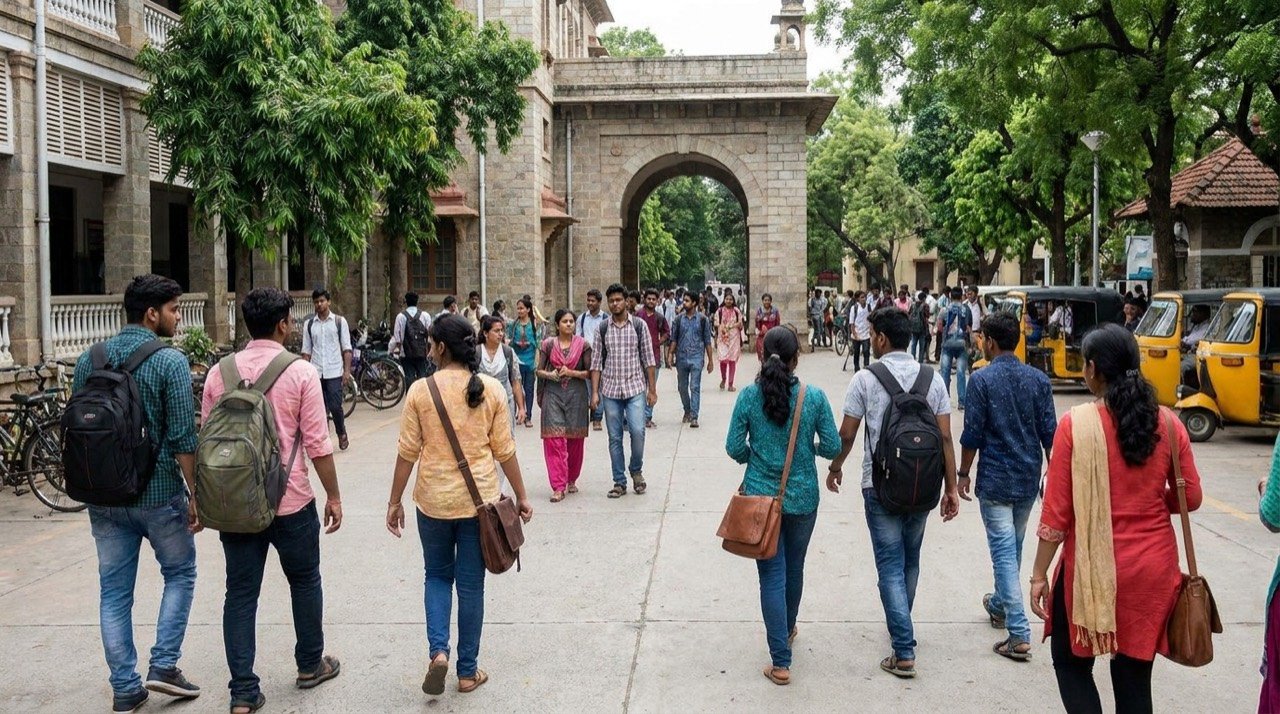
A sweeping change to the way the United States manages international student visas has cleared a key review stage, and the proposal lands squarely on Indian families. With nearly 3.6 lakh Indians enrolled, India is the largest source of international students in the US, meaning any tightening of the rules reverberates strongly across the country's aspiring graduates and their parents. The scale of the exposure is what makes this more than a routine regulatory update: no other nationality sends as many students to American campuses, and no other student community has as much riding on the terms under which they are allowed to stay.
What is changing
The proposal, which completed a review by the Office of Management and Budget, would replace the current system in which F-1 students can remain so long as they maintain valid status. Instead, students would be admitted for a fixed period and would need additional approval to stay beyond it. This is a structural change, not a cosmetic one. Under the existing arrangement, a student's authorised stay is tied to the length of their academic programme and continued compliance with its terms, a framework that has offered a degree of predictability for students planning multi-year degrees, optional practical training, and early career moves. A fixed admission period shifts that logic: instead of status flowing automatically from enrolment, students would need to actively seek extensions, introducing a recurring administrative hurdle and, with it, recurring uncertainty.
The post-study grace period would also shrink to 30 days from 60, giving graduates less time to find work, change visa categories or wind down their stay. That halving of the window matters more than the raw number suggests. Sixty days already required graduates to move quickly between finishing coursework, securing employment authorisation, lining up a job offer, or making arrangements to depart. Cutting that in half compresses an already tight sequence of steps into a period that leaves far less room for delays in paperwork, employer decisions, or unforeseen circumstances.
Part of a wider tightening
The shift sits alongside a wider overhaul of US work-visa policy, including an H-1B framework reworked to favour higher-paid, higher-skilled applicants over entry-level hires, and rising processing fees. Taken together, these changes point to a coordinated recalibration of the entire study-to-work pipeline that has long been the central selling point of a US education for Indian families. It is not simply that the student visa itself is becoming more conditional; the employment visa that many students hope to transition into afterwards is simultaneously being redesigned to favour more senior, better-compensated candidates. For a fresh graduate a few years into their career, that combination narrows the odds of successfully converting a US degree into a long-term US career at both ends of the pipeline.
A chilling effect already visible
The number of Indian students in the US has already fallen, dropping to roughly 352,600 as of early 2026 from about 378,800 a year earlier, a decline of nearly 7 percent. Visa issuance for new students slumped sharply over the previous year, and education consultants report growing interest in alternative destinations such as the United Kingdom, Germany and Australia. This decline predates the finalisation of the fixed-stay proposal, which suggests that anticipation of tighter rules, along with the accumulated effect of earlier visa and fee changes, is already reshaping decisions in Indian households. Prospective applicants and their families tend to price in future risk well before a rule takes effect, and a near 7 percent drop in a single year, for a market as large and established as India's, is a meaningful signal that confidence in the US as a study destination is softening.
For many Indian families, the appeal of a US degree has long rested on the pathway from study to work and, eventually, a longer-term career. Fixed stays and a shorter grace window narrow that runway, raising the financial risk of an expensive American education. A US master's degree frequently costs several years of an Indian household's income, an investment that has historically been justified by the prospect of working in the US afterwards to recoup costs and build savings. When the post-study runway shortens and the renewal of student status becomes a recurring bureaucratic contingency, the calculus underlying that investment changes considerably, even for families who can still afford the tuition.
What remains uncertain
The proposal still faces rulemaking steps before taking effect, and details could shift. Clearing an Office of Management and Budget review is a procedural milestone, not the final word; formal rulemaking typically involves further steps that can alter timelines, thresholds and exemptions before anything is locked in. But the direction of travel is clear, and counsellors are urging students to weigh timelines and backup options carefully. That advice reflects the reality facing this year's applicants: with the outcome unresolved, students admitted under current terms could still find the rules altered partway through their studies, making it prudent to plan around multiple contingencies rather than assume today's terms will hold for the duration of a two-to-four-year programme.
For India, the trend feeds a broader conversation about retaining talent and strengthening domestic higher education. Every cohort of students who reconsider the US in favour of Canada, Britain, Australia, or Indian institutions represents both a lost remittance-and-diaspora relationship for the US and a potential gain, in tuition revenue, research capacity and human capital, for whichever system captures that demand instead.
The NE Times View
Fixed admission windows would inject precisely the uncertainty that deters talent, and Indians, as America's largest student cohort, would absorb the brunt. A system that requires repeated approval to remain in status converts what was once a settled, multi-year commitment into a series of renewable permissions, each one a point of potential disruption for students who have already committed years of study and often significant family savings. The squeeze is also an opportunity: it strengthens the case for Canada, Britain and Australia, and for India to make its own universities worth staying for. Countries and institutions that can offer clearer, more stable post-study pathways stand to benefit directly from any loss of confidence in the American system, and Indian policymakers have long argued that domestic higher education needs to be strengthened precisely so that the country is not solely dependent on the goodwill of foreign immigration regimes. Families weighing lakhs in fees deserve clarity, and policymakers here should treat this as a recruitment signal, not merely a grievance. Rather than treating the tightening purely as a setback to be lamented, it is worth reading as a prompt: for Indian universities to compete harder for the students and faculty who might otherwise have gone abroad, and for Indian industry to make the case that world-class careers are increasingly buildable at home.
Key takeaways
- The proposal would replace indefinite F-1 student status with fixed admission periods requiring further approval to extend.
- The post-study grace period would shrink from 60 days to 30, compressing the window graduates have to secure work or change status.
- India is the largest source of international students in the US, with about 3.6 lakh enrolled, making it the most exposed nationality to this change.
- Indian student numbers have already fallen nearly 7 percent, to around 352,600, alongside tighter H-1B rules and rising visa fees.
- The rule is not yet final, but counsellors are advising students to plan for multiple contingencies, including alternative destinations such as the UK, Germany, Australia and Canada.
You may also like to read
Football's Biggest Tournament Yet Kicks Off Across North America
The 2026 FIFA World Cup has opened in Mexico City, Los Angeles and Toronto, launching the first 48-team edition spread across three host nations and sixteen cities.
US Citizenship Fee Hike Proposal Could Hit Indian Immigrants Hard
A proposed near-doubling of the US naturalisation fee, alongside the removal of waivers, threatens to reshape citizenship timelines and household budgets for one of America's largest immigrant communities.
BRICS Security Talks Open in India With Non-Traditional Threats in Focus
India hosts the BRICS National Security Advisers' meeting on 22-23 June 2026, with NSA Ajit Doval chairing talks on terrorism, cyber risks, emerging technology and regional instability amid Middle East tensions.

India-UAE Talks on BrahMos and Akashteer Open a New Defence Export Window
Early-stage talks for India to sell BrahMos supersonic cruise missiles and Akashteer air-defence systems to the UAE could mark a major step for Make in India and New Delhi's arms-export ambitions in the Gulf.
More from this section
More
India-New Zealand Ties: Visit Plans Put FTA and Diplomacy in Focus
Reports of a planned high-level India-New Zealand engagement have revived attention on free trade talks, professional mobility and Indo-Pacific cooperation between two partners with clear room to grow.

Modi Greets Trump on US 250th Independence Day, Hails Partnership
Prime Minister Narendra Modi marked America's 250th Independence Day with a message to President Trump, saying the next 250 years should lift the India-US partnership to new heights.
India Watches Dhaka's China-Backed Teesta Plan as Stakes Rise
New Delhi is closely tracking Bangladesh's proposal to develop the Teesta river with Chinese assistance, a move that revives one of South Asia's most sensitive water-sharing disputes and tests regional strategic trust.