The Human Cost of the NEET Leak: When a Fair Exam Is the Only Ladder Out
Behind the NEET-UG 2026 paper leak and protests lie first-generation aspirants and low-income families for whom a fair exam is a once-in-a-lifetime mobility ladder.
Commentary & Analysis ·
Key facts
- NEET-UG 2026, taken by over 2.27 million aspirants on 3 May, was cancelled on 12 May after a leaked guess paper overlapped with the real question paper; the case went to the CBI and a re-test followed.
- A two-year NEET coaching package in a hub like Kota runs roughly Rs 2.5-3.5 lakh, with living costs pushing the total to Rs 1.5-3 lakh a year.
- Activist Sonam Wangchuk ended a 26-day hunger strike at Jantar Mantar on 24 July 2026 after talks with Union ministers; student groups say protests over exam integrity will continue.
- Education researchers note that paper leaks fall hardest on first-generation learners and rural, state-board students who lack the money or networks to buy any illicit edge.
A leak measured in headlines, a loss measured in lives
When the National Testing Agency cancelled NEET-UG 2026 on 12 May, the story travelled through the country as a governance crisis: a leaked guess paper that overlapped with the real question paper, a Central Bureau of Investigation probe, a hastily arranged re-test, and a protest movement that carried Sonam Wangchuk to a 26-day fast at Delhi's Jantar Mantar. That fast ended on 24 July after talks with Union ministers, but the anger has not. Student groups say the demonstrations will go on.
Beneath the institutional vocabulary of the affair lies a quieter arithmetic, one that rarely makes the front page. More than 2.27 million young people sat that paper on 3 May. For a large share of them, it was not one attempt among many. It was the single narrow door through which an entire family hoped to walk into a different life. This is an attempt to describe that human cost, using composite portraits rather than named individuals, because the people it describes did not ask to become symbols.
The aspirant the system was supposed to lift
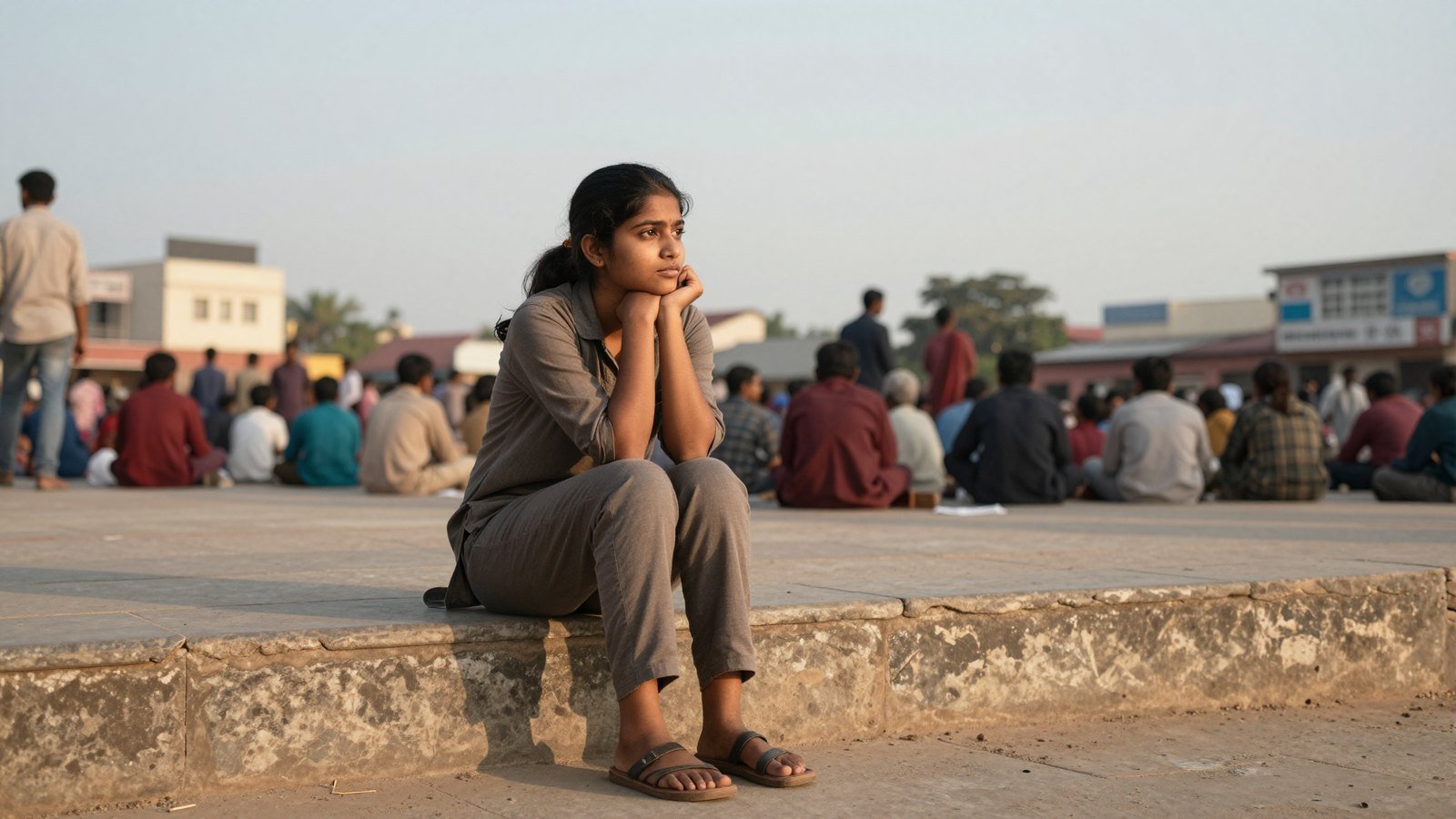
Consider a familiar composite: the daughter of a tenant farmer in a small town far from any metro, the first person in her family to finish Class 12, taught in a state-board school in her mother tongue. She is exactly the kind of student NEET, a single national gateway to medical seats, was meant to serve. On paper, one exam levels the field between her and a child of doctors in a big city.
In practice the field was never level, and a leak tilts it further. Researchers who study disadvantaged NEET candidates point out that state-board and first-generation learners already start behind students drilled for years in expensive, English-medium coaching. When a paper is compromised, the advantage flows to those with money and networks, not to the girl revising alone under a single bulb. Exam integrity, from where she sits, is not a procedural detail. It is the only thing that makes her presence at the desk mean anything at all.
The price of a dream, paid in loans
The financial stakes are easy to underestimate from a distance. A two-year coaching package in a preparation hub such as Kota costs roughly Rs 2.5 to 3.5 lakh, and once hostel rent, food and travel are added the annual outlay can climb to between Rs 1.5 and 3 lakh. For a household living on farm or construction wages, those are not numbers on a brochure. They are mortgaged land, gold pledged at the co-operative, a loan from a relative that comes with its own silent obligations.
Coaching chains advertise scholarships and fee waivers won through entrance tests, and the best-scoring poor students do receive real discounts. But the marginal aspirant, the one who is bright but not exceptional, rarely clears those bars and pays close to full price. Families take on that debt on a specific promise: that the exam at the end will be fair, and that merit, not money, will decide. A leak does not just delay an outcome. It breaks the contract on which the borrowing was justified.
Why a re-test is not a simple reset
Officials tend to present a re-examination as a clean remedy: the compromised paper is scrapped, a new one is set, fairness is restored. For students with resources, that is broadly true. For those without, a re-test is a second tax on families already stretched to their limit.
Every extra month of preparation is another month of hostel rent and coaching renewal, another year of a working parent's aging, another cycle in which a daughter of marriageable age must argue against pressure to stop studying and settle down. First-generation women aspirants, in particular, face a real risk that a delay is quietly converted into an end. A boy from a poor home may be given one more shot; a girl may be told the family has waited long enough. The re-test resets the clock for the institution, but not for the household counting its savings and its patience.
The small-town disadvantage the leak deepens
Geography compounds class. An aspirant in a district town does not have a well-lit exam centre a short auto ride away. She may travel overnight, sleep in a relative's crowded room, and sit an exam disoriented and underfed while a city rival walks in rested. When centres are reshuffled after a cancellation, as they were this year, it is the rural candidate who absorbs the logistical shock: the extra fare, the lost wages of a parent who must accompany her, the fear of a missed bus turning years of work to nothing.
These students also have the least access to the informal networks through which rumours, and sometimes leaks, circulate. They are the last to hear that a paper is out and the first to be harmed by it. That asymmetry is why disability-of-access, not just the leak itself, sits at the centre of the grievance. The playing field was uneven before the cheating began; the cheating simply exploited the tilt.
Integrity as social justice, not just administration
It is tempting to file the NEET affair under governance failure, to be fixed with better encryption, tamper-proof logistics and stiffer penalties. Those reforms matter. But treating the leak purely as an administrative problem misses what it does to the social compact around education. For India's first-generation learners, a fair examination is one of the very few working ladders out of inherited poverty. Break enough rungs and you do not merely lose an exam cycle; you teach a generation that the ladder was never real.
Higher education remains one of the most reliable ways to interrupt the transmission of poverty from parent to child. A single clean seat in a government medical college can change the trajectory of an entire extended family. When that seat is put at risk by a leak, the damage is not evenly shared. The wealthy aspirant reroutes to a private college or a repeat year abroad. The poor aspirant has no plan B, only a plan A that someone else has quietly rigged.
What the protests are really asking
Seen this way, the crowds at Jantar Mantar and in towns across the country are not simply demanding a particular re-test date or a specific arrest. They are asking whether the state still guarantees that effort and honesty will be rewarded over money and manipulation. Wangchuk's fast lent the movement a national stage, but its emotional core belongs to families who cannot afford to be cynical, because cynicism is a luxury for those with a fallback.
The test now facing the government is not only forensic, tracing how the paper escaped, but moral. Every reform announced will be read by millions of poor households as a signal about whether their sacrifice still counts. The cheapest way to lose them is to treat this as a story about systems. The truest way to answer them is to remember that behind every leaked page is a mortgaged field, a delayed marriage, a single bulb, and a young person who did everything right.
The NE Times View
Exam integrity in India is not a technical footnote; it is a promise made to the poorest that the one door open to them will not be sold from the inside. The NEET-UG 2026 leak matters most not for the institutions it embarrassed but for the first-generation aspirants it betrayed. A credible re-test, honestly conducted and generously supported for those least able to afford the delay, is the minimum owed. The larger debt, restoring faith that merit still outranks money, will take far longer to repay.
Sources
- https://en.wikipedia.org/wiki/2026_NEET_controversy
- https://www.thenewsminute.com/tamil-nadu/neet-systemic-discrimination-and-mental-health-tales-disadvantaged-students-156068
- https://medicine.careers360.com/articles/neet-coaching-in-kota-fees-scholarships-cost-of-living
- https://www.smilefoundationindia.org/blog/transformative-impact-of-first-generation-learners/
This article is original news analysis and commentary by The NE Times, based on reporting from the sources listed above.
You may also like to read
As the NEET-Leak Movement Moves South, It Meets a Region That Never Made Peace With the Exam
The CJP student movement over the NEET-UG 2026 paper leak is reaching Chennai, Bengaluru and Hyderabad, colliding with south India's older grievance against NEET.
NEET-UG 2026 Paper-Leak Investigation: Arrests, the Alleged Network and What Is Proven
The criminal investigation is the evidentiary core of the controversy, and it must be reported separately from political claims made at the protest
The Legal Aftermath of the NEET Protests: Why the Real Battle Now Moves to the Courtroom
With FIRs registered after the Chalo Sansad march, detentions and an internet blackout, the NEET-UG protest fallout is set to move into India's High Courts and the Supreme Court.
After NEET, A Blueprint: What A National Exam Integrity Authority Must Actually Do
As NEET-UG 2026 protests force reform, here is a concrete blueprint for a National Exam Integrity Authority to secure question papers, audit, and investigate leaks.
More from this section
More
Beyond NEET: Government Recruitment Leaks and the National Exam-Integrity Crisis
The movement resonated nationally because medical entrance testing is only one part of a wider system on which young people depend for education and
Is Sonam Wangchuk’s Hunger Strike About NEET or Ladakh? Clearing Up the Search Confusion
Conflicting search results describe the current fast as a NEET protest, a Ladakh protest or both. Here is how to separate the immediate campaign from Wangchuk’s wider activism
What a Real Examination Reform Package Should Include After the NEET Crisis and Hunger Strike
The hunger strike has created pressure for reform. A credible response needs secure paper handling, independent audits, transparent investigations and support for affected students