Project Hawk Eye: AI, Drones and Snipers to Guard the Amarnath Yatra
Anantnag police have unveiled Project Hawk Eye, a layered surveillance net of drones, facial recognition, hundreds of CCTV cameras and sniper teams to secure the 2026 Amarnath Yatra beginning 3 July.
Commentary & Analysis ·
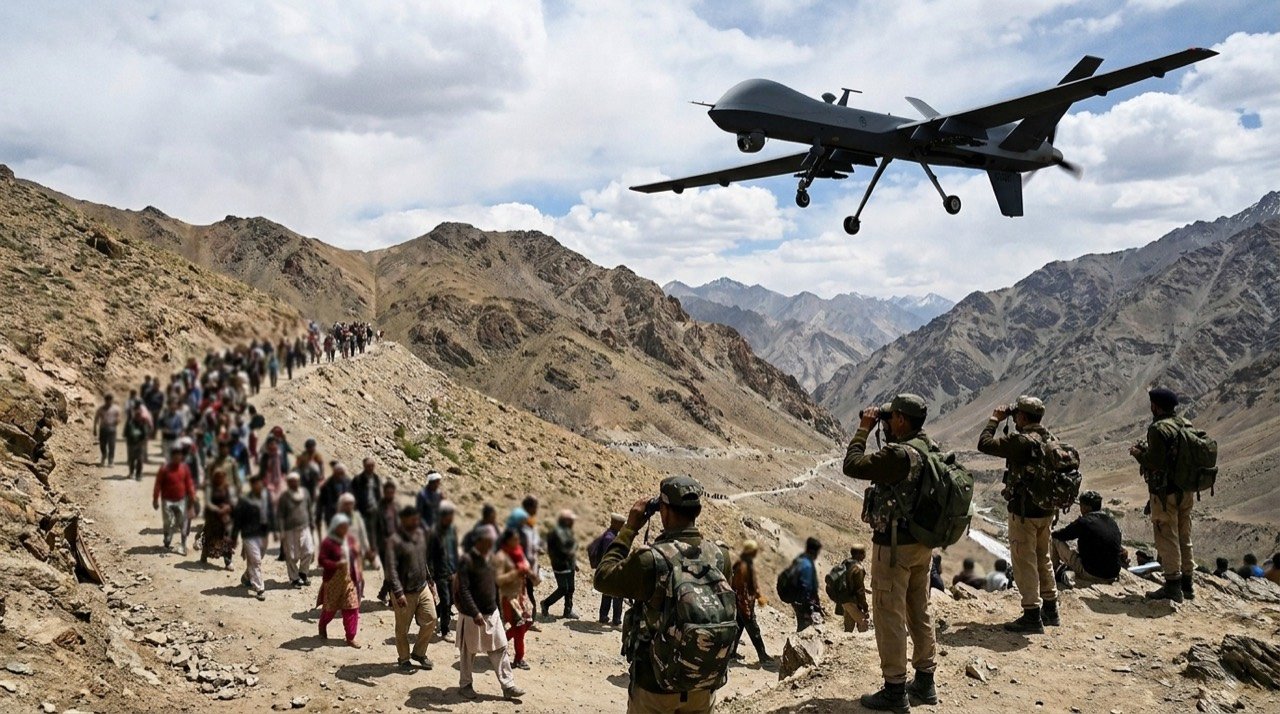
Ahead of the Shri Amarnath Ji Yatra, which begins on 3 July and runs through 28 August, the Jammu and Kashmir Police in Anantnag district have launched an ambitious technology-driven security framework named Project Hawk Eye, designed to keep round-the-clock watch over the high-altitude pilgrimage route from the sky to the ground. The 57-day pilgrimage draws hundreds of thousands of devotees along twin routes to the cave shrine each year, and the terrain itself, narrow mountain tracks, steep inclines and constricted approach corridors, has long made comprehensive security a formidable logistical undertaking. Project Hawk Eye represents an attempt to close gaps in that coverage by fusing aerial, biometric and human elements into a single monitoring architecture rather than relying on any one method in isolation.
A layered surveillance net
At the heart of the initiative is a layered surveillance net that knits together high-altitude aerial tracking with ground-level biometric systems, fortified observation posts and specialised tactical units. Five drones have been positioned at strategic points to beam real-time video and intelligence to command centres, allowing forces to respond rapidly to any suspicious movement along the corridor. The logic of this layering is straightforward: a single surveillance method, whether cameras, patrols or drones alone, tends to have blind spots that a determined actor can exploit, whereas overlapping systems are designed so that a lapse in one layer is caught by another. For a pilgrimage route that snakes through remote, elevated and often weather-affected terrain, aerial coverage in particular offers a vantage point that ground patrols simply cannot replicate, especially across stretches where road access is limited or seasonal.
Facial recognition and camera coverage
At critical choke points, facial recognition software cross-references the profiles of travellers to automatically flag blacklisted or suspect individuals in real time, while a network of 416 high-resolution CCTV cameras provides continuous monitoring of sensitive transit stretches. The rationale for concentrating this technology at choke points is one of practical security design: with hundreds of thousands of people moving through a limited number of physical bottlenecks, these are the most efficient locations to screen large volumes of pilgrims without stopping the flow of the Yatra altogether. It also reflects a broader pattern seen at other mass religious gatherings in India, where authorities increasingly lean on automated recognition systems to manage scale that manual verification alone cannot handle. Whether such systems perform reliably in the field, at speed and in variable mountain lighting and weather conditions, is a separate operational question from their intended design, and one that will only be answered by how the deployment actually functions once the Yatra is under way.
Eyes on the heights
To cover vulnerable and elevated terrain, police have set up 28 observation posts, locally described as Machan Morchas, that function as static watchtowers, supported by 22 specially trained sniper teams positioned to counter any threat. These elevated posts serve a dual purpose: they extend the sightlines of ground forces across ridgelines and passes that would otherwise be difficult to monitor continuously, and they provide a rapid-response capability should a threat materialise at long range. The pairing of static watchtowers with trained sniper units suggests planners are treating the route not merely as a policing exercise but as a security corridor requiring military-grade vigilance, an approach consistent with the sensitivity of the wider region and the history of threats directed at the pilgrimage in past years.
Scale of the deployment
The initiative dovetails with a wider deployment of 670 companies of central and state forces and a separate grid of facial recognition cameras across six locations on the route. Taken together, the numbers, five drones, 416 CCTV cameras, 28 observation posts, 22 sniper teams and 670 companies of forces, describe a security operation of considerable scale, one that spans the full 57 days of the pilgrimage rather than a short or symbolic window. Officials have framed the aim as a seamless monitoring loop from the sky to the ground so that pilgrims can undertake the Yatra without fear, and have urged pilgrims to register and follow advisories, presenting the technology push as an effort to make one of India's largest annual pilgrimages both safer and smoother. For a state apparatus balancing the safety of a religious congregation against the practical difficulty of managing dense crowds on narrow mountain paths, this scale of deployment is a signal of how seriously the threat environment is being treated, even as it raises the stakes for how well the technology performs in practice.
The NE Times View
Layered surveillance for the Amarnath Yatra is a reasonable response to a real and persistent threat to pilgrims. Drones and snipers can deter attackers, but facial recognition deployed on lakhs of devotees raises questions about data retention and oversight that the state has not adequately answered. A pilgrimage of this scale, drawing devotees from across the country into a geographically sensitive and historically contested region, understandably invites a security posture built around technology that can scan, track and respond faster than manual policing ever could. But the introduction of facial recognition at population scale is not a neutral technical upgrade; it is a policy choice with consequences that outlast the 57 days of the Yatra itself. Questions about how long biometric data is stored, who has access to it, whether it is purged after the pilgrimage concludes, and what recourse a wrongly flagged pilgrim has, remain unanswered in what has been made public so far. Security and civil liberties both deserve protection; one should not quietly erase the other. The test for Project Hawk Eye will not only be whether it prevents an attack, but whether it does so while being transparent about the footprint it leaves on the privacy of the ordinary devotee who has done nothing more than register for a pilgrimage.
Key takeaways
- Project Hawk Eye combines five surveillance drones, 416 CCTV cameras, 28 elevated observation posts and 22 sniper teams to secure the Amarnath Yatra route from 3 July to 28 August.
- Facial recognition software is deployed at critical choke points and across six separate locations to flag blacklisted or suspect individuals among the hundreds of thousands of pilgrims expected.
- The effort is backed by 670 companies of central and state forces, reflecting a security operation of considerable scale spanning the full 57-day pilgrimage.
- Authorities describe the goal as a seamless sky-to-ground monitoring loop and have urged pilgrims to register and follow advisories.
- The use of facial recognition on a mass scale raises unresolved questions about data retention, oversight and recourse that warrant greater transparency from the state.
You may also like to read
Amarnath Yatra Security Drill Sharpens Jammu Base Camp Readiness
Security agencies ran a mock drill at Jammu's Bhagwati Nagar base camp ahead of the Amarnath Yatra, bringing NSG, SOG and local police together to test response times and perimeter defence.
Amarnath Yatra 2026 Set for July Start as Registrations and Security Tighten
The 57-day pilgrimage to the Himalayan cave shrine will begin in early July, with the ceremonial first puja in late June and advance registration already running into the lakhs.
Sabarimala Plans Drones and AI Systems for Pilgrimage Crowd Safety
Kerala's Sabarimala temple administration is preparing to deploy artificial intelligence, drones and predictive systems to manage pilgrim crowds and improve safety during the coming pilgrimage season.
Char Dham Yatra Crosses 20 Lakh Pilgrims as Kedarnath Rush Sets Records
Uttarakhand's high-altitude shrine circuit has drawn an unprecedented turnout this season, prompting crowd-control measures and helicopter booking curbs as June footfall climbs.
More from this section
More
AICTE Industry Fellowship 2026: Rs 1.5 Lakh Scheme Closes July 5
The AICTE Industry Fellowship Programme 2026, which places technical-education faculty inside leading companies on a Rs 1.5 lakh monthly stipend, reached its application deadline on July 5.
Bay of Bengal Low Pressure System Revives Monsoon Over Western India
A low-pressure system over the Bay of Bengal has pushed the monsoon back into an active phase, bringing steady heavy rain to Kerala, coastal Karnataka and Maharashtra, and putting Mumbai and Pune on preparedness watch.
Bishnoi Gang Suspects Injured in Haryana Encounter as Police Tighten Net
A joint Haryana-Delhi Police operation in Bahadurgarh left two suspected Lawrence Bishnoi gang members injured, spotlighting the multi-state coordination now central to India's fight against organised crime networks.