Monsoon Home Care 2026: A Practical Checklist Before the Rains Settle In
From rooftop waterproofing to keeping electronics and wardrobes safe from damp, here is how Indian households are monsoon-proofing their homes this season.
Commentary & Analysis ·
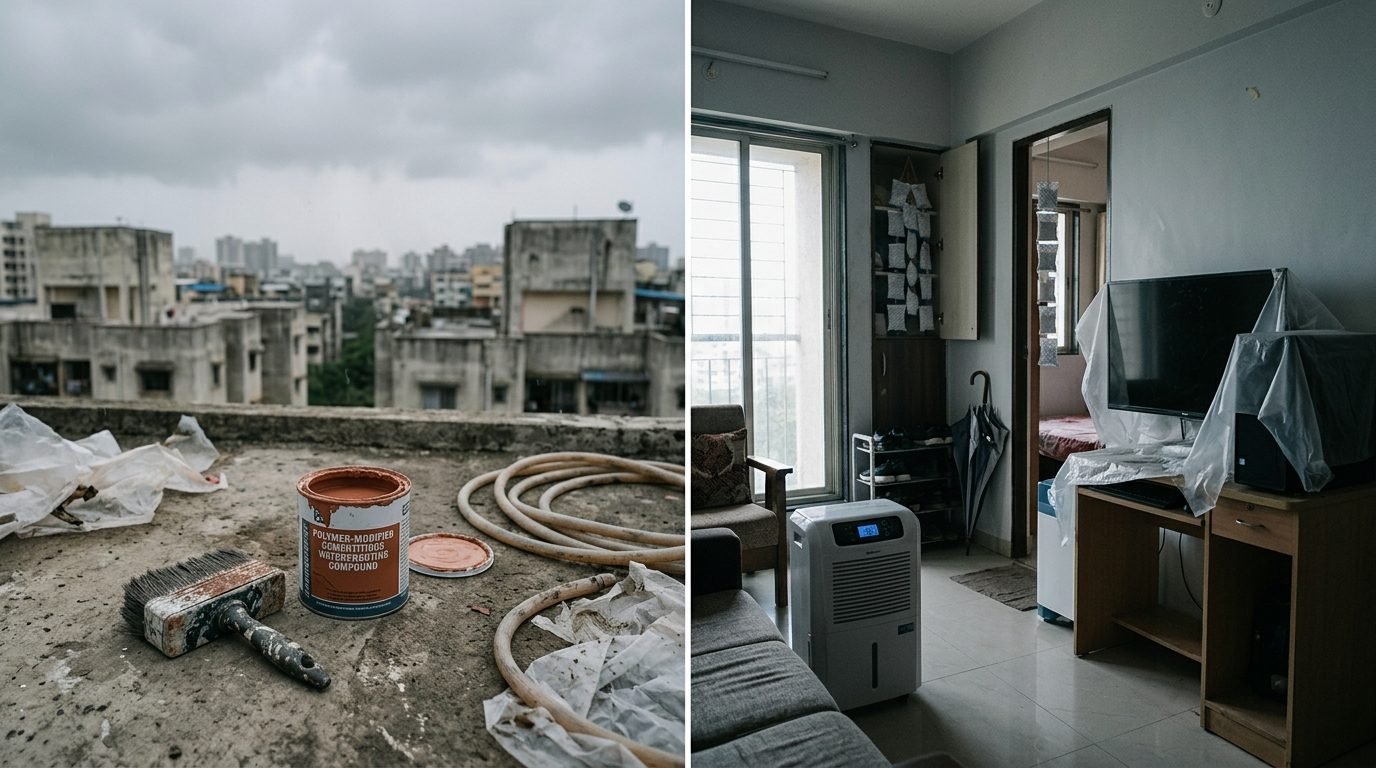
Every year the first heavy shower exposes the small failures households meant to fix and never did: the seeping balcony wall, the swollen wooden door, the wardrobe that smells of damp by August. With the 2026 monsoon advancing rapidly after an early onset, home experts say the window for cheap, effective prevention is closing fast. What makes this an annual story rather than a one-off warning is precisely the point worth dwelling on: the problems are entirely predictable, the fixes are well understood, and yet millions of Indian households arrive at the rains each year having done nothing differently from the last.
Why timing is the whole game
The single most important rule in monsoon-proofing a home is timing, and it is also the rule most often ignored. Most waterproofing chemicals need a dry surface to bond properly, which means treatments on rooftops, outer walls and bathroom floors are far more effective, and far cheaper, before the rain begins than as emergency repairs attempted during it. This is not a minor technical footnote. A coating applied to a damp or actively leaking surface tends to fail faster, requiring premature reapplication, while the same material applied to a properly dried surface in the pre-monsoon weeks can deliver years of protection. The economics follow directly from the chemistry: prevention is a scheduled, controllable cost, whereas mid-monsoon repair is an emergency cost, often inflated by contractor scarcity, water damage that has already spread, and the difficulty of working on wet surfaces at all.
In high-rainfall states such as Kerala and Maharashtra, where the sheer volume and duration of rainfall punishes any weakness in a building's envelope, professionals often recommend APP membrane systems costing roughly 80 to 160 rupees per square foot. These membranes can bridge cracks and are rated to last eight to ten years, which makes them a reasonably long-horizon investment rather than a seasonal patch. For most homes, however, the high-impact starting point is far more modest: sealing visible cracks and refreshing terrace coatings. These are the interventions that address the majority of common leak points without requiring a full membrane installation, and they are within reach of most household budgets if undertaken in the dry weeks before the rains settle in.
The indoor threat that is easy to miss
Outdoors, the enemy is water intrusion through the building envelope. Indoors, the enemy is humidity, and it is arguably more insidious precisely because it does its damage slowly and invisibly. Storing electronics, important documents and seasonal fabrics in airtight containers prevents the kind of gradual moisture damage that often goes unnoticed until something stops working, or starts to smell, or a document is found warped and unreadable months later. Unlike a leaking roof, which announces itself immediately, humidity damage is cumulative and silent, which is exactly why it tends to be underestimated by households focused on the more visible threat of water ingress.
This distinction matters for how families should think about monsoon preparation: it is not one problem but two, requiring two different responses. The structural problem, water getting into the building, is addressed through waterproofing, sealing and drainage. The environmental problem, humidity accumulating inside the building, is addressed through storage practices, ventilation and moisture-absorbing measures. Treating only the first while ignoring the second is a common reason households still suffer damp-related losses even after spending on rooftop or wall treatments.
The checklist itself
The practical advice, distilled, is straightforward and does not require specialist knowledge to execute. Waterproof rooftops, outer walls and bathroom floors before the first heavy rain arrives, since these are the surfaces most directly exposed to sustained water contact. Seal exposed wood with laminate or a waterproof coating, and lift furniture onto risers so that legs are not sitting in standing water or absorbing ground moisture. Store electronics, documents and fabrics in airtight containers to guard against humidity rather than direct water contact. Place absorbent doormats at entrances to cut down on mud and wet footprints being carried through the house, a small measure that protects flooring and reduces the ongoing cleaning burden through the wettest months.
None of these steps is expensive or technically demanding in isolation. What they share is a dependency on timing: each is markedly more effective, and cheaper, when done in a dry week rather than attempted or improvised once the rain has already arrived.
Why small fixes carry outsized weight
Furniture risers and rubber pads keep wooden legs off damp floors, while doormats and a simple entryway routine stop mud from spreading through the house. These low-cost steps rarely make it into a design magazine, and they lack the visible payoff of a freshly waterproofed terrace, but they are what separate a comfortable monsoon from three months of mildew, warped furniture and avoidable repair bills. Their unglamorous nature is precisely why they are so often skipped, even though the labour and cost involved is minimal compared with what is at stake.
The recurring advice from professionals is the same every year, and it is worth repeating precisely because repetition has not translated into widespread adoption: prevention done in a dry week costs a fraction of restoration done in a wet one. For households that act now, while the 2026 monsoon is still settling in, the rest of the season becomes mostly about enjoying the rain rather than fighting it. That is a meaningful difference in quality of life across four months, achieved through a handful of interventions that could be completed over a single weekend.
The NE Times View
Practical, low-cost prevention before the rains is sound advice that saves households far more than reactive repairs ever do, and it deserves to be treated as a genuine annual ritual rather than an optional extra. But The NE Times View is that the recurring need for such checklists also indicts the quality of Indian housing and civic drainage. A society in which the same waterproofing advice must be issued afresh every year, to every household, is one in which individual vigilance is being asked to compensate for a systemic shortfall. Builders who use substandard waterproofing at construction stage, and municipalities whose drainage systems cannot cope with monsoon volumes, are effectively transferring the cost of that failure onto homeowners, who then pay twice: once in the inflated price of a flat that should have included proper waterproofing, and again in the annual maintenance cycle described above. Until builders and municipalities treat waterproofing and water management as baseline standards rather than optional upgrades, families will keep shouldering a burden that better construction and better civic planning should have removed in the first place.
Key takeaways
- Waterproofing works best and cheapest on dry surfaces, so treatments to rooftops, walls and bathroom floors should be completed before the rains, not during them.
- APP membrane systems, costing roughly 80 to 160 rupees per square foot and lasting eight to ten years, are commonly used in high-rainfall states like Kerala and Maharashtra, though sealing cracks and refreshing terrace coatings is the higher-impact starting point for most homes.
- Indoor humidity is a separate, slower-acting threat to electronics, documents and fabrics, best addressed through airtight storage rather than waterproofing alone.
- Low-cost measures such as furniture risers, rubber pads and entryway doormats meaningfully reduce damp-related damage and mud spread through the home.
- The annual necessity of these checklists points to a deeper structural issue: substandard builder practices and inadequate civic drainage that shift preventable costs onto individual households.
You may also like to read
Earthy Tones and Indoor Greens: The Mood Indian Homes Are Chasing in 2026
As monsoon light turns flat and grey, Indian interiors in 2026 lean into warm earthy palettes, humidity-loving plants and layered lighting to keep spaces cosy and alive.
Misty Valleys and Cheaper Fares: India's Offbeat Monsoon Travel Boom in 2026
With domestic fares falling sharply and travellers seeking solitude, offbeat Himalayan hamlets, the rain-soaked Northeast and Ladakh's rain-shadow deserts are redrawing India's monsoon travel map in 2026.

The Smart Traveller's Secret: Why India's Monsoon Months Are the Cheapest Time to Roam
With fares down 30-50% and a milder rainy season forecast, savvy Indians are turning the off-season into the main event.

India's Monsoon Plate Returns to Its Roots as Seasonal Eating Goes Mainstream in 2026
From Kerala's ten-leaf stir-fries to jamun, rasam and warming spices, India's monsoon kitchens are blending ancestral ritucharya wisdom with the 2026 obsession with gut health and immunity.
More from this section
More
Bengaluru Lamborghini-Auto Swap: Entrepreneur's Gesture Goes Viral
A Bengaluru entrepreneur's spontaneous decision to trade seats with an auto-rickshaw driver, putting the cabbie behind a Lamborghini's wheel, has charmed social media and become the city's feel-good story of the week.
India's Monsoon Plate Returns to Its Roots as Seasonal Eating Goes Mainstream in 2026
From Kerala's ten-leaf stir-fries to jamun, rasam and warming spices, India's monsoon kitchens are blending ancestral ritucharya wisdom with the 2026 obsession with gut health and immunity.
Misty Valleys and Cheaper Fares: India's Offbeat Monsoon Travel Boom in 2026
With domestic fares falling sharply and travellers seeking solitude, offbeat Himalayan hamlets, the rain-soaked Northeast and Ladakh's rain-shadow deserts are redrawing India's monsoon travel map in 2026.