Foreign Investors Pull Rs 62,853 Crore From Indian Stocks in Early June
Overseas selling pushed 2026 outflows past Rs 2.87 lakh crore, but record domestic institutional buying of Rs 4.3 trillion has cushioned the blow.
Commentary & Analysis ·
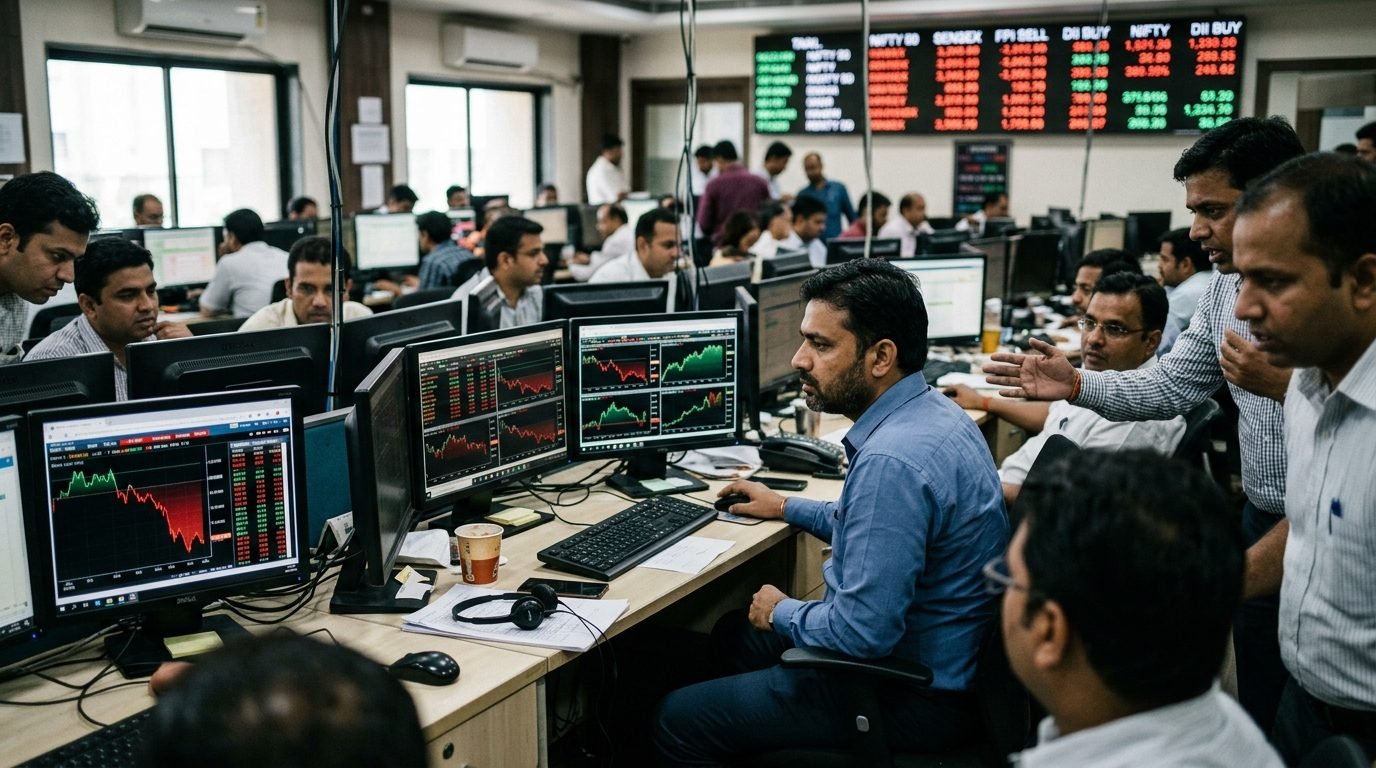
Foreign portfolio investors sold more than Rs 62,853 crore of Indian equities in the first fortnight of June, taking net outflows for 2026 past Rs 2.87 lakh crore and extending one of the longest selling streaks Indian markets have seen in years. The pace of the early-June exit underscored how persistent the foreign retreat has become, with overseas funds appearing reluctant to re-enter even after repeated bouts of heavy selling earlier in the year.
The scale of the withdrawal would, in earlier cycles, have been expected to drag benchmark indices sharply lower. That it has not is largely down to a counterweight that has quietly become the defining feature of this market: a wall of domestic money. The tug-of-war between exiting foreign capital and incoming household savings has become the central story of Indian equities in 2026, reshaping who sets prices and who absorbs the shocks.
A year of near-continuous selling
FPIs have been net sellers in every month of 2026 bar February, a rhythm of withdrawal interrupted only briefly. Heavy selling resumed in March with record outflows of about Rs 1.17 lakh crore, followed by further exits through April and May. The cumulative effect has been to push 2026 firmly into the territory of the most sustained foreign-selling phases on record, a stretch in which positive months have been the exception rather than the rule.
The streak matters because foreign institutions have historically been among the most influential price-setters on Indian exchanges, particularly in large-cap and index-heavy stocks where their order flow can move sentiment quickly. A prolonged absence, or active selling, removes a major source of marginal demand and can leave valuations more vulnerable to swings in global risk appetite.
Domestic money fills the gap
Cushioning the impact, domestic institutional investors bought a record Rs 4.3 trillion of equities in the first half of the calendar year, the highest ever January-June inflow, equivalent to roughly Rs 4,000 crore every trading session. That steady, almost mechanical buying has effectively matched and at times exceeded the foreign selling, keeping indices afloat even as overseas funds headed for the exits.
Much of this domestic firepower is rooted in the structural shift of Indian household savings into financial assets, channelled increasingly through mutual funds and systematic investment plans. Regular monthly contributions give fund managers a predictable stream of capital to deploy, which means selling pressure is absorbed by buyers who are investing on a fixed schedule rather than reacting to headlines. The result is a market that has grown markedly more resilient to foreign outflows than it would have been a decade ago.
Why the foreigners are leaving
Analysts attribute the foreign exodus to a weak rupee, down nearly 6 percent this year, alongside global growth worries and geopolitical tension that have made emerging-market assets less attractive. A depreciating currency erodes the dollar-denominated returns that international investors ultimately care about, so even flat or modestly rising local share prices can translate into losses once converted home, giving funds a strong incentive to reduce exposure.
- A weaker rupee that eats into dollar returns for overseas holders
- Concerns about the pace of global economic growth
- Geopolitical tension that has dimmed appetite for emerging-market risk
- The pull of competing assets, including a buoyant global technology and AI trade
Taken together, these forces have made the relative case for Indian equities harder to argue in dollar terms, even as the domestic growth narrative remains intact. For foreign allocators weighing India against other destinations, currency risk and global uncertainty have outweighed the structural story for much of the year.
Why it matters and what comes next
Some strategists argue that a cooling of the global AI-stock trade could eventually redirect foreign money back toward India, on the view that capital chasing crowded technology bets abroad may rotate into emerging markets once those valuations look stretched. A turn in the rupee or an easing of global tensions could accelerate that shift. For now, though, the steady flow of household savings into mutual funds is what is holding indices up.
The key question for the months ahead is durability: domestic inflows have so far proved remarkably consistent, but they depend on continued retail confidence and the discipline of systematic investing. Should sentiment among households soften, the cushion that has masked the foreign retreat could thin out quickly. Until foreign flows turn or domestic appetite wavers, the market looks set to keep tracking the balance between these two opposing tides.
The NE Times View
The standout story is not the foreign exit but who replaced them. Rs 4.3 trillion in domestic institutional buying absorbing relentless overseas selling marks a structural shift: Indian savers, via mutual funds and SIPs, now anchor their own market. That is a hard-won resilience worth recognising, though it also means retail India increasingly owns the downside if sentiment turns.
This article is original commentary and analysis by The NE Times. Background facts were referenced from Business Standard, Free Press Journal.
You may also like to read

Foreign Cash Floods Indian Bonds As Tax-Free G-Secs Lure Up To $50 Billion
Foreign investors poured fresh money into Indian government bonds in June 2026 after a capital-gains tax exemption on G-Secs, with economists estimating the move could draw $45-50 billion over two years.

Sensex Holds Above 77,000 As Crude Pullback And RBI Liquidity Push Lift Indian Markets
Indian benchmarks extended gains around 24 June 2026 as easing crude prices, calmer West Asia tensions and fresh RBI liquidity support kept financial and auto stocks firmly in demand.
Crude spike from West Asia conflict pins rupee near record low, widens deficit fears
Surging oil prices have revived pressure on the currency and the current account, exposing India's enduring vulnerability to energy shocks.

Rupee Claws Back To 94.55 As US-Iran Deal Hopes Ease Oil Fears
The rupee recovered to around 94.55 against the dollar by mid-June 2026, rebounding from a record low near 97 as reports of a US-Iran agreement to reopen the Strait of Hormuz lifted sentiment.
More from this section
More
Adani Case: US DOJ Pushes for Permanent Dismissal of Charges
The US Department of Justice has urged a judge to permanently dismiss charges against Gautam Adani, calling the case legally flawed — a reversal with consequences for markets, diplomacy and cross-border enforcement.

Akasa Air Inducts 40th Aircraft in Indian Aviation Scale-Up
Akasa Air's 40th aircraft, ferried to Bengaluru via Seattle, Reykjavik and Cairo, marks a fleet milestone for the young carrier and a fresh signal that India's aviation market remains firmly in expansion mode.
BARC Ratings Suspension Leaves Indian TV Industry Flying Blind
BARC's pause on television ratings has put India's broadcast measurement system under fresh scrutiny, leaving broadcasters, advertisers and media planners without the weekly audience data that anchors the TV economy.