E20 Fuel Dispute Reaches Consumer Court as Car Maker Is Ordered to Replace Vehicle or Pay Compensation
A consumer commission in Raipur has ordered a vehicle manufacturer and dealer to replace a Maruti Grand Vitara Strong Hybrid with an E20-compatible vehicle or provide monetary relief reported at more...
Commentary & Analysis ·
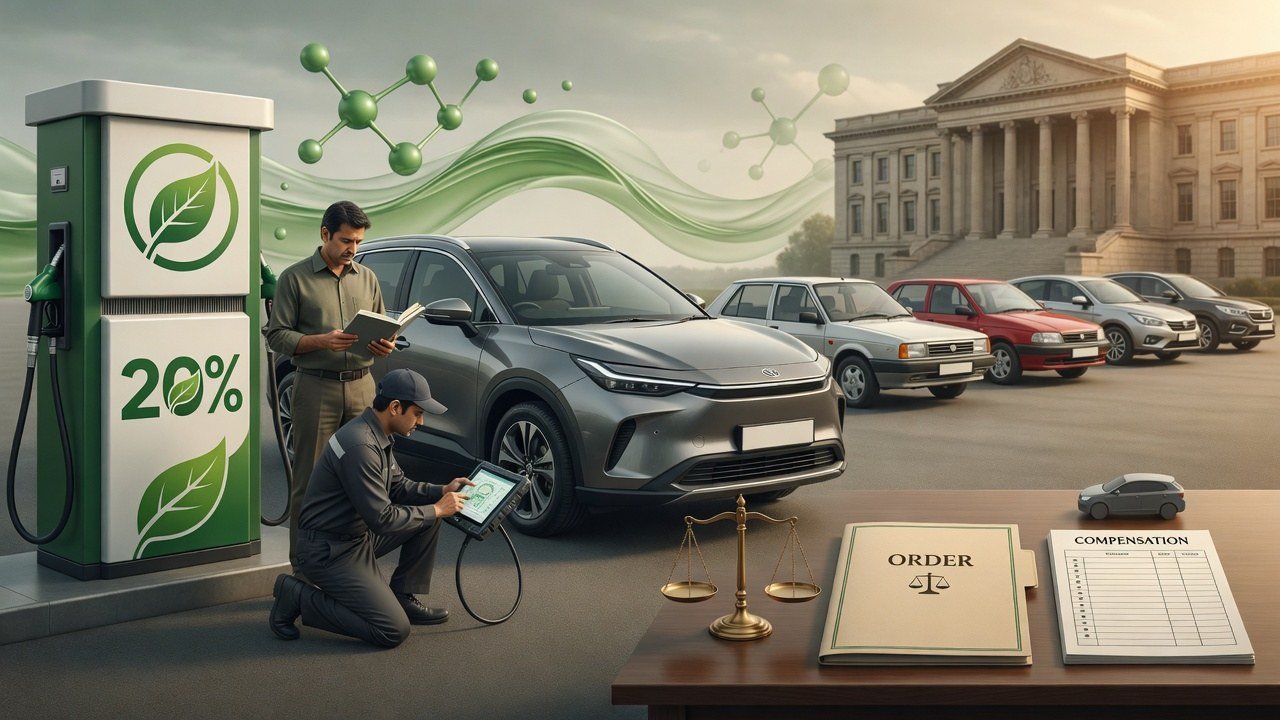
Key facts
- The Raipur District Consumer Disputes Redressal Commission ruled in favour of a Grand Vitara Strong Hybrid owner in an E20-related dispute.
- The order reportedly requires replacement with an E20-compatible vehicle or payment exceeding Rs 21.6 lakh, including compensation components.
- The decision concerns one case and may be appealed; it does not by itself establish that E20 petrol damages every vehicle.
A single dispute with national relevance
A consumer commission in Raipur has ordered a vehicle manufacturer and dealer to replace a Maruti Grand Vitara Strong Hybrid with an E20-compatible vehicle or provide monetary relief reported at more than Rs 21.6 lakh. The owner alleged recurring engine problems after using petrol blended with 20 percent ethanol. The decision has attracted national attention because India's fuel market is moving rapidly toward E20 and many drivers have limited access to alternative blends. The order should be reported carefully. It resolves a specific consumer complaint on the evidence before the commission. It is not a scientific finding that E20 damages every car, and it may be challenged on appeal.
Why compatibility has become confusing
Vehicles are designed and certified for particular fuel specifications. Ethanol can affect some materials, seals and performance characteristics, especially in older vehicles not engineered for higher blends. Newer models may be compatible, partially compatible or calibrated with certain conditions. Consumers often struggle to find clear information because the label E20-ready can refer to different components or model years. Fuel pumps may also offer little choice. That makes the owner's manual, production date and manufacturer communication important. A driver should not have to interpret technical standards from scattered press statements after a breakdown. Automakers and dealers need simple, model-specific compatibility guidance.
What the commission appears to have considered
Reports say the commission focused on repeated problems, the consumer's limited fuel choice and the responsibility of the manufacturer and dealer to provide a usable product. The full written order is the best source for the precise reasoning, evidence and relief. News summaries may omit expert reports, service records or warranty arguments. Readers should therefore avoid treating a headline figure as the complete case. Consumer commissions examine whether there was a defect, deficiency in service or unfair practice. Their findings depend on documents and testimony. The order's wider influence will depend on whether it is appealed and how other forums assess similar facts.
Government policy and individual liability are separate
The national E20 programme is intended to reduce petroleum imports and support ethanol production. Ministers have rejected broad claims that the fuel causes engine damage, while acknowledging that mileage can vary. A consumer dispute does not necessarily challenge the policy itself. It asks who bears the cost when a particular vehicle allegedly fails under fuel that is widely sold. Even if E20 is safe for most compatible vehicles, a manufacturer may still be liable for inaccurate assurances, a defective component or poor service in an individual case. Separating those questions helps prevent the debate from becoming a binary fight between supporters and opponents of ethanol blending.
What vehicle owners should do
Drivers should check the owner's manual, fuel-lid label, manufacturer website and service centre for model-year guidance. They should retain fuel receipts and service records if problems occur. Warning lights, rough running or mileage changes should be documented rather than ignored. Owners should not attempt unsafe fuel mixing or unofficial mechanical modifications based on social-media advice. If a dispute develops, a written complaint to the dealer and manufacturer creates a record. Independent technical inspection may be useful. The new order will encourage more complaints, but consumers still need evidence linking the defect, service response and claimed loss.
What automakers need to improve
Manufacturers should publish searchable compatibility databases using vehicle identification numbers, not broad statements about product ranges. Dealers should explain fuel requirements at sale and record that explanation. Service centres need diagnostic protocols that consider fuel blend without automatically blaming the customer. If a component upgrade is necessary, companies should state whether it is covered by warranty. The transition to E20 is a national policy shift, so unclear communication can create thousands of avoidable disputes. Transparency is cheaper than litigation and protects confidence in both vehicles and fuel policy.
The limits of calling the case a precedent
Media reports have described the ruling as a first or landmark decision. It may be among the earliest widely reported E20 consumer orders, but a district commission does not create a binding national precedent in the same way as the Supreme Court. Other cases can still find its reasoning persuasive. Appeals may also modify or reverse the relief. Publishers should use landmark cautiously and explain the forum. The real significance is that fuel compatibility has moved from online complaint to formal adjudication. That will likely pressure manufacturers, regulators and fuel suppliers to produce clearer evidence.
A transition that needs consumer trust
India's ethanol-blending strategy will succeed only if drivers believe their vehicles can use the mandated fuel without hidden cost. That trust requires tested standards, accurate labels, responsive warranties and accessible complaint mechanisms. The Raipur order places those responsibilities under public scrutiny. It should not trigger panic among all E20 users, nor should it be dismissed as an isolated inconvenience. Regulators can use the case to review communication and post-market monitoring. Automakers can clarify compatibility. Consumers can document problems carefully. The most useful outcome would be a transition in which environmental and import-reduction goals are matched by clear accountability when individual products fail.
Sources
- Business Today - Raipur consumer commission E20 fuel ruling (16 July 2026)
- The Economic Times - Grand Vitara E20 dispute and compensation order (16 July 2026)
- India Today - Consumer rights questions raised by E20 case (16 July 2026)
This article is original news analysis and commentary by The NE Times, based on reporting from the sources listed above.
You may also like to read
Supreme Court Fines Chhattisgarh Rs 2 Lakh in Decades-Old Land Compensation Case
The Supreme Court has fined the Chhattisgarh government Rs 2 lakh and upheld compensation with interest for landowners whose plot was taken for a road in 1986 without payment.
Chhattisgarh Biogas Policy 2026: Farm Waste to Clean Fuel and Jobs
Chhattisgarh has approved a compressed biogas policy for 2026 that aims to convert agricultural residue, cattle dung and organic waste into clean fuel while opening up new employment opportunities across rural districts.
Gujarat Reworks Land Compensation Rules for Power Transmission
Gujarat has revised its land compensation policy for power transmission projects, a move that could ease landowner disputes and speed the grid expansion India's energy transition depends on.
Oil Shock Tests India: Fuel Hikes, Wider Deficit Risk Loom Over Recovery
A West Asia-driven crude spike forced India's first petrol and diesel price hikes in four years and revived fears of a wider current account deficit, even as hopes of a US-Iran deal offered a lifeline.
More from this section
More
India Smartphone Shipments Fall 10 Percent in Q2 2026 as Rising Prices Hit Affordable Demand
India remains one of the world's largest smartphone markets, so a double-digit quarterly shipment decline is a significant signal for manufacturers, retailers, app businesses and telecom operators.

Sensex Surges About 800 Points as IT and Banking Stocks Defy Weak Global Cues
An intraday gain of about 800 points in the Sensex is large enough to dominate financial headlines, yet one session cannot establish a durable bull market.

India-UK CETA Takes Effect, Opening a New Test for Exporters, Services Firms and Consumers
The India-UK Comprehensive Economic and Trade Agreement has moved from negotiation and ceremony into implementation. That transition is the real beginning of the story.