Counting the Cost: What Central Delhi's Protest Shutdown Meant for Its Street Economy
As the NEET-UG protest fast ends, we examine who bore the economic cost of central Delhi's disruptions, from daily-wage traders to gig workers, and how such losses are estimated.
Commentary & Analysis ·
Key facts
- The fast ended on 24 July 2026 after roughly 26 days of on-and-off disruption around Jantar Mantar and central Delhi.
- A localised mobile-internet suspension, metro-station closures and traffic diversions squeezed cash-based street trade for days.
- Top10VPN, using the NetBlocks COST tool, estimated India's 2024 internet-shutdown losses at about $322 million; ICRIER earlier put 2012-2017 losses near $3.04 billion.
- Roughly 90% of Indian employment is informal, leaving daily-wage and gig workers with the thinnest buffer against lost trading days.
The bill nobody itemises
When Sonam Wangchuk ended his hunger strike on 24 July, the barricades around Jantar Mantar began to come down and central Delhi started the slow work of returning to normal. The political and civic stakes of the roughly 26-day standoff over the NEET-UG 2026 paper-leak crisis have been widely reported. Less examined is the quieter arithmetic left behind: the earnings that did not happen, the stock that did not sell, and the shifts that were never logged.
That bill is real, but it is unusually hard to itemise. Much of the affected activity is cash-based, unregistered and informal, which means it leaves few receipts to count. What follows is not a single confirmed total, which would be false precision, but an honest look at where the costs landed, who absorbed them, and how analysts try to put a number on disruptions like these.
Who actually absorbs the loss
The first thing to understand is that disruption costs are not shared evenly. A salaried professional working from home during a hybrid school day loses little; a chaat vendor whose regular pavement was inside a barricaded zone loses a full day's takings with no way to recover them. Economists describe this as the difference between deferred demand and destroyed demand. A software contract slips a day and is completed later. A day of footfall at a tea stall, by contrast, is simply gone.
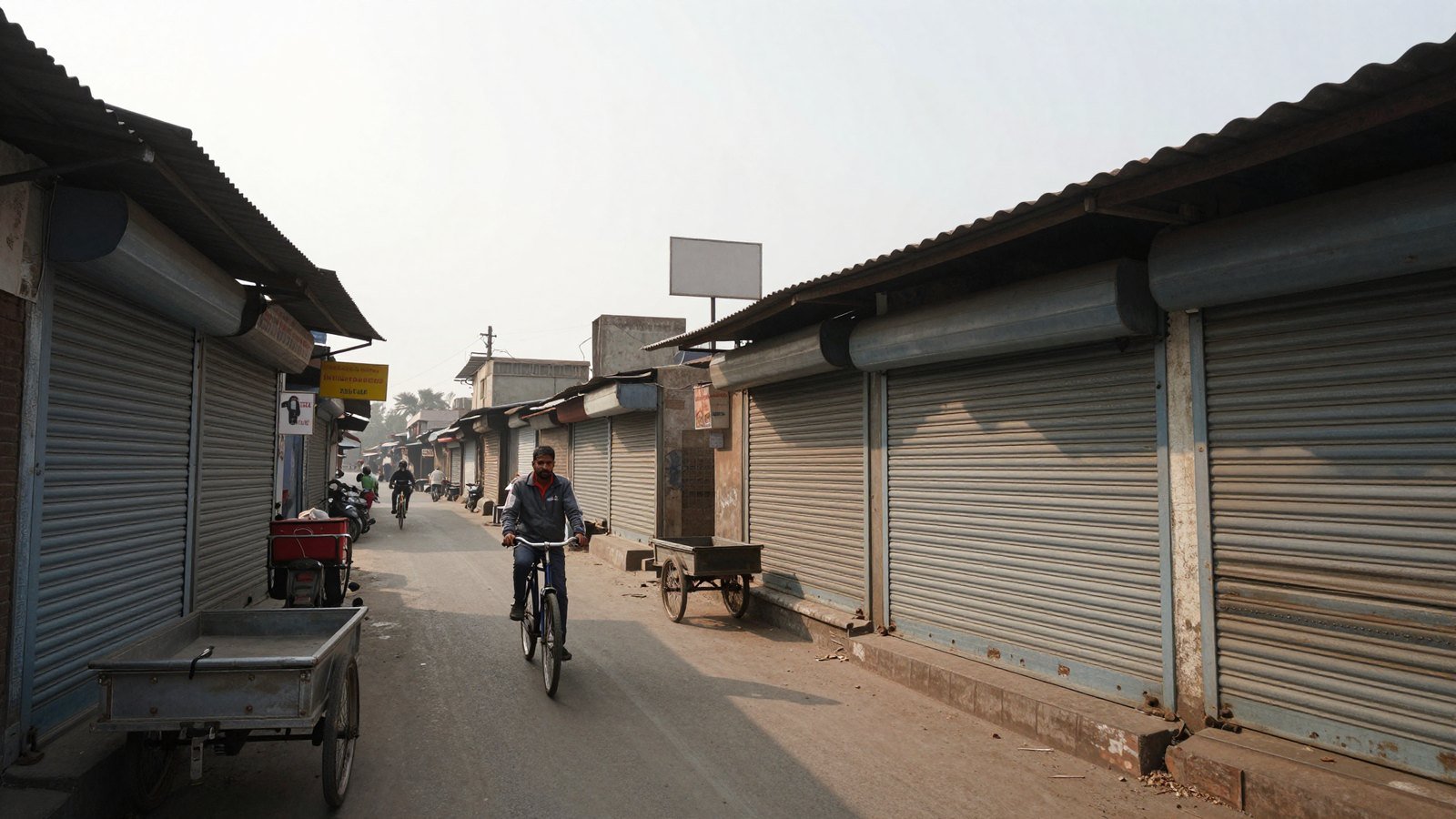
This matters because central Delhi's protest zone sits atop a dense informal economy: hawkers, autorickshaw drivers, cycle-rickshaw pullers, tiffin suppliers, photocopy kiosks and the small kirana shops that serve office workers. Roughly 90% of Indian employment is informal, according to widely cited labour estimates, and for this group there is no paid leave, no business-interruption cover and rarely more than a few days of savings to fall back on.
Traders and the geometry of a barricade
For small traders, the damage is a matter of geometry. A barricade or a diversion does not need to close a shop to hurt it; it only needs to move the crowd. When metro stations near the protest site shut and traffic was rerouted, the customer flow that a shopkeeper depends on was redrawn overnight. Shops a few hundred metres inside a cordon can sit with shutters half-raised and no one passing, while businesses on a newly busy diversion route see an unexpected, and temporary, bump.
Perishables sharpen the loss. A vegetable seller or sweet-shop owner who has already paid for stock watches margin rot in real time when buyers cannot reach the stall. Industry bodies have long made this point in the context of bandhs: the Confederation of Indian Industry has previously observed that in any shutdown 'the worst affected are daily wage earners and people dependent on small trade.' A protest cordon is narrower in scope than a citywide bandh, but for the streets inside it, the mechanism is the same.
Gig and delivery work: paid by the drop
India's fast-growing platform economy occupies an awkward middle ground during disruptions like this. Delivery and ride-hailing workers are paid per trip, so idle time is unpaid time, yet a barricaded district does not stop orders so much as make them slower and costlier to fulfil. Riders face longer detours, blocked lanes and cancelled drops, burning fuel and hours for fewer completed jobs. Surge conditions may lift the per-order rate, but rarely enough to offset the collapse in volume.
The cushion here is thin. The number of gig workers in India rose from about 77 lakh in FY21 to roughly 120 lakh in FY25, and a 2024 NITI Aayog report found that around 90% of them lack meaningful savings. With average monthly earnings often quoted in the range of Rs 15,000 to Rs 20,000, even two or three disrupted working days register immediately in a household budget.
The internet suspension has its own price tag
The mobile-internet suspension near Jantar Mantar carried a distinct economic cost, and this is the one category analysts have tried hardest to quantify. When connectivity drops in a commercial area, the damage is not only to browsing. Digital payments stall, so a UPI-first vendor who no longer carries a card machine or float cannot transact. Delivery apps lose their addressing and dispatch backbone. Small online sellers go dark to their customers for the duration.
The most-cited estimator is the NetBlocks COST tool, used in the annual Top10VPN reviews. It works top-down: it takes World Bank, ITU and other indicators of how much economic activity a connected hour represents in a given country, then multiplies that rate by the affected population and the number of hours offline. On that method, Top10VPN estimated India's total 2024 losses from shutdowns at about $322 million across roughly 2,920 hours. Earlier, a 2018 ICRIER study put India's 2012-2017 losses near $3.04 billion by triangulating the internet economy's contribution to GDP and its multiplier effects.
Why the numbers should be read as ranges
It is tempting to take those headline figures, scale them to a few days in one district, and publish a neat total for the Delhi disruption. That temptation should be resisted. Top-down models such as the COST tool are transparent and useful for comparison over time, but they average national activity across every hour and every user, and they cannot see the local texture: how much informal trade shifted to cash, how much demand was merely deferred, or how much was recovered the following week.
Bottom-up estimates from industry bodies carry their own caveats. In past bandhs, the CII and Assocham have offered figures differing by a factor of three for the same event, precisely because assumptions about participation and lost output vary so widely. The honest position is that the cost of the Delhi episode is real and concentrated among people least able to bear it, but any single rupee figure presented as confirmed would be a guess dressed as a measurement.
The recovery is uneven too
As barricades lift, footfall returns, but not symmetrically. A formal retailer can run a weekend promotion to claw back lost sales. A daily-wage worker cannot work a thirteenth hour to recover the day the site was sealed. Recovery favours those with balance sheets and disadvantages those living shift to shift, which means the episode quietly widens, rather than narrows, the gap between the formal and informal economy in the affected zone.
This is the part that rarely enters the cost debate over any protest or shutdown, whatever its cause. The visible disruption ends when the crowd disperses and the internet is restored. The invisible disruption, on the ledgers of vendors and riders who never appear in a GDP release, takes longer to settle and is almost never counted.
The NE Times View
The economic cost of central Delhi's protest disruption is genuine, but it deserves to be reported with method rather than a manufactured headline number. The most useful truth is not a total; it is a distribution. The burden fell hardest on cash-dependent traders, gig riders and daily-wage earners with no buffer, while internet suspensions imposed a measurable but hard-to-localise cost on digital commerce. As internet-throttling and cordons become routine tools of crowd management, both the state and platform companies owe these workers something better than silence on the bill they were handed.
Sources
- https://www.top10vpn.com/research/cost-of-internet-shutdowns/
- https://icrier.org/pdf/Anatomy_of_an_Internet_Blackout.pdf
- https://www.forbesindia.com/article/budget-2026/economic-survey-warns-indias-booming-gig-economy-rests-on-unstable-work/2990824/1
- https://inc42.com/buzz/internet-shutdowns-cost-india-322-mn-in-2024-report/
This article is original news analysis and commentary by The NE Times, based on reporting from the sources listed above.
You may also like to read

Sanand Semiconductor Plant: What CG Semi's Launch Means for India
Commercial production at CG Semi's chip assembly and test facility in Sanand, marked by remarks from Prime Minister Modi, has renewed focus on how far India's semiconductor manufacturing push has actually come.

India Wins FATF Vice Presidency for the First Time, Lifting Its Global Financial Standing
India's first-ever election to the vice presidency of the Financial Action Task Force hands New Delhi a stronger voice in shaping global rules on money laundering, terror financing and virtual-asset risk.

Youth Unemployment and Exam Protests: Why the Cockroach Movement Grew So Quickly
Paper leaks became a symbol for a wider belief that scarce opportunities are distributed through systems young people cannot trust

CJP X Account Restored: What the Delhi High Court Decision Means for Digital Protest and Free Speech
The Delhi High Court’s restoration of CJP’s X account highlights how platform blocking, Section 69A and fast-moving protest movements collide online
More from this section
More
India-UK CETA Takes Effect, Opening a New Test for Exporters, Services Firms and Consumers
The India-UK Comprehensive Economic and Trade Agreement has moved from negotiation and ceremony into implementation. That transition is the real beginning of the story.

India’s New IIP Base Year 2022-23: Why the Industrial Production Index Has Been Rebuilt
The revised index aims to capture today’s manufacturing structure more accurately, but users must understand what changed before comparing new and old growth numbers.

Gold Prices Ease Across Indian Cities: What the July 4 Dip Means
Gold rates for 24-karat and 22-karat metal edged lower across Delhi, Mumbai, Bengaluru, Chennai and Hyderabad on July 4, offering a window for buyers weighing jewellery and investment purchases.