Serum Institute and Gates MRI Agree to Manufacture the M72 Tuberculosis Vaccine Candidate Pending Phase 3 Success
The Serum Institute–Gates MRI agreement is unusual enough to require careful explanation.
Commentary & Analysis ·
Key facts
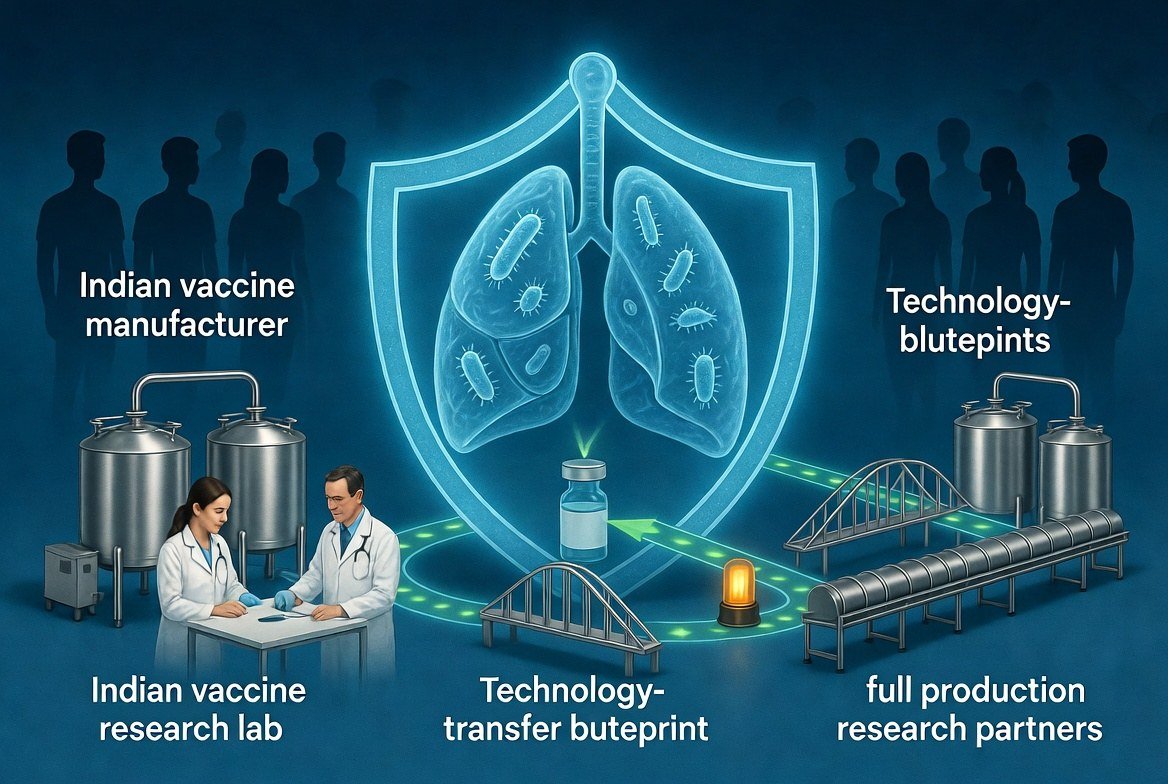
- Serum Institute of India and the Gates Medical Research Institute announced an agreement covering manufacturing preparation and technology transfer for the M72/AS01E tuberculosis vaccine candidate.
- The candidate remains in Phase 3 evaluation; the agreement anticipates successful trial and regulatory outcomes and should not be reported as proof that efficacy has already been established.
- The organisations have discussed substantial production investment, with reports citing more than $100 million for capacity and supply preparation.
- If successful, M72 could become the first new tuberculosis vaccine in more than a century and would target adolescents and adults, populations for whom the existing BCG vaccine offers limited protection against pulmonary TB.
A manufacturing agreement before the final result
The Serum Institute–Gates MRI agreement is unusual enough to require careful explanation. The organisations are preparing manufacturing capability while the M72/AS01E vaccine candidate is still being tested in Phase 3. This is a form of at-risk investment: capacity, technical transfer and supply planning begin before the product is guaranteed to succeed. The advantage is speed. If the trial demonstrates safety and efficacy and regulators approve the vaccine, doses can reach countries sooner than if manufacturing preparation begins afterward. The risk is financial, because facilities and training may not be used for this product if the candidate fails. Public reports must preserve that conditional language. A production agreement is an expression of confidence and preparedness, not a positive Phase 3 result.
Why tuberculosis needs a new vaccine
Tuberculosis remains one of the world's deadliest infectious diseases, and India carries a large share of the burden. The BCG vaccine protects young children against severe forms of TB but provides inconsistent protection against pulmonary disease in adolescents and adults, who account for much transmission. Treatment is effective when completed, yet diagnosis can be delayed and drug-resistant strains require longer, more difficult regimens. A vaccine that prevents pulmonary TB in older age groups could reduce illness and interrupt transmission. That potential explains the global attention around M72. It also means the evidence threshold must remain high, because a vaccine used at population scale needs strong safety, efficacy and durability data.
What M72/AS01E is
M72/AS01E is a protein-based vaccine candidate combined with an adjuvant system designed to strengthen the immune response. It is not a live tuberculosis bacterium. Earlier studies produced encouraging evidence, leading to the large Phase 3 trial now underway. Phase 3 is intended to test performance across a broader and more diverse population and to detect safety issues that smaller studies may miss. Researchers will examine how well the vaccine prevents disease, how long protection lasts and whether outcomes differ by age, geography, infection status or other factors. Until those results are complete and peer reviewed, any claim that the vaccine 'works' should be qualified as based on earlier-stage evidence rather than final confirmation.
Serum Institute's manufacturing role
Serum Institute has extensive experience producing vaccines at large scale for global markets. Its involvement matters because a successful TB vaccine would require hundreds of millions of doses over time, not a limited premium launch. Manufacturing biological products involves consistent antigen production, adjuvant handling, sterile filling, quality testing, cold-chain planning and regulatory inspections. Technology transfer must reproduce the same product across sites without changing performance. Building that capability early can reduce years of delay, but it requires transparent standards and coordination with global and national regulators. The agreement's real value will be measured by whether it creates reliable, affordable and geographically broad supply after approval.
The reported investment and access question
Reports have cited more than $100 million in planned production investment. Large capital spending is necessary, but access depends on pricing, procurement and financing as much as factory capacity. Many high-burden countries have constrained health budgets. A vaccine can be scientifically successful yet fail to change disease patterns if the price is too high, delivery systems are weak or priority groups are unclear. The partners and global health agencies will need an access plan that addresses licensing, public procurement, donor support and equitable allocation. India has a dual role as both a major manufacturer and a high-burden country, making domestic availability and affordability central to the story.
What Phase 3 must answer
The trial needs to establish more than a statistically significant result. Policymakers will want to know absolute risk reduction, protection across subgroups, adverse-event rates and durability. They will also compare vaccination with other TB-control investments such as faster diagnostics, preventive therapy, nutrition and treatment adherence. A vaccine does not replace those tools. Even a moderately effective product could have large population benefits if deployed well, but implementation models must be based on real trial data. Regulatory agencies will independently review the evidence rather than rely on manufacturer announcements. Scientific publication and transparent protocol information will allow researchers to assess the claims.
How the vaccine could be delivered
If approved, health systems would need to decide who receives M72 first. Possible priority groups include adolescents, close contacts of TB patients, people with latent infection or communities with high incidence. Delivery through schools, clinics or targeted campaigns would each have different costs and consent requirements. Screening may be necessary depending on the approved indication. Countries will also need pharmacovigilance systems to monitor rare side effects after rollout. Public trust will be shaped by honest communication about benefits, uncertainty and the difference between infection and active disease. Overpromising before approval could damage confidence later, even if the vaccine ultimately proves useful.
A milestone worth watching, not declaring finished
The agreement is genuinely important because it shortens the path between scientific success and public-health use. It demonstrates that funders and manufacturers are willing to invest before the final commercial case is certain. But the decisive event remains the Phase 3 outcome. News reports should resist the temptation to call M72 the first new TB vaccine in a century before regulators have approved it. The accurate description is a leading candidate with manufacturing preparations underway. If the evidence is positive, Serum Institute's scale could help turn a research result into global supply. If it is not, the same transparency that builds excitement now must be used to explain what was learned. Scientific progress includes preparation, testing and uncertainty—not only triumphant launches.
Sources
- Serum Institute of India, official announcement on the M72/AS01E manufacturing collaboration, July 2026.
- Gates Medical Research Institute, official information on the M72 Phase 3 programme and manufacturing agreement.
- The Economic Times and Reuters-linked ET Pharma coverage of planned investment and access goals, July 17, 2026.
This article is original news analysis and commentary by The NE Times, based on reporting from the sources listed above.
You may also like to read
NMC Move to Phase Out PG Medical Diplomas Reshapes Specialist Training Debate
The National Medical Commission's reported plan to discontinue postgraduate medical diplomas and convert eligible seats into MD and MS programmes is stirring debate over India's specialist training and seat availability.

NMC to Phase Out PG Diploma Medical Courses, Shift Seats to MD and MS
The National Medical Commission says 2026-27 will be the final admission cycle for postgraduate diploma medical courses, with seats set to convert into MD and MS degree programmes from 2027-28.
An AI Helped Design This Coronavirus Vaccine. It Just Passed Its First Human Test
A needle-free, AI-designed vaccine aimed at an entire family of coronaviruses cleared an early-stage human trial, generating broad immune responses without serious side effects.

Andhra Pradesh Reports 12 COVID-19 Cases and Four Deaths as Samples Go for Genome Sequencing
Twelve detected cases across several weeks and districts do not by themselves indicate a large outbreak.
More from this section
More
Jharkhand Teen Dies During Fracture Treatment; CM Orders Probe
The death of a Jharkhand teenager during treatment for a reported fracture has led to family allegations of medical negligence and an official probe ordered by the Chief Minister into what went wrong.
Aarogya Setu 2.0 Returns as India's Personal Health Record App
The pandemic-era contact tracing app has been relaunched as a personal health record platform, betting that portable medical data can find a place in India's growing digital health ecosystem.
India Bets on AI to Catch the Next Outbreak Under One Health Mission in 2026
Drawing on the hard lessons of COVID-19, the ICMR is inviting proposals for AI systems to detect emerging pathogens across people, animals and the environment, in a bid to predict outbreaks rather than react to them.