Army Air Defence Training Upgrade Targets Drone and Missile Threats
The Indian Army is acquiring new target systems that simulate drone swarms, helicopters and missile-like threats, sharpening air-defence training for an era of unmanned and smart weapons.
Commentary & Analysis ·
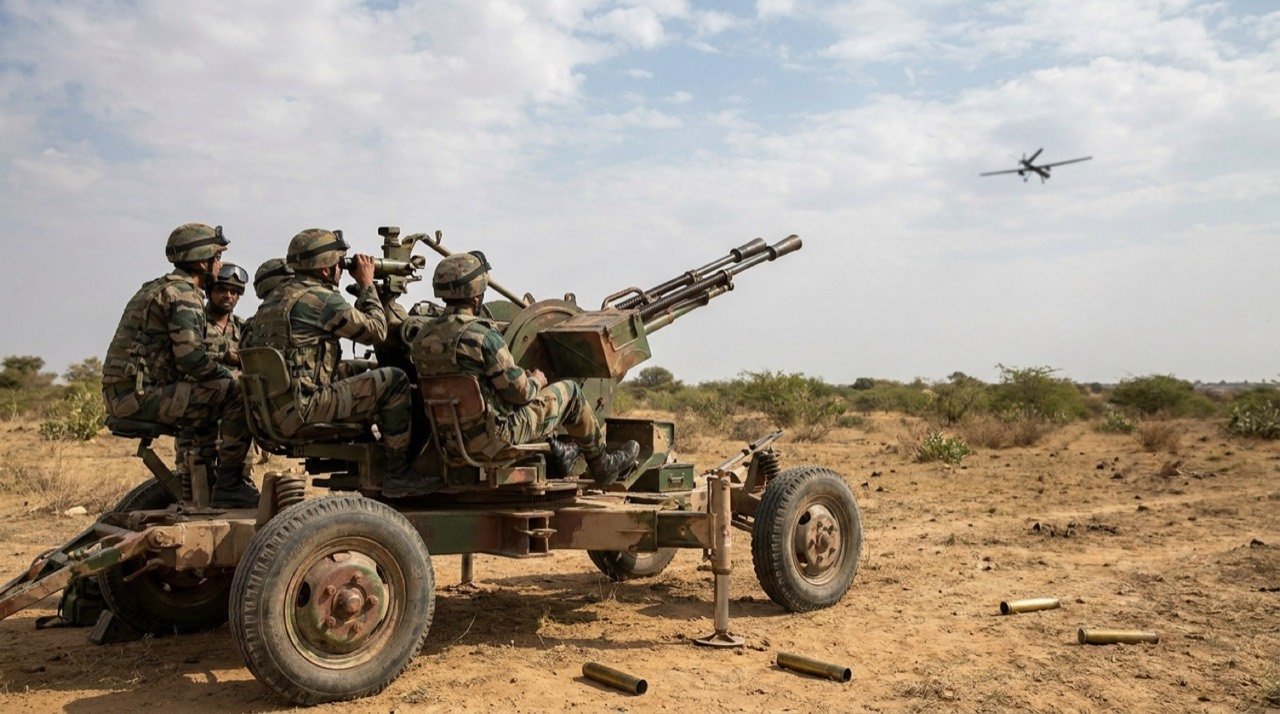
Modern air threats no longer announce themselves as a roar of fighter jets on the horizon. Increasingly, they arrive as swarms of small drones, low-flying cruise missiles and precision-guided munitions that demand a different kind of vigilance. The Indian Army, recognising that shift, has begun acquiring new target systems designed to simulate drone swarms, helicopters and missile-like threats so that its air-defence crews can train against the adversaries they are most likely to face. The move is modest in scale but significant in what it reveals about how the Army now thinks about the aerial battlespace.
Training for a changed threat
Public reporting indicates the Army wants target systems that reproduce realistic threat patterns, allowing troops to rehearse detection, tracking and engagement under conditions that mirror contemporary aerial attacks. The logic is straightforward: crews fight as they train, and outdated targets breed outdated reflexes. If a gunner or radar operator has only ever practised against a slow, predictable drone silhouette, that operator is poorly prepared for the erratic, low-signature behaviour of an actual swarm or a missile skimming the terrain to avoid detection. By simulating fast, small and numerous threats, the new systems aim to stress-test the full kill chain, from spotting an incoming object to deciding whether and how to engage it in time.
This distinction between procurement and proficiency is easy to overlook but central to understanding why the move matters. Buying a counter-drone gun or a missile battery is a discrete, visible event; training crews to use it instinctively, under stress, against a target that behaves unpredictably, is a continuous and far less visible process. It is also the process on which actual battlefield performance depends. The value of a target system that can convincingly imitate a drone swarm's erratic movement, or the low, fast profile of a cruise missile, lies precisely in forcing crews to confront the ambiguity and time pressure of a real intercept rather than the clean, scripted scenarios that older training aids tend to offer.
Part of a broader modernisation
The move follows recent emergency purchases of drones, missiles and other modern platforms, suggesting that training investment is being aligned with the hardware entering service. Acquiring capable weapons is only half the equation; crews must be drilled to use them against the right targets. Emergency procurement, by its nature, tends to prioritise speed of acquisition over the slower work of doctrine and training, so it is notable that the Army appears to be closing that gap relatively quickly here rather than allowing a lag to persist between new equipment arriving and troops being competent to exploit it fully.
The Army's underlying message is that the definition of an air threat has widened. It now spans unmanned aerial systems, cruise missiles and smart weapons, not merely manned aircraft, and air-defence preparation has to widen with it. This is not a marginal adjustment. Air defence doctrine built around detecting and destroying manned aircraft, with their larger radar signatures, predictable flight profiles and finite numbers, does not automatically transfer to a world of cheap, numerous, expendable drones that can be launched in swarms designed to saturate and overwhelm a defender's attention and ammunition. Training systems that can simulate swarms, helicopters and missile-like threats in combination are, in effect, an acknowledgement that a single-threat mental model is no longer adequate.
Lessons drawn from recent conflicts
Recent conflicts have made the lesson brutally clear: cheap drones can blunt expensive armies, and training must catch up to the threat. Across several recent theatres, low-cost unmanned systems and loitering munitions have repeatedly exposed gaps in traditional air-defence postures, forcing militaries worldwide to reassess how they detect, classify and prioritise threats that would once have been dismissed as too small or too slow to matter. For a force the size of the Indian Army, absorbing that lesson through simulated training is considerably cheaper, and considerably less costly in lives and equipment, than absorbing it in an actual engagement.
Realistic training systems are, in this sense, a relatively low-cost but high-leverage investment. They allow the force to internalise lessons from contemporary conflicts without waiting for the next operational test to reveal the same weaknesses at a far higher price. Given how quickly drone technology and swarm tactics are evolving elsewhere, the ability to update and iterate training scenarios as new threat profiles emerge is arguably as important as the initial acquisition of the target systems themselves.
Measuring success beyond procurement notices
The effectiveness of the upgrade will ultimately be measured not in procurement notices but in readiness, in how quickly and accurately air-defence units can respond when an unmanned swarm or a low-flying missile appears on radar. Metrics such as detection-to-engagement time, discrimination between decoys and genuine threats, and the ability to manage a saturating swarm rather than a single target are the kinds of outcomes that will actually indicate whether this investment has paid off. None of these outcomes are easily visible from the outside, which means the public will largely have to take the Army's modernisation claims on faith until, hopefully, they are never tested in earnest.
For now, the acquisition signals an Army adapting its drills to the shape of modern aerial warfare. It reflects an institutional recognition that hardware and doctrine cannot be allowed to drift apart, and that the character of the aerial threat facing Indian forces, on contested borders and in any future conflict, has changed permanently rather than temporarily.
The NE Times View
Recent conflicts have made the lesson brutally clear: cheap drones can blunt expensive armies, and training must catch up to the threat. Acquiring systems that simulate swarms and missile profiles is sensible modernisation, and it deserves credit as a proactive rather than reactive step. The deeper challenge is doctrine and indigenous production at scale, so that air defence is not perpetually importing the counter to yesterday's weapon while adversaries move on to tomorrow's. Training against realistic threat simulations is necessary, but it is only as good as the pace at which those simulations themselves are updated to reflect an evolving battlefield. Realistic rehearsal is a start, not the finish line.
Key takeaways
- The Indian Army is acquiring new target systems that simulate drone swarms, helicopters and missile-like threats for air-defence training.
- The initiative follows recent emergency purchases of drones and missiles, aligning training investment with new hardware entering service.
- It reflects a widened definition of aerial threats, extending beyond manned aircraft to unmanned systems and precision munitions.
- Realistic training is a low-cost, high-leverage way to absorb lessons from contemporary conflicts without waiting for an operational test.
- Long-term success will depend on doctrine development and indigenous production, not just procurement of training systems.
You may also like to read
Gen Seth Set to Take Charge as Indian Army Chief: What It Means
General Seth is poised to assume command of the Indian Army at a moment defined by modernisation drives, jointness reforms, active border sensitivities and a push for faster technology induction.
India and Israel Identify New Defence Projects to Build Joint Resilience
India and Israel have identified new defence projects aimed at deepening cooperation in technology, resilience and strategic industry, with co-development and local manufacturing at the heart of the partnership.
DRDO Tests Missile Defence Interceptors and New Anti-Ship Missile
India conducted a series of flight tests from Odisha in mid-June, validating its Phase-II ballistic missile defence interceptors and carrying out the maiden trial of an indigenous medium-range anti-ship missile.
General Dwivedi's Tenure Puts Drones and New Battle Formations in Focus
As Army Chief General Upendra Dwivedi nears the end of his tenure on June 30, his legacy is being weighed through accelerated doctrine, drones and reorganised battle formations.
More from this section
More
AICTE Industry Fellowship 2026: Rs 1.5 Lakh Scheme Closes July 5
The AICTE Industry Fellowship Programme 2026, which places technical-education faculty inside leading companies on a Rs 1.5 lakh monthly stipend, reached its application deadline on July 5.

Bay of Bengal Low Pressure System Revives Monsoon Over Western India
A low-pressure system over the Bay of Bengal has pushed the monsoon back into an active phase, bringing steady heavy rain to Kerala, coastal Karnataka and Maharashtra, and putting Mumbai and Pune on preparedness watch.
Bishnoi Gang Suspects Injured in Haryana Encounter as Police Tighten Net
A joint Haryana-Delhi Police operation in Bahadurgarh left two suspected Lawrence Bishnoi gang members injured, spotlighting the multi-state coordination now central to India's fight against organised crime networks.