TCS Cut 23,460 Jobs in FY26 as Indian IT Bets on an AI-First Model
India's largest software exporter led sector-wide reductions as firms slimmed benches and slowed fresher intake, even as global capability centres kept hiring.
Commentary & Analysis ·

Tata Consultancy Services reduced its headcount by 23,460 employees in FY26, the largest workforce cut among India's IT majors, as the company accelerates a pivot to what it calls an AI-first services model with leaner benches and reduced fresher hiring. The scale of the reduction at India's biggest software exporter sends a powerful signal across a sector that has long been one of the country's largest and most aspirational employers.
The move marks a structural shift rather than a routine adjustment. For two decades the Indian IT story was one of relentless headcount growth tracking revenue; TCS trimming its workforce while talking up an AI-first model suggests that long-standing equation is being rewritten in real time.
A sector-wide squeeze
Across the top five firms, an estimated 3,400 mid-tier engineers exited in May and June alone through performance-improvement-plan separations and bench releases, with thousands more affected over the year. The concentration of cuts among mid-tier engineers is telling, as these are often the roles most exposed to automation and the easiest to release when utilisation comes under pressure.
The use of performance-improvement plans and bench releases as the mechanism points to a deliberate slimming of the workforce rather than mass redundancies tied to lost business. Reducing the bench, the pool of staff between projects, directly improves utilisation and margins, and is a lever firms pull when they expect to need fewer people per unit of revenue.
AI rewrites the staffing math
Executives say automation and generative AI tools are cutting the number of people needed per client engagement, weakening the long-standing link between revenue growth and headcount growth that defined the Indian IT story for two decades. If a firm can deliver the same project with fewer engineers because AI handles a share of the coding, testing and support work, then growing revenue no longer requires growing the workforce in lockstep.
That decoupling is the heart of the AI-first thesis, and its implications are profound for a sector built on a pyramid model of large junior cohorts. Lower fresher hiring, in particular, threatens the traditional on-ramp through which campus graduates entered the industry in huge numbers, raising questions about how the next generation of talent will be absorbed.
- TCS cut 23,460 jobs in FY26, the largest among Indian IT majors.
- About 3,400 mid-tier engineers exited the top five firms in May and June.
- AI and automation are reducing the people needed per client engagement.
- Global capability centres added a net ~22,000 roles in May.
- The IT ministry is monitoring the larger layoff plans.
A counterweight in capability centres
There is a counterweight. Global capability centres, the in-house tech arms of multinationals operating in India, added a net of roughly 22,000 roles in May, absorbing some of the displaced talent. These centres have become a major and fast-growing source of high-quality technology employment, often offering work closer to product development than the project-services model of traditional IT firms.
The growth of GCCs suggests the demand for skilled technology talent in India remains strong even as the services majors slim down, and that the churn is partly a reallocation rather than a pure contraction. For displaced engineers, these centres represent an alternative path, though the transition is rarely seamless and the skills sought may differ from those honed in the services model.
The churn has drawn attention from policymakers, with the IT ministry said to be monitoring the larger layoff plans given their social and political sensitivity. The IT sector's status as a flagship employer of educated, middle-class workers makes large-scale job cuts politically charged, and the government's watchfulness reflects the stakes. The outlook now hinges on whether AI-driven productivity gains and the rise of capability centres can together generate enough new, higher-value roles to offset the erosion of the traditional headcount-led model, a transition that will shape the future of one of India's defining industries.
The NE Times View
When India's largest IT employer sheds 23,460 jobs, it is signalling that the old labour-arbitrage model is ending, not pausing. The pivot to AI-first delivery may protect margins, but slowing fresher intake quietly shifts the burden onto a generation that built its aspirations on the IT escalator. The sector's challenge now is reskilling at scale, before the productivity story becomes an employment crisis.
This article is original commentary and analysis by The NE Times. Background facts were referenced from Deccan Herald, Careers360.
You may also like to read

Mumbai-Ahmedabad Bullet Train Project Opens Over 200 Jobs
The Mumbai-Ahmedabad bullet train project has opened applications for more than 200 posts, offering engineers, technicians and operations specialists a new hiring window in India's flagship high-speed rail programme.
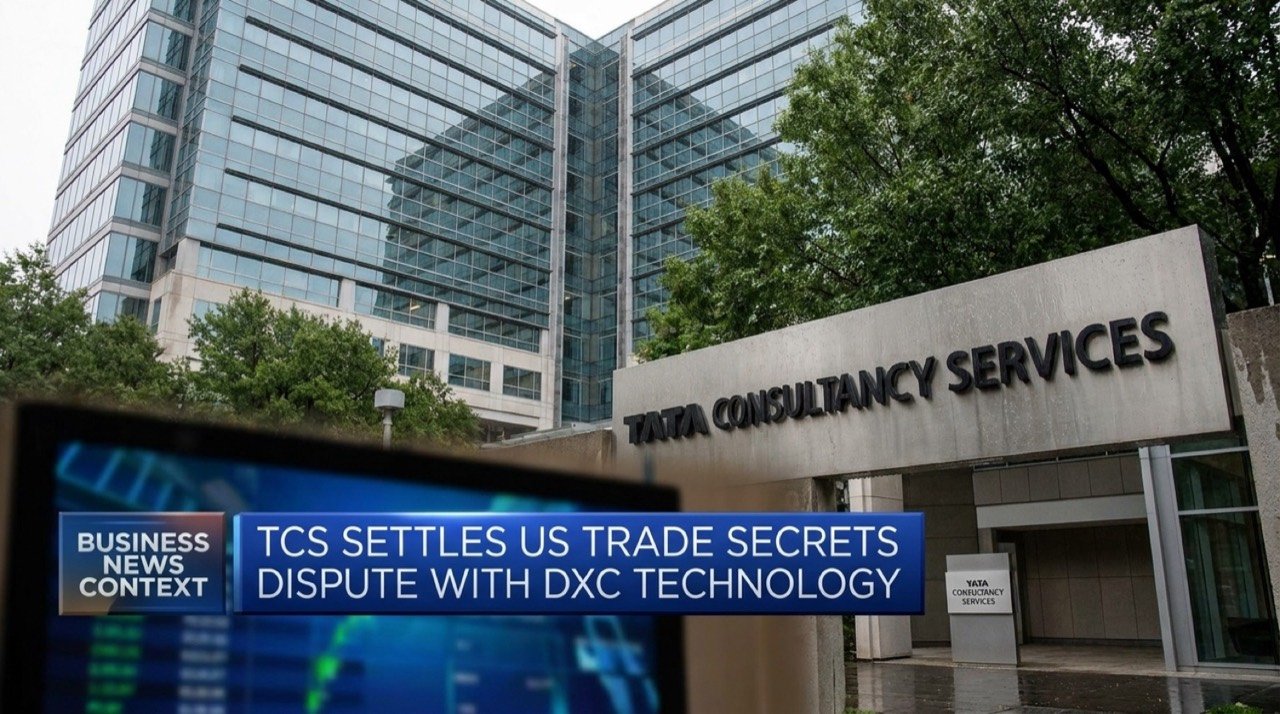
TCS Payment to DXC Closes a Long-Running US Trade Secrets Dispute
Tata Consultancy Services has paid about $213.6 million to DXC Technology after the US Supreme Court declined its appeal, moving a high-profile trade secrets case toward financial closure.

Infosys, TCS And Wipro Cross 300,000 Copilot Seats As AI Reshapes Hiring
India's top IT services firms have scaled Microsoft 365 Copilot to more than 300,000 employees in under six months, even as leaders warn that AI agents will slow future hiring across the sector.

India Targets $1 Trillion in FY26 Exports as Trade Push Widens
The commerce ministry has reaffirmed a $1 trillion export goal for FY26 at a Board of Trade meeting led by Piyush Goyal, leaning on a seven-point action plan spanning merchandise, services and defence exports.
More from this section
More
Adani Case: US DOJ Pushes for Permanent Dismissal of Charges
The US Department of Justice has urged a judge to permanently dismiss charges against Gautam Adani, calling the case legally flawed — a reversal with consequences for markets, diplomacy and cross-border enforcement.

Akasa Air Inducts 40th Aircraft in Indian Aviation Scale-Up
Akasa Air's 40th aircraft, ferried to Bengaluru via Seattle, Reykjavik and Cairo, marks a fleet milestone for the young carrier and a fresh signal that India's aviation market remains firmly in expansion mode.
BARC Ratings Suspension Leaves Indian TV Industry Flying Blind
BARC's pause on television ratings has put India's broadcast measurement system under fresh scrutiny, leaving broadcasters, advertisers and media planners without the weekly audience data that anchors the TV economy.