Sports Ministry Seeks an Independent IOA Panel on Asunta Lakra's Hockey Harassment Allegations
When a complaint concerns people within a sports body, an inquiry run solely by the same organisation can face a real or perceived conflict of interest.
Commentary & Analysis ·
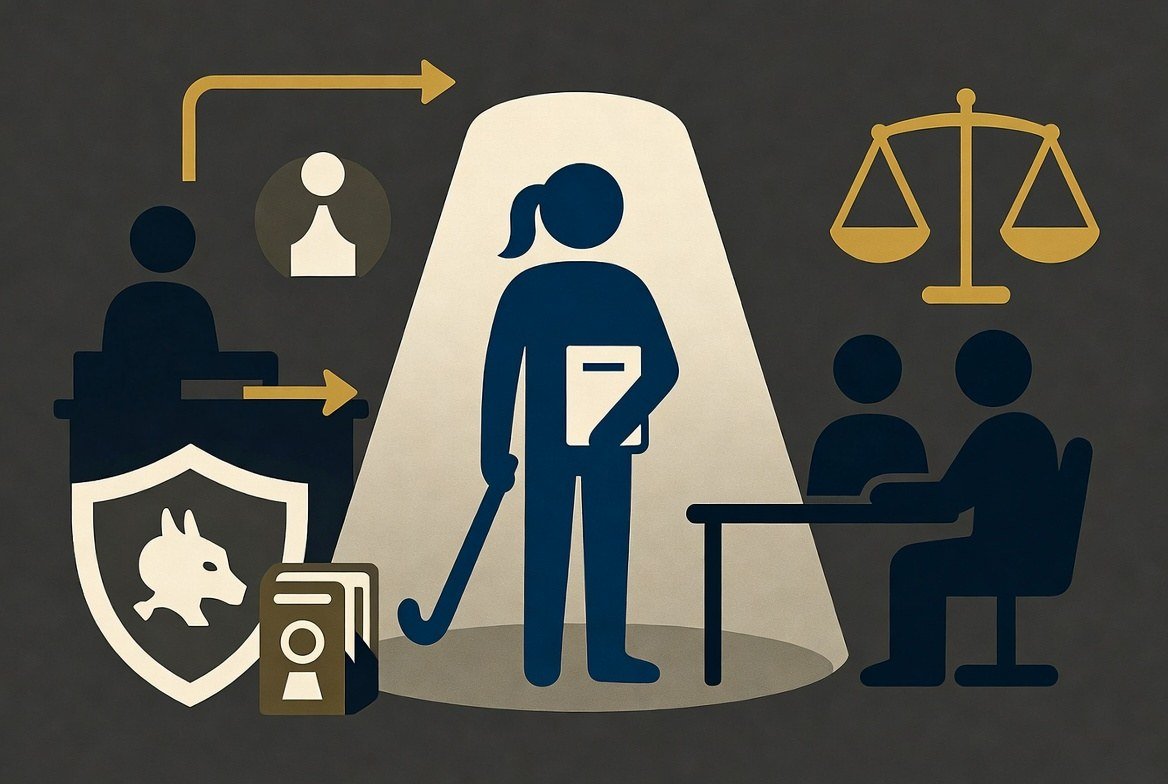
Key facts
- The Sports Ministry directed the Indian Olympic Association to constitute an independent panel after former India women's hockey captain and Hockey India office-bearer Asunta Lakra raised allegations including sexual harassment, intimidation and retaliation.
- The allegations remain unproven and are disputed; an independent process is intended to establish facts while protecting due process for every party.
- Hockey India president Dilip Tirkey indicated that an internal Hockey India inquiry could create concerns about impartiality.
- The case has renewed attention on athlete-safeguarding systems, complaint independence, confidentiality and protection against retaliation in Indian sport.
Why independence is the central issue
When a complaint concerns people within a sports body, an inquiry run solely by the same organisation can face a real or perceived conflict of interest. Even a fair internal committee may struggle to earn trust if its members work with the accused, report to the same leadership or depend on the institution for future roles. The Sports Ministry's request for an Indian Olympic Association panel recognises that problem. Independence does not predetermine guilt. It creates a process in which evidence can be examined without organisational loyalty shaping the outcome. For Asunta Lakra, the accused individuals and Hockey India, a credible external mechanism is more likely to produce a result that withstands scrutiny. The panel's composition and terms of reference will therefore be as important as the announcement.
Allegations must remain allegations
Reports describe claims of sexual harassment, intimidation and retaliation. These are serious matters, but they have not yet been established by findings. Responsible coverage should attribute each claim to the complainant and note any denial or competing account. It should not use language that assumes either guilt or fabrication. Due process protects everyone: the complainant needs safety, confidentiality and freedom from retaliation, while the accused need notice of the allegations, an opportunity to respond and a decision based on evidence. Public pressure can help ensure that a complaint is not ignored, but social-media verdicts cannot replace an inquiry. The final report should explain the evidentiary standard and reasons for its conclusions.
Asunta Lakra's standing in Indian hockey
Lakra is not an anonymous outsider. She is a former India women's captain and has held roles within Hockey India's governance structure. That experience may give her detailed knowledge of institutional processes, but it can also make the complaint more complex because professional relationships and power hierarchies overlap. Senior athletes and office-bearers may be expected to understand complaint mechanisms, yet they can still fear reputational or career consequences. Her decision to raise the matter publicly has intensified scrutiny of how the sport handles internal grievances. The inquiry should focus on evidence rather than status, but her profile ensures that the outcome will influence confidence among younger players and staff.
Retaliation is a distinct safeguarding risk
A complaint system is ineffective if people believe that speaking up will cost them selection, employment, accreditation or access to facilities. Allegations of retaliation therefore require separate examination from the underlying harassment claim. Investigators should review communications, role changes, exclusions, performance records and timing to determine whether adverse action followed protected reporting. Policies must also prohibit informal pressure, such as colleagues being encouraged to isolate a complainant. Interim protections may be necessary while the inquiry proceeds, but they should be designed carefully so that they do not imply a final finding. Clear anti-retaliation rules are among the strongest indicators of a mature sports-governance system.
What a credible panel should include
An independent panel should include expertise in law, sexual-harassment prevention, trauma-informed interviewing and sports administration. Members should disclose any relationship with Hockey India, the complainant or the accused. The process needs a written timeline, secure evidence handling, private interviews and access to relevant messages or documents. The complainant should be allowed support, and witnesses should be protected from pressure. The accused should receive enough detail to answer the claims. If the allegations fall under workplace sexual-harassment law, the panel must also ensure that statutory requirements are met rather than treating the matter as only an internal ethics dispute. A summary outcome should be published without exposing sensitive personal information.
Dilip Tirkey's concern about an internal inquiry
Hockey India president Dilip Tirkey's acknowledgement that an internal process could raise impartiality questions is significant. Institutions often respond defensively to allegations, treating outside review as an attack on autonomy. Recognising a conflict can instead protect the organisation. If the IOA panel is genuinely independent, Hockey India should preserve records, facilitate access and avoid public commentary that prejudges witnesses. Cooperation will be tested not by statements of support but by whether investigators receive complete information. The governing body must also continue normal sporting operations without allowing the case to become factional warfare. Institutional credibility comes from accepting scrutiny, not controlling it.
The wider safeguarding gap in Indian sport
Athletes frequently operate in closed environments where coaches, selectors and officials control opportunities. Travel, camps and residential training can increase vulnerability, while young athletes may be far from family support. Complaint mechanisms need to be visible, accessible in multiple languages and independent of selection decisions. Regular training should explain boundaries, consent, bystander responsibility and reporting routes. Background checks and codes of conduct are useful, but they must be enforced. Anonymous reporting can surface patterns, although formal action may require corroboration. The Lakra case should prompt every national federation to audit whether its internal committee exists only on paper or is capable of handling a powerful respondent.
What accountability should look like
Accountability is not achieved merely by forming a committee. The panel must complete its work within a reasonable period, explain delays, recommend proportionate action and identify any institutional failure. If allegations are substantiated, sanctions and corrective measures should follow. If they are not substantiated, the decision should be explained without attacking the complainant for using a legitimate process. The ministry and IOA should also publish broader safeguarding reforms that do not depend on the outcome of one case. The most important legacy would be a system in which athletes trust that concerns will be heard before they become public crises. An independent inquiry is a necessary step; transparent implementation will determine whether it becomes meaningful reform.
Sources
- The Indian Express, PTI/Rediff, The Tribune and The Times of India reports on the Sports Ministry direction and competing statements, July 17, 2026.
- The IOA panel notification, terms of reference and final findings should be used for subsequent reporting; allegations remain unproven until a competent process concludes.
This article is original news analysis and commentary by The NE Times, based on reporting from the sources listed above.
You may also like to read
Meghalaya Sports Conclave 2026 Lays Out a Youth-First Vision for Grassroots Sport
The Meghalaya Sports Conclave 2026 set out a roadmap to use sport as an engine of youth development, infrastructure growth and community participation across the state's hill and tribal regions.
India Crush Pakistan 7-1 in FIH Pro League London Finale as Pro-Hockey Campaign Closes Out
India ran riot against arch-rivals Pakistan with a 7-1 rout at Lee Valley in their FIH Pro League finale, a result that sealed Pakistan's relegation and capped India's European leg in style.
India Brace For High-Stakes Pakistan Double-Header In FIH Pro League London Leg
India's struggling Pro League campaign heads to London for two charged clashes with Pakistan, as the men's hockey team chases form and momentum before a demanding World Cup year.
India Fall Short Again as Netherlands Edge Five-Goal Pro League Thriller
Dilpreet Singh and Sukhjeet Singh found the net but the Indian men could not overturn the Dutch lead in a 2-3 defeat to open their European leg in Rotterdam.
More from this section
More
ICC Revamps ODI and T20 World Cup Formats, Creating Super 7, Super 10 and New Eliminators
The International Cricket Council has approved significant format changes for the men's ODI World Cup in 2027 and the T20 World Cup in 2028.
India Beat England by Six Wickets in First ODI as Axar Patel Delivers Match-Winning All-Round Show
India chased 259 at Edgbaston to beat England by six wickets, led by Axar Patel's 4/62 and unbeaten 57, Shubman Gill's 80 and Washington Sundar's 52 not out.
BCCI Emerging Men's Tournament to Hunt Test Prospects in Bengaluru
The BCCI's red-ball Emerging Men's Tournament, running at the Centre of Excellence in Bengaluru through July, is designed to give selectors a longer, harder look at India's next generation of Test cricketers.