National Drone Summit Puts Cooperative-Led Drone Model in Focus
India's National Drone Summit has spotlighted a cooperative-led drone platform, signalling a shift in the country's drone economy from startups and defence towards rural and commercial applications.
The NE Times Technology Desk
Commentary & Analysis ·

The National Drone Summit has pushed India's drone conversation beyond startups and defence contracts into new territory: cooperative-led adoption. Reports around a cooperative-run drone platform drew significant attention at the summit, reflecting a broader shift as drones move from demonstration projects into practical, everyday use cases.
From showcase to working tool
The potential applications are wide-ranging — crop spraying, land mapping, infrastructure monitoring, disaster assessment and logistics. But real adoption depends on far more than the machines themselves. Training, safety rules, financing, repair networks and local trust decide whether drones become routine tools or remain trade-show novelties.
Why the cooperative model matters
A cooperative-led approach is notable because it tackles the affordability barrier head-on. Expensive technology that no single small farmer could justify becomes viable when a cooperative owns, maintains and rents out the equipment. That structure can extend drone access to rural users and small institutions that the startup-driven market has largely bypassed.
The policy challenge, as the summit discussions underlined, is to build an ecosystem rather than merely sell hardware. Operators need certification pathways, clear data rules, maintenance support and defined liability standards, while farmers and local bodies need evidence that drone services are genuinely affordable and useful.
The NE Times View
The most significant thing about this summit is where it places drones: inside India's development conversation, not just its technology showcase circuit. India has repeatedly shown — with telecom, UPI and low-cost solar — that scale arrives when technology is made institutionally cheap, and cooperatives are one of the few structures capable of doing that in rural India. If the cooperative model scales, drones could become part of everyday agrarian and civic infrastructure within a few years. The risk is familiar too: without maintenance networks and trained local operators, subsidised machines end up idle. Policymakers should judge this push by utilisation rates, not procurement numbers.
This article is original commentary and analysis by The NE Times. Background facts were referenced from The Economic Times, the Ministry of Civil Aviation and Digital Sky (DGCA).
You may also like to read

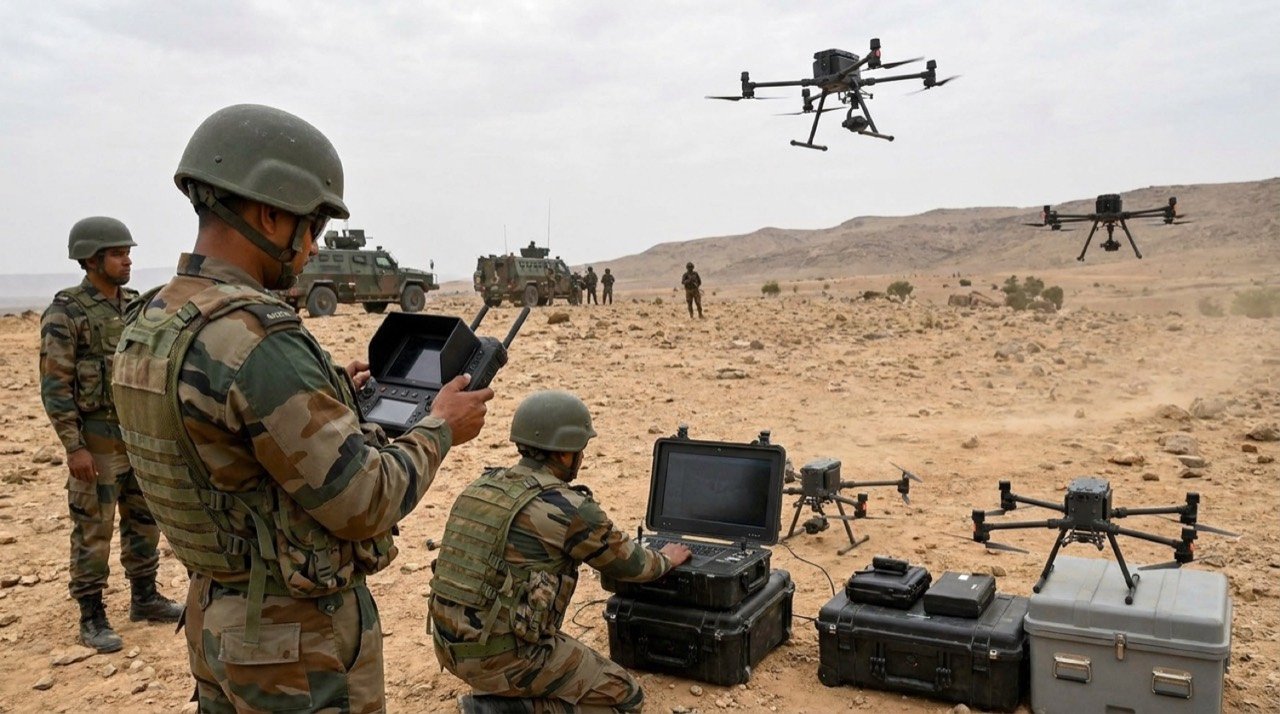
Army Air Defence Training Upgrade Targets Drone and Missile Threats
The Indian Army is acquiring new target systems that simulate drone swarms, helicopters and missile-like threats, sharpening air-defence training for an era of unmanned and smart weapons.
General Dwivedi's Tenure Puts Drones and New Battle Formations in Focus
As Army Chief General Upendra Dwivedi nears the end of his tenure on June 30, his legacy is being weighed through accelerated doctrine, drones and reorganised battle formations.

India and Israel Identify New Defence Projects to Build Joint Resilience
India and Israel have identified new defence projects aimed at deepening cooperation in technology, resilience and strategic industry, with co-development and local manufacturing at the heart of the partnership.

Karan Johar's Alpha Defence Puts Bollywood Trolling Back in Focus
Karan Johar's reported defence of Alia Bhatt's Alpha has widened the film's release conversation from box-office numbers to a bigger question: how Bollywood should handle relentless online negativity.
More from this section
More
CG Semi Sanand Plant Opens, Boosting India's Semiconductor Drive
Prime Minister Narendra Modi inaugurated CG Semi's chip assembly and test facility in Sanand, Gujarat, giving India's semiconductor mission a working manufacturing milestone rather than another policy promise.

Chinese E-Rickshaw Apps Banned in India Over Remote Disable Risk
The Centre has ordered the removal of three Chinese apps — BAT-BMS, Lossigy and Epoch-i-ion — over fears they could remotely disable battery-run e-rickshaws, turning mobility software into a public safety concern.
Connected Car Rules: India Plans Vehicle Software Update Norms
With cars increasingly run by software, the government is reportedly preparing update and security norms aimed at preventing vehicle hijacking and governing how connected cars in India are patched and protected.