FIIs Offload Rs 1,350 Crore As DIIs Step In To Steady Markets
Foreign institutional investors sold Indian equities worth Rs 1,350 crore on June 29 while domestic institutions bought Rs 2,801 crore, cushioning benchmarks on a volatile day that ended in the red.
The NE Times Business Desk
Commentary & Analysis ·
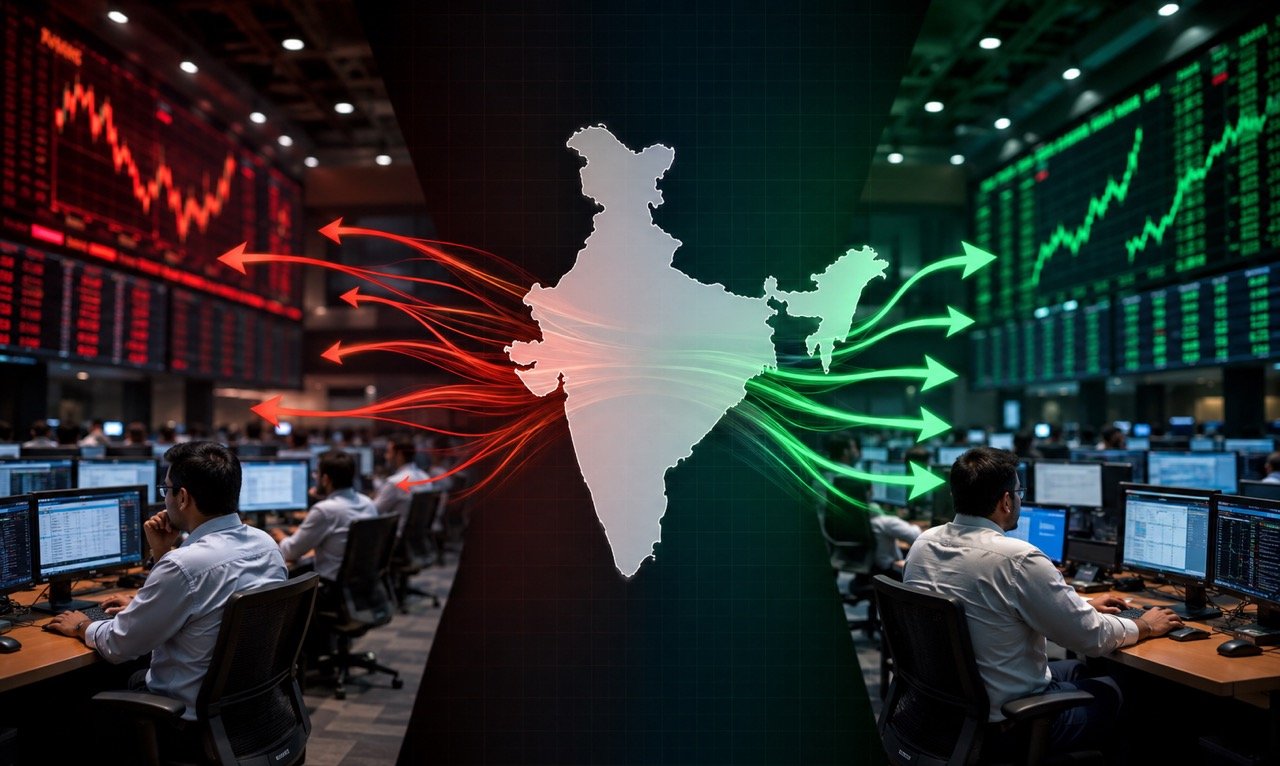
Institutional flow data for June 29 captured a now-familiar tug of war in Indian equities. Foreign institutional investors were net sellers to the tune of Rs 1,350 crore, while domestic institutional investors stepped in as net buyers of Rs 2,801 crore, according to market data reported by Moneycontrol. The session itself ended lower, with volatility picking up.
Flow numbers are among the most closely tracked daily indicators because they help explain why markets hold up, or fail to, under pressure. Foreign selling tends to weigh on indices, particularly large-cap names where FII ownership is concentrated. Domestic buying, driven by mutual funds and insurance-linked investors, can absorb much of that pressure.
Domestic liquidity as a shock absorber
The June 29 pattern fits a recurring theme in recent years: global risk-off episodes push foreign money out of Indian equities, but steady domestic inflows soften the blow. This does not guarantee that indices rise, but it can limit the depth of corrections and shift how individual sectors behave during a sell-off.
Analysts caution against treating a single day's data as a trend. FII behaviour swings with the rupee, crude oil prices, US interest rates and global risk appetite, while DII buying reflects domestic fund inflows and allocation calls. The meaningful signal emerges only when a pattern persists across several sessions.
What retail investors should take away
For retail participants, flow data is context, not a trading system. It frames why the market moved, but it is no substitute for company fundamentals, valuation discipline and sensible risk management.
The NE Times View
The real story in these numbers is the quiet structural shift in who owns India's stock market. A decade ago, an FII selling day of this size would have rattled the indices far more; today, the SIP-fuelled wall of domestic money routinely absorbs foreign exits. That is a source of genuine resilience, but it carries its own risk: domestic investors are increasingly the marginal buyers at elevated valuations, and their conviction has not yet been tested by a prolonged bear market. Readers should welcome the stability domestic flows provide while remembering that liquidity support is not the same as value. Watching whether DIIs keep buying through a sustained global downturn will tell us far more than any single session's data.
This article is original commentary and analysis by The NE Times. Background facts were referenced from Moneycontrol.
You may also like to read
Sensex Sheds 893 Points as Global Risk and West Asia Tensions Weigh on Indian Equities
Indian benchmark indices closed sharply lower on June 23 as weak global cues and West Asian uncertainty dragged the Sensex below 76,300 and the Nifty under 23,850.

Netweb Shares Slide 11% Before Board Meets On Fundraise Plan
Netweb Technologies India stock logged its steepest single-day fall since January 2025, dropping as much as 11 percent after the company said its board would meet to consider raising fresh capital.

Sensex Drops 372 Points, Nifty Slips Below 24,000 On IT, Auto Drag
Indian benchmarks closed lower on June 29 as the Sensex fell 372 points to 76,728 and the Nifty ended at 23,946, with IT, auto and oil and gas stocks dragging while pharma outperformed.
Sensex Crashes Nearly 900 Points as Global Risk-Off Mood Hits Indian Markets
Indian equities tumbled on Tuesday as the Sensex shed about 893 points and the Nifty slipped below 23,900, dragged by weak global cues, IT and metal selling and foreign outflow fears.
More from this section
More
Assam Estate Sells India's First Home-Grown Matcha Batch
An Assam tea estate has sold the first batch of India-made matcha, a small-volume but symbolically significant step as the country's tea industry hunts for premium products and new consumers.

Board of Trade Meets as Exporters Press on FTAs and GST Refunds
Commerce Minister Piyush Goyal chaired a Board of Trade meeting where exporters pushed for faster GST refunds, lower logistics costs and workable free trade agreements amid global demand uncertainty.
Four Chinese Firms With Indian Plants Cleared To Bid For Power Work
Four Chinese companies operating factories in India have reportedly been cleared to bid for power projects, a calibrated move that balances security screening against the country's manufacturing and infrastructure needs.