Dharmendra Pradhan Resigns as Education Minister, Handing India's Student Movement Its Biggest Victory
Dharmendra Pradhan's resignation as Union Education Minister on 25 July 2026, announced on X after weeks of NEET paper leak protests, is only the second ministerial exit under Modi in 12 years.
Commentary & Analysis ·
Key facts
- Pradhan posted his resignation letter to PM Narendra Modi on X on Saturday, 25 July 2026, saying the decision was not about 'individual prestige'
- Business Standard reported he is only the second minister to quit a Modi government in 12 years, after M J Akbar in October 2018
- The NEET-UG 2026 examination of 3 May, sat by around 22 lakh candidates, was cancelled over paper leak allegations now under CBI investigation
- Sonam Wangchuk, who began a hunger strike at Jantar Mantar on 28 June, called the resignation 'a victory of democracy' (India TV, 25 July)
- Hours after the announcement, Cockroach Janta Party leaders called off their protests 'in good faith' (Al Jazeera, 25 July)
A Resignation That Breaks the Modi Government's Mould
Dharmendra Pradhan resigned as Union Education Minister on Saturday, 25 July 2026, announcing in a post on X that he had sent his resignation letter to Prime Minister Narendra Modi. The announcement, reported by ThePrint and The Week, ended weeks of speculation over whether the government would yield to a student movement that had made his exit a central demand ever since the NEET-UG 2026 paper leak erupted into the largest youth agitation India has seen in years.
The scale of the concession is difficult to overstate. Business Standard noted that, once formally accepted, the resignation would make Pradhan only the second minister to leave the Union council of ministers in twelve years of Modi-led governments — an administration that has built much of its identity on never appearing to bend to street pressure. That students, satirists and first-time protesters extracted such a concession marks an inflection point in how power responds to protest in India.
How Saturday Unfolded in Delhi
The sequence of Saturday's events captured how quickly the ground shifted. According to Al Jazeera, the resignation appeared on X even as Delhi Police fired tear gas to scatter demonstrators in the capital, and only hours before protest leaders were due to sit down for another round of talks with Union ministers. The announcement, in other words, pre-empted the negotiation it might otherwise have emerged from.
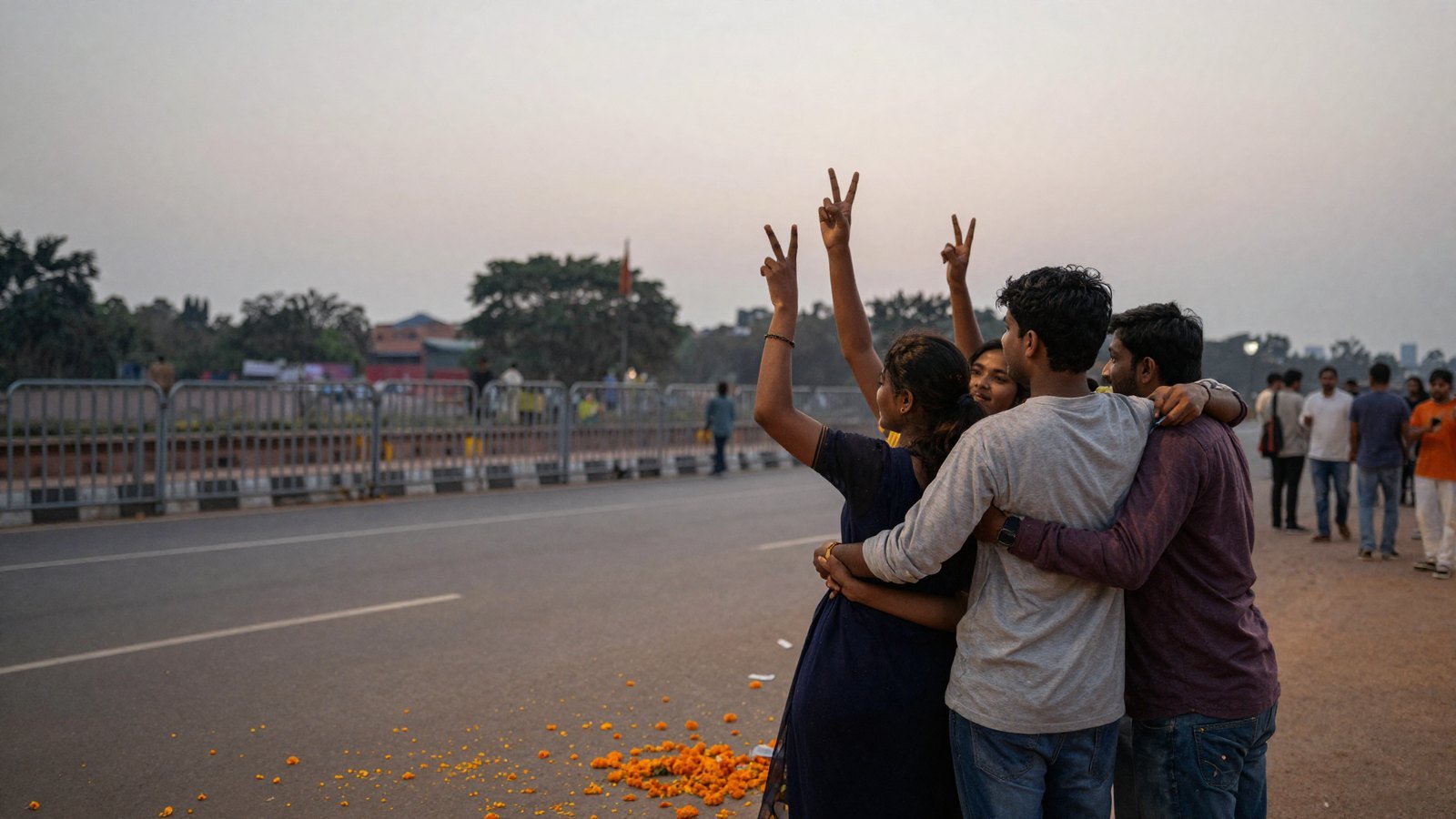
By evening, confrontation had dissolved into celebration. Leaders of the Cockroach Janta Party, the satirical youth movement that fronted the agitation, said they were calling off their weeks-old protests 'in good faith', telling reporters the government had accepted their demands, Al Jazeera reported. A movement tear-gassed in the morning had, by nightfall, declared victory.
'I Will Not Let the Youth Get Trapped in Confusion'
Pradhan framed his exit as an act of protection rather than capitulation. In the letter addressed to the Prime Minister and posted on X, he said the decision was not about 'individual prestige' but flowed from concern for students, according to The Federal and The Tribune, appealing that young people not be dragged into prolonged legal and political battles.
'The youth power of India is the real strength of this country. I will not let the youth of the country get trapped in the vicious cycle of confusion — that is my resolve,' the letter read, as reproduced by The Federal. Reporting in Organiser similarly quoted him saying he did not want students trapped in confusion, and that their future must not become a casualty of a political battle.
The framing matters. By presenting the resignation as a minister stepping aside for the sake of students rather than as an admission of responsibility for the leak, Pradhan left the question of institutional accountability — at the National Testing Agency and inside the ministry itself — formally unsettled. His letter conceded the protesters their demand while conceding almost nothing of their argument.
Only the Second Exit in Twelve Years
Ministerial exits under pressure are vanishingly rare in this government. Business Standard's tally shows the only previous instance was M J Akbar, the former minister of state for external affairs, who resigned in October 2018 after sexual misconduct allegations surfaced during the MeToo movement. No minister in twelve years had left office over a governance failure — until Saturday.
Only days before the resignation, Al Jazeera had published an analysis noting that Modi's refusal to sack embattled ministers fits a long-established pattern, one designed to deny opponents the scalp they seek. The reversal within the same week suggests the government concluded the usual playbook was inflaming the crisis rather than exhausting it, and that holding the line had begun to cost more than breaking precedent.
Seven Weeks From Paper Leak to Resignation
The road to Saturday began on 3 May, when around 22 lakh aspirants sat the NEET-UG medical entrance examination. Allegations that the question paper had leaked surfaced within days; the National Testing Agency cancelled the examination, the investigation was handed to the CBI, and a re-examination was ordered. None of it stemmed the anger, because the grievance had moved beyond one test to the credibility of the examination system itself.
The Cockroach Janta Party began its sit-in at Delhi's Jantar Mantar on 6 June, joined by student organisations including the SFI, AISA and AISF — meaning Saturday's resignation came roughly seven weeks after the first gathering. Sonam Wangchuk's indefinite hunger strike from 28 June turned a students' grievance into a national moral cause, and his forcible removal by police only deepened it. Bloomberg reported that action against Pradhan was one of the movement's three core demands, alongside accountability for the examination irregularities and structural reform of how public examinations are conducted.
Wangchuk's Verdict: 'A Victory of Democracy'
'It's a victory of democracy,' Sonam Wangchuk said in his first reaction, reported by India TV, describing the outcome as democracy arriving straight from the streets. Business Today and The Week quoted the activist — recovering at Medanta Hospital, where he was photographed flashing a victory sign — calling it a victory of 'peace, patience and perseverance' and congratulating the CJP, Gen Z and citizens who joined from across the country.
Wangchuk's next line may prove the most consequential: 'From accountability, now to reforms,' he wrote on X, per The Week. It signals an attempt to pivot the movement from personnel to policy — from the symbolic removal of a minister to the slower work of fixing how India conducts the examinations on which tens of millions of futures depend.
How the World Read It
International coverage treated the resignation as a landmark. Bloomberg called it the government's biggest concession yet to one of India's largest student movements in years, headlining its report as a resignation in a bow to youth protest demands. CNBC described jubilant young protesters claiming victory, while Al Jazeera reported that India's 'Cockroach' youth had called off their protests after the minister quit.
The framing abroad matters at home. A government conscious of its international image has spent weeks watching foreign outlets describe tear gas, detentions and a hospitalised hunger striker. Saturday's resignation converts that story, at least partly, into one about a democracy whose institutions responded — an outcome New Delhi may find easier to live with.
What to Watch Next
Several questions now hang over the aftermath. The first is procedural: the Prime Minister must formally accept the resignation, and the choice of successor will indicate whether the government intends genuine repair of the examination system or merely a change of face. The education ministry inherits a cancelled NEET-UG cycle, an unfinished CBI investigation and a promised legal regime against paper leaks, all demanding early decisions.
The second is whether the movement's declared truce holds. The CJP has ended its protests 'in good faith', language that leaves room to return if the remaining demands stall, and Wangchuk has already pointed towards reforms as the next front. The precedent itself will linger: a government that yielded once to sustained, peaceful, well-organised street pressure has told every future movement that yielding is possible. How it manages that new expectation may shape Indian protest politics well beyond this monsoon.
Sources
- Bloomberg - India Education Minister Pradhan Resigns After Student Protests (25 July 2026)
- Business Standard - Pradhan only the second minister to quit Modi government in 12 years (25 July 2026)
- The Federal - Dharmendra Pradhan's full resignation letter posted on X (25 July 2026)
- India TV News - Sonam Wangchuk's first reaction: 'It's a victory of democracy' (25 July 2026)
- Al Jazeera - India's 'Cockroach' youth call off protests after education minister quits (25 July 2026)
This article is original news analysis and commentary by The NE Times, based on reporting from the sources listed above.
You may also like to read

Dharmendra Pradhan Resignation Demand: Would a Minister’s Exit Fix India’s Examination Crisis?
The demand for Education Minister Dharmendra Pradhan’s resignation has become the protest’s central test of accountability, but structural reform will require more than one personnel change
Prime Minister Modi's First Major Response to the Exam-Leak Protests: What He Announced and What He Did Not
The prime minister's intervention shifted the official response from silence or departmental statements to a national political commitment, while
Dharmendra Pradhan Resignation Demand After Government Concessions: Has the Political Question Changed?
Government concessions reduced some immediate pressure but did not eliminate the argument that ministerial responsibility is distinct from criminal
George Kurian Resigns as Minister After Rajya Sabha Term Ends
The exit of one of Kerala BJP's most prominent national faces reopens questions over the party's southern strategy and its Rajya Sabha arithmetic.
More from this section
More
George Kurian Resigns as Union Minister After BJP Skips Rajya Sabha Renomination
Union minister George Kurian has resigned after the BJP did not renominate him to the Rajya Sabha, a reminder of how ministerial tenure hinges on parliamentary membership and party seat calculations.
After the Fast Ends, the Paperwork Begins: Tracking Wangchuk's Written Assurances
Sonam Wangchuk's fast is over, but the government's written promises on NEET-UG reform and paper-leak courts still await gazette notifications and formal orders.
After Wangchuk's Fast, the Real Test: What a Credible Exam-Reform Panel Must Look Like
The Centre has promised an exam-system review to end Sonam Wangchuk's fast. Whether the oversight panel is real reform or symbolism depends on how it is built.