CJP Calls Off 49-Day Agitation as Centre Agrees to Withdraw FIRs and Pay Compensation
CJP calls off agitation after 49 days as the Centre agrees to withdraw FIRs against protesters with written confirmation and pay compensation to families of NEET aspirants who died by suicide.
Commentary & Analysis ·
Key facts
- CJP ended its 49-day nationwide agitation on 25 July 2026 at a joint briefing with Union ministers JP Nadda and Jitendra Singh, after three rounds of talks
- JP Nadda committed to withdrawing all police cases against protesting students, with written confirmation of FIR withdrawals covering BJP-ruled and allied states
- Negotiator Saurav Das said 15 to 20 FIRs were filed in Delhi and copies would be shared with the movement within three to four days
- The Centre agreed to compensate families of students who died by suicide in leak-linked incidents; the CJP said its Rs 1 crore demand was accepted
- National spokesperson Ashutosh Ranka announced the withdrawal and urged peaceful dispersal from Jantar Mantar and other protest sites
A Settlement Sealed on Camera, Not in a Back Room
The Cockroach Janta Party formally called off its nationwide agitation on 25 July 2026, hours after Dharmendra Pradhan resigned as Union education minister, and it did so in a format with little recent precedent in Indian protest politics. CJP national spokesperson Ashutosh Ranka announced the withdrawal at a joint press briefing alongside Union ministers JP Nadda and Jitendra Singh, the same ministers who had led negotiations for the government, and urged protesters to disperse peacefully from Jantar Mantar and from sites across the country.
The staging was deliberate. For the movement, a joint appearance converted private assurances into commitments made publicly, on camera, beside the ministers who gave them. For the government, it signalled that a seven-week confrontation with a leaderless youth movement had ended through dialogue rather than dispersal, a contrast that will not be lost on either side's constituencies.
The Centrepiece: FIR Withdrawal, in Writing
The settlement's most consequential term concerns the police cases. Nadda committed that all cases registered against protesting students would be withdrawn, and, in the detail the movement's negotiators pressed hardest for, that the FIR withdrawals would come with written confirmation. Reports said the undertaking extends beyond Delhi to BJP-ruled and BJP-allied states, a notable commitment given that policing is a state subject and the Centre cannot ordinarily direct state prosecutions.
That breadth matters. As the agitation spread through June and July, cases were registered against organisers and volunteers in several states. A Delhi-only settlement would have left them exposed. By extending the assurance across the NDA's map, the Centre has taken political ownership of unwinding the entire legal net, and handed the movement a single address to hold accountable if any state drags its feet.
Fifteen to Twenty Delhi FIRs and a Three-to-Four-Day Test
Saurav Das, one of the CJP's lead negotiators, put numbers on the Delhi cases: between 15 and 20 FIRs, he said, with the government agreeing to share copies of all of them with the movement within three to four days. Das also indicated, according to reports, that the CJP had handed the government a draft that functions as a written guarantee of the agreed terms.
The document-sharing deadline is the settlement's first enforceable milestone, and its logic is straightforward: a movement cannot verify the withdrawal of cases it has never seen. If the copies arrive by the end of the month, the government will have demonstrated good faith on the cheapest of its promises. If they do not, the CJP will have an early and specific grievance around which to regroup.
Compensation: Rs 1 Crore, With Caveats in the Fine Print
The Centre agreed to compensate the families of students who died by suicide in incidents linked to the NEET paper leak. The CJP said its demand of Rs 1 crore per family had been accepted; the government's own formulation, as reported, was that an honorary compensation would be paid under whatever rules and regulations allow.
The gap between those two phrasings is where difficulty could live. No public list of eligible families has been released, no disbursal timeline has been announced, and the language about rules and regulations leaves the final figure open to administrative interpretation. Of the three headline commitments, this is the softest, and the one most likely to require sustained follow-up from the movement.
Forty-Nine Days, Not Thirty-Six, and Three Rounds of Talks
There has been confusion over the agitation's length, with figures of 36 and 49 days both in circulation. The arithmetic favours the larger number: the CJP launched its nationwide agitation on 6 June 2026, making 25 July the forty-ninth day of the movement. The smaller figures refer to the Jantar Mantar encampment specifically, which began later in June and had run for roughly 37 days by the time the tents came down.
The endgame compressed into 48 hours. Two rounds of talks with Nadda and Jitendra Singh had produced in-principle agreement on FIR withdrawal and compensation by 24 July, but deadlocked on Pradhan's position, which the CJP had called non-negotiable. The third round, held on 25 July after the resignation was announced, converted those in-principle assurances into the terms unveiled at the joint briefing.
Celebration, Then an Orderly Retreat from Jantar Mantar
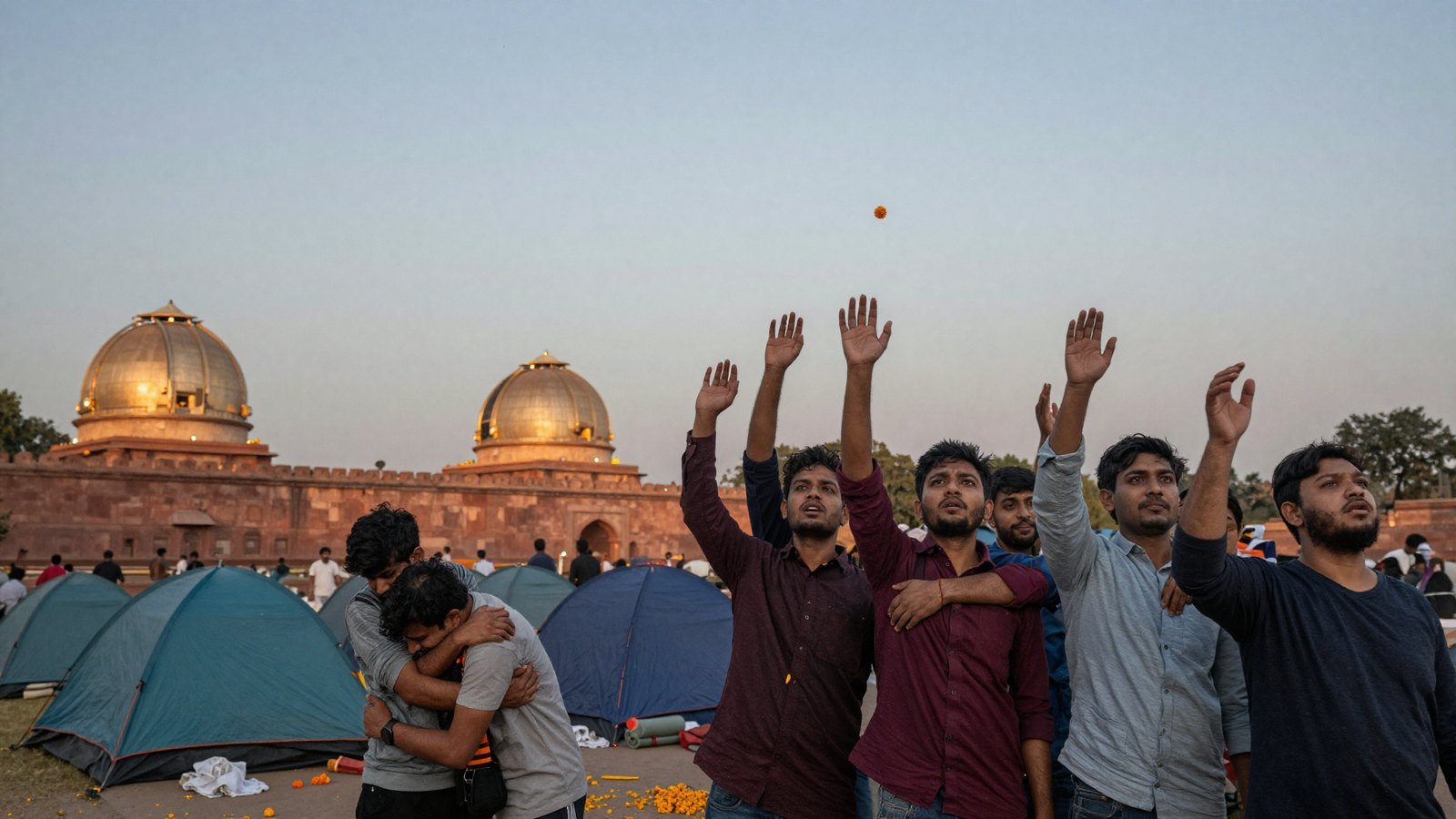
News of Pradhan's resignation reached Jantar Mantar before the formal briefing did, and television coverage showed the protest site erupt, with students embracing and drumming as slogans gave way to celebration at a site that had braced for a possible crackdown only days earlier. India TV's live coverage captured scenes of jubilation as the announcement spread through the encampment.
Ranka's appeal for peaceful dispersal was answered in kind, with reports describing supporters being asked to return home rather than linger. For a movement whose discipline had been one of its principal assets, an orderly exit was itself a message: the restraint that sustained seven weeks of protest would also govern its final hours.
Why the Architecture of This Settlement Matters
Indian protest movements have usually ended on verbal assurances: committees promised, files opened, momentum quietly dissipated. This settlement is structured differently, with written confirmations of FIR withdrawals, document delivery against a stated deadline, compensation acknowledged on the record, and a joint briefing that binds ministers to the terms in public. It reads less like a truce and more like a contract with deliverables.
The caveats are real. Withdrawing a case is a legal process, not an administrative switch; prosecutions already before courts require judicial consent to withdraw, and closure of cases at the FIR stage runs through police reports that courts must accept. The written confirmations Nadda promised will therefore trail the announcement by weeks in some states. But by demanding paper rather than promises, the CJP has made any slippage visible, and measurable.
What to Watch Next
The settlement's credibility will be decided over the next month, on several specific fronts.
The agitation is over; the settlement has only begun. Whether 25 July is remembered as a template for negotiated protest endings or as another set of assurances that thinned with time now depends on paperwork that has been promised, dated and, unusually for such moments, put in writing.
- Whether copies of the 15 to 20 Delhi FIRs reach the movement within the promised three to four days, by around 28 or 29 July.
- Written confirmations of FIR withdrawals from BJP-ruled and allied states, the term most dependent on cooperation beyond the Centre's direct control.
- The compensation mechanism: who qualifies, whether the amount disbursed matches the Rs 1 crore the CJP says was accepted, and on what timeline.
- The five-point charter on examination reform, which Nadda said the government would study closely, with the next CJP-government meeting expected in about four weeks.
- The choice of Pradhan's successor at the education ministry, which will signal how much of the reform agenda the government intends to own.
Sources
- The Tribune - CJP declared withdrawal of agitation in joint briefing with the government after its demands were accepted (25 July 2026)
- BusinessToday - CJP ended its Delhi protest after the Centre accepted demands; cases against protesters to be withdrawn (25 July 2026)
- Organiser - CJP announced immediate withdrawal of the 37-day Jantar Mantar protest; government assured exam reforms (25 July 2026)
- ANI - Centre agreed in principle to FIR withdrawal and compensation after Nadda-led talks with CJP negotiators (24 July 2026)
- The Statesman - CJP withdrew the Jantar Mantar protest and asked supporters to return home after Pradhan's resignation (25 July 2026)
This article is original news analysis and commentary by The NE Times, based on reporting from the sources listed above.
You may also like to read
NTA Sacks 47 Officials as Centre Mounts Its Biggest-Ever Overhaul of Exam Machinery
The NTA overhaul began on 24 July 2026 with 47 officials removed, specialist hires in cybersecurity and forensics, revamped outsourcing, and a reported multi-day computer-based NEET-UG 2027.
Assam Floods Kill More Than 60 and Displace 700,000 as Brahmaputra Overflows
Assam floods have killed more than 60 people and displaced about 700,000 as the Brahmaputra burst its banks, submerging nearly 900 villages across 11 districts with Sivasagar worst hit.
Sonam Wangchuk Ends 26-Day Hunger Strike: The Agreement, the Timing and What Changed
Sonam Wangchuk ended his 26-day fast at a Gurugram hospital after negotiations and assurances from the Union government, but the student movement did

Why Delhi Schools Shifted to Hybrid Classes During the CJP Mobilisation
The shift to hybrid schooling illustrates how a national protest can create second-order effects for younger students, parents, transport operators and
More from this section
More
CJP's Nationwide Protest Call: Every District, One Day, One Demand Explained
The call for district-level action marked a shift from a Delhi-centred confrontation to a distributed national mobilisation designed to demonstrate

FIRs After Chalo Sansad: Charges, Due Process and the Government's Later Assurance
The coexistence of registered cases and a later political assurance creates urgent questions about withdrawal, investigation discretion and equal
Who Is Sonam Wangchuk? From SECMOL and Ice Stupas to a National Hunger Strike
A factual profile of Sonam Wangchuk’s work with SECMOL, alternative education and Ice Stupas, with a clear explanation of the disputed 3 Idiots connection