Supriya Sule Signals Conditional NCP (SP) Support for Delimitation Bill While Rejecting Alliance Speculation
Supriya Sule says NCP (SP) may support the Centre's delimitation proposal if Lok Sabha seats rise by 50% across all states, while denying an imminent NDA switch.
Commentary & Analysis ·
Verified key facts
- Supriya Sule said support would depend on a written commitment to a 50% increase in Lok Sabha seats across all states.
- The comments came amid speculation about NCP (SP)'s relationship with the BJP-led NDA.
- Some reports described the proposed constitutional amendment as expanding the Lok Sabha to about 850 seats; an official final position was still developing.
A procedural reform becomes a test of political alignment
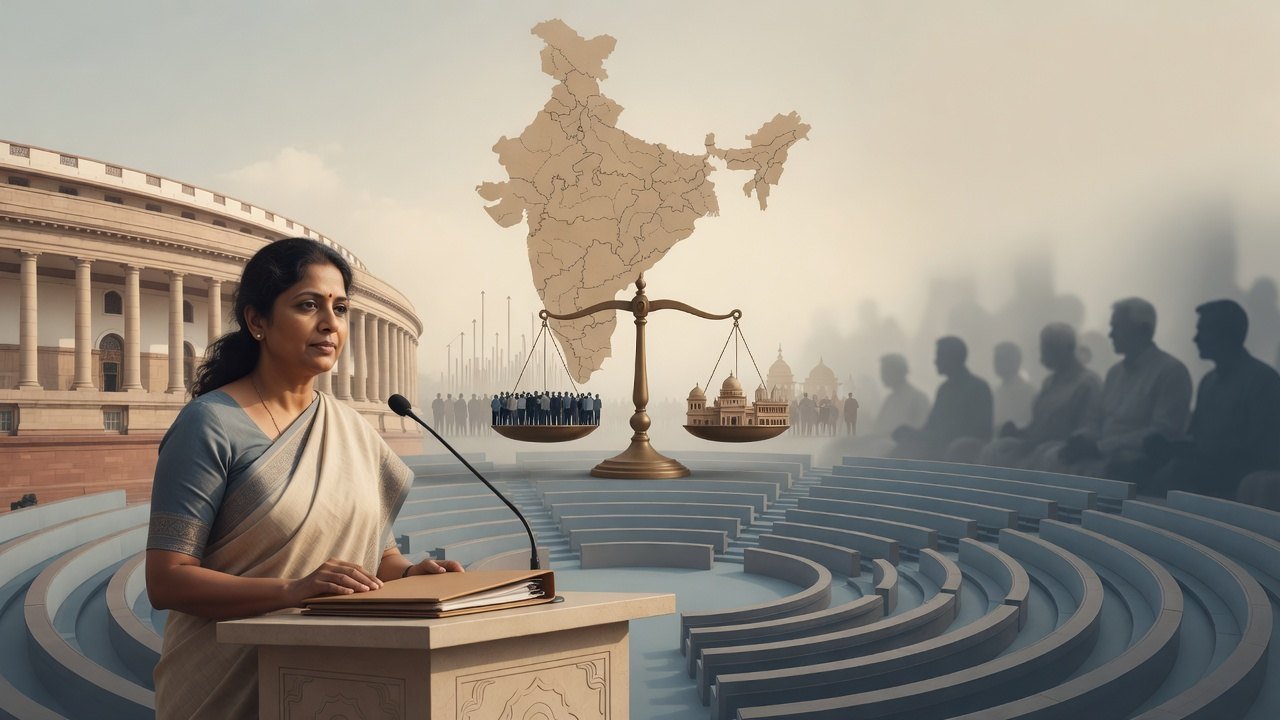
Supriya Sule’s statement that the Nationalist Congress Party (Sharadchandra Pawar) could support the Centre’s delimitation proposal under a specific condition has immediately become a major political headline. Sule said the party would consider support if the government put in writing a plan to increase Lok Sabha seats by 50 per cent across all states. Her intervention came amid persistent speculation that sections of the NCP (SP) were moving closer to the BJP-led National Democratic Alliance. Sule rejected the idea that a policy position automatically signalled an alliance switch. The distinction is important: opposition parties can support a constitutional measure without joining the government, but in a fragmented political environment every cross-party vote is read for hidden realignment.
What delimitation means
Delimitation is the process of redrawing electoral constituencies and allocating seats to reflect population and legal rules. India has postponed a major reallocation of parliamentary seats for decades, partly to avoid penalising states that achieved lower population growth. Any new exercise therefore raises foundational questions about federal fairness. States with faster population growth may argue that equal representation requires more seats. Southern and other lower-fertility states fear losing relative influence despite stronger performance on health, education and population stabilisation. Increasing the total size of the Lok Sabha, rather than merely transferring seats from one region to another, is often proposed as a way to soften that conflict.
Why the 50 per cent condition matters
Sule’s condition appears designed to make expansion the central principle. A broad increase could allow populous northern states to gain representation without requiring absolute seat losses elsewhere. It would not eliminate relative change: some states could still gain a larger share of the total. Nor would it answer how constituencies are drawn within states, how Scheduled Caste and Scheduled Tribe reservations are adjusted, or how the Women’s Reservation framework interacts with the new map. A written commitment is therefore only the beginning. The final bill, census base, formula and timetable would determine whether the proposal protects federal balance.
The numbers and the need for official text
Media reports have referred to a constitutional amendment that could take the Lok Sabha toward roughly 850 seats. Because the political discussion was still developing on 15 July, responsible analysis should distinguish sourced reports from enacted policy. A proposed number can change during cabinet consideration, all-party consultation or parliamentary drafting. The government should publish the bill text, statement of objects, state-wise modelling and constitutional rationale early enough for public scrutiny. Delimitation cannot be treated as a technical boundary exercise. It changes political power for decades and requires legitimacy beyond a narrow parliamentary majority.
Alliance rumours around the NCP factions
Maharashtra politics makes Sule’s statement especially sensitive. The original NCP split, producing factions aligned with different coalitions, and every meeting between leaders generates speculation about reunion, defection or a new arrangement. Policy support can be used by rivals as evidence that ideological lines are collapsing. Sule has sought to separate the delimitation question from alliance arithmetic. Whether that separation is accepted will depend on future votes and organisational decisions. For the moment, the accurate position is conditional support, not an unconditional endorsement and not proof of joining the NDA.
What other opposition parties will consider
Regional parties will evaluate the proposal through state interest as well as national principle. They will ask whether the seat increase is uniform, population-based or weighted; whether no state loses its existing number; and how new seats affect coalition formation. Parties in states with successful population control may demand constitutional safeguards or fiscal compensation. Women’s representation adds another layer because reservation could be implemented after delimitation. A larger House may make the reservation transition easier numerically, but only if the timetable is credible. The NCP (SP) position may encourage other parties to state conditions rather than reject the idea outright.
A debate that requires more than political signalling
India’s current Lok Sabha represents a vastly larger population than it did when the seat freeze was designed. Expansion has a democratic logic: smaller constituencies could improve access to representatives and reduce the population represented by each MP. It also creates practical questions about Parliament facilities, staffing, expenditure and committee work. Most importantly, it risks a federal backlash if states believe responsible demographic policy has weakened their voice. Sule’s 50 per cent condition has moved the debate toward expansion rather than redistribution, but the government must still provide a transparent formula. Until official text is available, headlines should avoid declaring a completed alliance or settled bill. The real story is that delimitation, once an abstract post-census issue, is becoming a live negotiation over the future balance of Indian democracy.
Why this story matters beyond the headline
The political significance of the statement lies in its conditional language. Supporting a parliamentary measure after examining its text is not the same as joining a governing coalition, yet campaign rhetoric often collapses those distinctions. Delimitation carries unusually high stakes because it can reshape the balance of representation among states, influence constituency boundaries and affect debates about federal fairness. Parties may agree that representation requires periodic review while disagreeing sharply over the formula, timing and safeguards. Maharashtra leaders will also assess how any national framework affects the state's seat share and internal regional balance. Sule's comments therefore place emphasis on the details of a bill that has not been reduced to a simple alliance test. Voters should watch for the actual legislative text, committee scrutiny and recorded votes rather than relying only on speculative headlines. The issue is likely to produce cross-party bargaining because its consequences could last for decades, well beyond the lifespan of current coalitions.
Sources
- The Indian Express - Supriya Sule sets condition for support
- NDTV - Sule rejects NDA switch speculation
- The New Indian Express - developing amendment discussion
You may also like to read
PM Modi Calls on President Murmu as Cabinet Reshuffle Speculation Grows in Delhi
Prime Minister Narendra Modi met President Droupadi Murmu at Rashtrapati Bhavan on June 23, a call that drew sharp political attention amid mounting speculation over a possible Union Council of Ministers reshuffle.

Government Plans Fresh Push On Delimitation After 131st Amendment Defeat
Having seen the Constitution (131st Amendment) Bill fall short of the two-thirds majority earlier this year, the Centre is preparing to bring delimitation-linked legislation back in the monsoon session.
Nitin Nabin's Punjab Outreach Signals BJP's Early 2027 Election Push
BJP national president Nitin Nabin's Punjab visit sharpened the party's positioning for the 2027 Assembly polls, with sharp attacks on CM Bhagwant Mann and plans to contest all 117 seats.
NDA Eyes Second Run at Delimitation and Women's Quota Bills With DMK, TMC Outreach
After its April defeat, the central government is courting DMK and Trinamool Congress MPs to revive the delimitation and women's reservation bills, with shifting numbers in the Lok Sabha reopening the arithmetic.