Karsh Kale Returns With 'Dust', a Comeback Album a Decade in the Making and a Tribute to Zakir Hussain
The New York-raised, India-rooted producer breaks a long silence with his first solo album in roughly a decade, born from 28 paintings and carrying a heartfelt homage to the late tabla master Ustad Zakir Hussain.
Commentary & Analysis ·
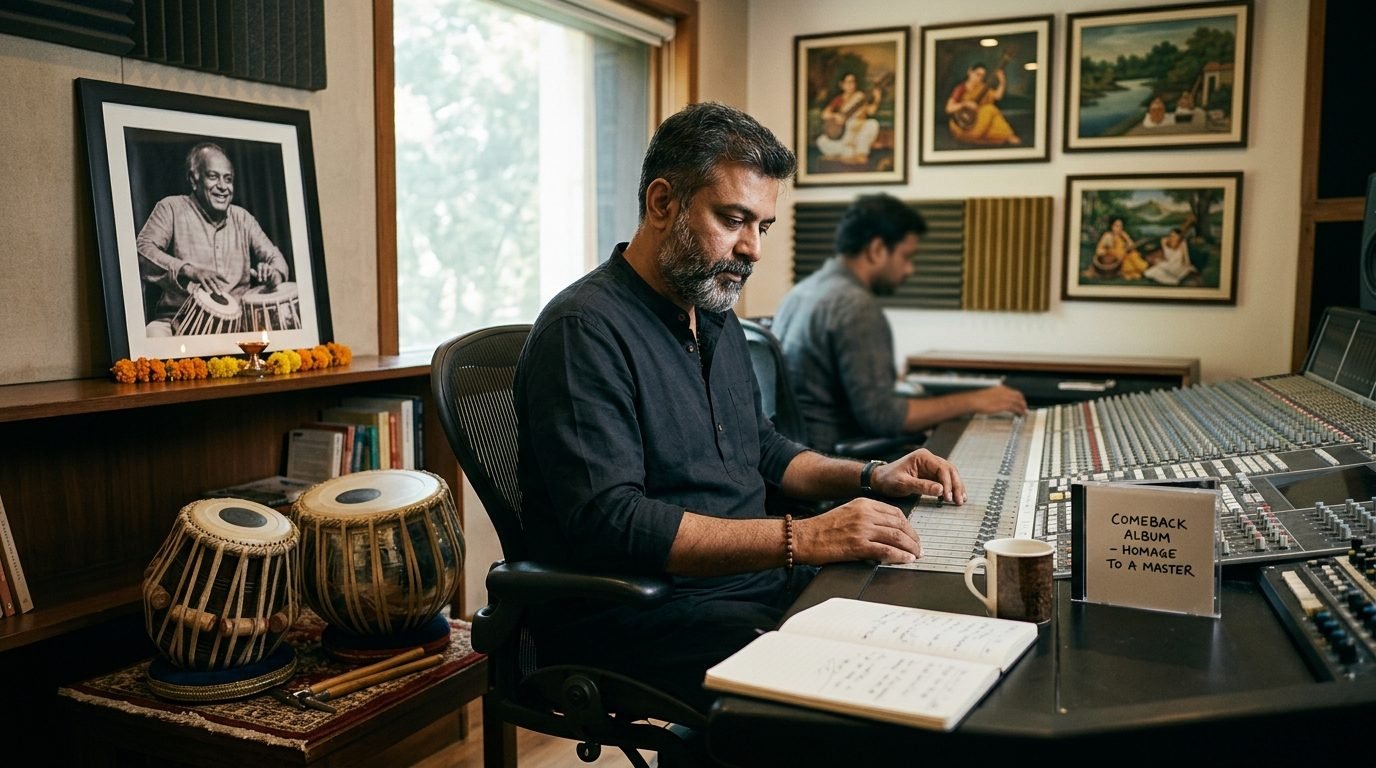
For nearly a decade, one of the most distinctive voices in Indian electronic and fusion music had gone quiet. Karsh Kale, the New York-raised producer, drummer and tabla player who helped pioneer a genre-blurring sound, had all but stopped making music, disillusioned with an industry he found increasingly formulaic. His return, in the form of the album 'Dust', is therefore as much a personal story as a musical one.
'Dust' is Kale's first full-length solo album in roughly ten years, following 2016's 'Up'. The gap was not a strategic pause but a genuine retreat, and the album that emerges from it carries the marks of an artist rediscovering why he made music in the first place. For a figure long associated with the Indian fusion movement, the comeback resonates well beyond his core audience.
An Album That Began as Paintings
The most striking detail of the record's origin is that it did not begin with sound at all. Before writing a single song, Kale turned to painting, creating 28 canvases that served as visual prompts for the compositions. He then developed those ideas on the piano before moving into the broader soundscapes that define the album. It is an unusual creative path, and it helps explain the record's painterly, atmospheric quality.
The album was recorded across New York City, Mumbai, Delhi and Goa, a geography that mirrors Kale's own dual identity. That cross-continental process bleeds into the music, which moves between ambient passages, Indian percussion, electronica and driving rhythmic sections.
A New Role as Singer-Storyteller
'Dust' also marks a shift in Kale's role. For the first time, he steps forward as a singer-storyteller, departing from the largely instrumental, electronic and fusion-driven work that built his reputation. The result blends high-energy moments with mellow contemplation, filtered through a modern sensibility. The breakout single 'Night Turns' captures that range, a funky, groove-led track that fuses rock, electronica and Asian fusion percussion.
The 11-song album runs to around 56 minutes and is described as an immersive listen, mixing ambient textures with Indian percussion and electronic beats. For longtime followers, hearing Kale's voice take center stage is the clearest sign that this is a deliberately reinvented chapter rather than a continuation of past work.
A Tribute to Ustad Zakir Hussain
At the emotional heart of 'Dust' is 'Tabla Beat Scientist', a tribute to the late tabla master Ustad Zakir Hussain, who was deeply influential in Kale's life and career. The connection runs back to 2000, when Kale was part of the Tabla Beat Science project alongside Hussain, Bill Laswell and the late Ustad Sultan Khan, a collaboration that launched a movement and, by Kale's account, his own career with the blessing of the master.
- First solo album in roughly a decade, following 2016's 'Up'
- Built from 28 paintings used as visual prompts for the music
- Recorded across New York, Mumbai, Delhi and Goa
- Features 'Tabla Beat Scientist', a homage to Ustad Zakir Hussain
- Marks Kale's debut as a singer-storyteller
Why the Comeback Resonates
Kale's candor about stepping away gives the album an unusual weight. In an era when artists are pressured to release constantly, a decade-long silence followed by a record made on its creator's own terms reads as a quiet act of resistance. The painting-first process and the tribute to a departed mentor reinforce the sense of an artist making music for himself again.
For the Indian fusion scene that Kale helped shape, his return is a reminder of the genre's roots in genuine cross-cultural exchange rather than trend-chasing. 'Dust' arrives as both a personal reckoning and a statement about what made the movement matter.
Looking Forward
With the album out and the story behind it resonating across coverage, attention now turns to how Kale carries this reinvented sound into live performance and what a renewed creative appetite might yield next. After ten years, the door appears to be open again.
The NE Times View
A decade-long silence broken by an album born of paintings and dedicated to Zakir Hussain is the rare comeback driven by feeling rather than commerce. Kale's fusion of Indian and electronic sensibilities has always defied easy categories. As a tribute to the late tabla master, the record carries a poignancy that should resonate well beyond his core following.
This article is original commentary and analysis by The NE Times. Background facts were referenced from Rolling Stone India and Jefferson Public Radio.
You may also like to read

Celina Jaitly Comeback: Nivedita Biopic Marks a Personal Return
Celina Jaitly's reported return to the screen through a biopic connected to her sister Nivedita has emerged as one of Bollywood's most personal comeback stories, trading nostalgia for emotional grounding.

A Decade in the Making: Perrie Edwards and Alex Oxlade-Chamberlain Marry in Intimate Portugal Ceremony
The former Little Mix star and the footballer exchanged vows in a picturesque church in the Algarve, capping a ten-year romance with a low-key celebration attended by family, close friends and at least one famous former bandmate.

IMAX returns to Hyderabad after a decade as Asian Cinemas deal targets India's premium boom
A new partnership will bring three IMAX with Laser screens to the AMB Cinemas brand, with the first opening at Mahesh Babu's flagship venue ahead of S.S. Rajamouli's 'Varanasi', as large-format exhibition chases record Indian demand.

The Economics of Reality: Why Indian Broadcasters Can’t Stop Making These Shows
To understand why Indian television in 2026 looks the way it does, you have to stop thinking about entertainment and start thinking about arithmetic.
More from this section
More
72nd National Film Awards: Fans Back Mammootty, Allu Arjun, Sai Pallavi
Speculation around the 72nd National Film Awards is intensifying as fan communities across India's language film industries champion favourites including Mammootty, Allu Arjun and Sai Pallavi ahead of any official announcement.

Aamir Khan Marries Gauri Spratt in Private Pali Hill Ceremony
Aamir Khan and Gauri Spratt tied the knot at the actor's Pali Hill home in Mumbai on July 5, turning a deliberately small family ceremony into Bollywood's biggest story of the day.

Akanksha Chamola's Lock Upp 2 Confession Sets Reality TV Abuzz
A personal revelation by Akanksha Chamola ahead of Lock Upp 2 has handed the reality show a viral talking point, underlining how confession-driven formats continue to dominate Indian television conversation.