Europe battles deadly wildfires from Spain to the Paris outskirts after its hottest June on record
India's Supreme Court imposed Rs 3 lakh costs on Samay Raina, Ranveer Allahbadia and Ashish Chanchlani after finding non-compliance with directions in a disability-related case.
Commentary & Analysis ·

Verified key facts
- Wildfires across Spain, Portugal, France, Greece, Italy and Turkey had killed at least 14 people by early July, per Inside Climate News.
- Spain is hardest hit, with roughly 50,000 hectares burned across 14 major fires, including its deadliest wildfire in about two decades.
- About 850 firefighters battled a blaze near Fontainebleau, some 64 km south of Paris; around 10,000 people were evacuated in France, CTIF said.
- June 2026 was Western Europe's hottest June on record, averaging 20.7C, about 3.06C above the 1991-2020 norm; Andujar in Spain hit 45.1C.
- European countries reported roughly 10,650 excess deaths during the late-June heatwave.
What happened
Europe is fighting wildfires on multiple fronts after three successive heatwaves and weeks of scant rainfall left the continent dangerously dry. Fire crews are battling blazes from southern Spain to the forests south of Paris and into the United Kingdom. Insurance Journal reported on July 13 that fires were still growing after relentless heat.
The human toll is mounting. Inside Climate News reported that fires had killed at least 14 people by early July and forced tens of thousands to flee. Flames have scorched swathes of Spain, Portugal, France, Greece, Italy and Turkey in one of the most intense starts to a European fire season on record.
Spain suffers its deadliest fire in two decades
Spain has been hit hardest. Roughly 50,000 hectares have burned across 14 major fires since the season began. One of those blazes became the deadliest wildfire Spain has recorded in about twenty years, according to Inside Climate News.
The heat behind the fires has been extraordinary. The mercury reached 45.1 degrees Celsius at Andujar in southern Spain during the June heatwave. Soils and vegetation across the Iberian peninsula have dried to tinder, and officials warn that any spark can now become a major incident within hours. Neighbouring Portugal faces similar conditions along its border regions.
Flames within an hour of Paris
France's fires have come unusually close to the capital. About 850 firefighters raced to contain a blaze in forest land near Fontainebleau, some 64 kilometres south of Paris, which burned about 20 square kilometres before being contained on July 14. The international fire-services body CTIF said around 10,000 people were evacuated in France as crews battled extreme conditions.
The national picture is stark. Wildfires have burned roughly 320 square kilometres in France so far this year. That is about twice the area destroyed by the same point last year, a pace that has alarmed civil-protection planners heading into August, traditionally the peak fire month. Authorities have restricted access to several forests around the capital as a precaution.
The hottest June ever measured in Western Europe
The fires sit on top of a record-shattering heat event. June 2026 was the hottest June on record for Western Europe, averaging 20.7 degrees Celsius, about 3.06 degrees above the 1991 to 2020 norm. Temperature anomalies peaked at around nine degrees above normal over France and Germany.
The health consequences were severe. European countries reported some 10,650 excess deaths during the late-June heatwave that engulfed the west of the continent. Scientists have repeatedly shown that climate change is making such heatwaves hotter, longer and more frequent, turning summer into a public-health emergency across Europe.
Climate scientists link the pattern directly to global warming. Marine heatwaves in the Mediterranean have amplified land temperatures, while persistent high-pressure systems blocked cooling Atlantic weather. Similar blocking patterns drove the lethal European summers of 2003 and 2022, but this year's event started earlier and has spread wider.
Energy and insurance systems are straining too. Insurance Journal reported that weeks of extreme heat have built up fire and power risks simultaneously, with grids stressed by cooling demand just as fire threatens transmission lines. Insured losses from this season are expected to run into billions of euros.
Why Indian readers should watch Europe burn
The most direct link is human. Hundreds of thousands of Indian students, professionals and tourists are in Europe during peak summer, and July is the busiest travel month. Heat alerts, transport disruption and evacuation zones now belong on the checklist for any European itinerary.
Travel plans deserve specific attention. Airlines have warned of delays at southern European airports during peak heat hours, and rail operators have imposed speed restrictions on heat-stressed tracks. Indian travellers with July and August bookings should track national weather alerts and keep itineraries flexible.
The larger lesson is climatic. Europe's 2026 summer shows how quickly compound extremes, heat plus drought plus fire, can overwhelm rich, well-prepared states. India faces its own lethal heatwaves and increasingly erratic monsoons. The European experience strengthens the case Indian negotiators make for adaptation finance at global climate talks.
What happens next
Forecasters see little immediate relief, with high temperatures and dry conditions expected to persist across much of southern Europe. Fire agencies are shifting resources between countries under the EU's civil-protection mechanism as new ignitions emerge.
Reinsurers, meanwhile, are recalculating wildfire exposure for a continent that once treated fire as a Mediterranean niche risk. Premiums for homes near forests are rising from Portugal to Germany. That quiet repricing may prove the season's most lasting economic legacy.
- August, historically Europe's worst fire month, still lies ahead with vegetation at record dryness.
- Watch for further excess-death data as national health agencies process late-June and July figures.
- Watch EU-level debates on expanding shared firefighting fleets and heat-adaptation funding.
For now, the continent is trading emergency for emergency: evacuations in France, mourning in Spain, and grid stress everywhere. Europe's summer of 2026 is already a case study in what a warming world does to even the most prepared societies.
Sources
- Insurance Journal - Europe battles growing wildfires after relentless heat (13 July 2026)
- Inside Climate News - Record heat drives wildfires in Europe, forces thousands to evacuate (7 July 2026)
- CTIF - Heatwave drives major wildfires across Europe; 10,000 evacuated in France (July 2026)
- Anews - Wildfire rages near Paris as heatwave scorches Europe (13 July 2026)
You may also like to read
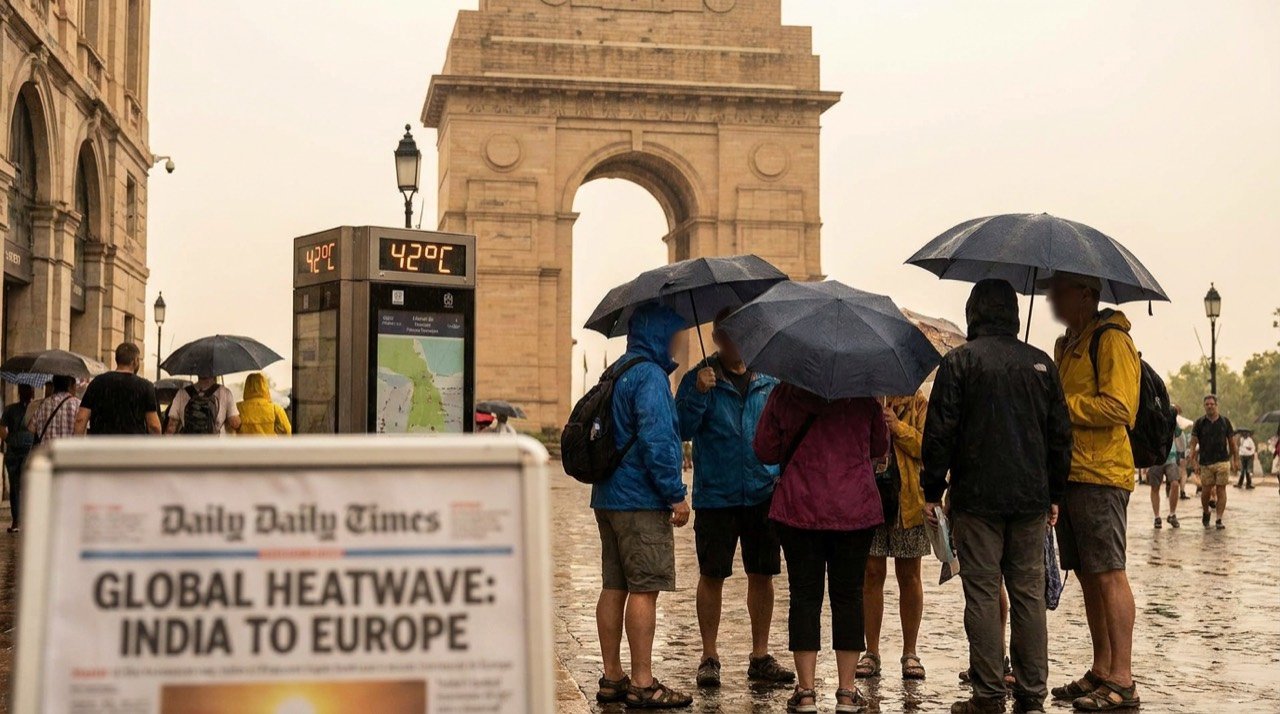
Europe's Record-Breaking Heatwave Turns Deadly as France Logs Its Hottest Day
A ferocious early-summer heatwave has shattered temperature records across Western Europe and killed hundreds, prompting red alerts, early monument closures and fresh caution for the thousands of Indian tourists and students heading there this season.

Bastille Day 2026: Record Parade Signals Ukraine Resolve
France staged its largest-ever Bastille Day parade on July 14, with 6,700 troops and Ukrainian soldiers marching as Zelensky watched alongside 30 leaders.

Scientists Warn Of More Heat Records Ahead As Atlantic Current Nears Tipping Point
A WMO forecast projects near-record global temperatures through 2030 as researchers raise fresh alarm that a key Atlantic ocean current may be approaching collapse.
Pakistan Unveils Record Defence Budget While Bowing to IMF Targets
Islamabad's 18.77 trillion-rupee budget pushes military spending past three trillion rupees for the first time, even as the government holds the line on fiscal targets set by the International Monetary Fund.