Ayodhya Ram Mandir Donation Case Reaches Supreme Court as Judges Seek SIT Status Report and Trust Response
The court’s intervention intensifies scrutiny of an alleged donation embezzlement case that has already led to arrests, leadership exits and demands for stronger safeguards.
Commentary & Analysis ·
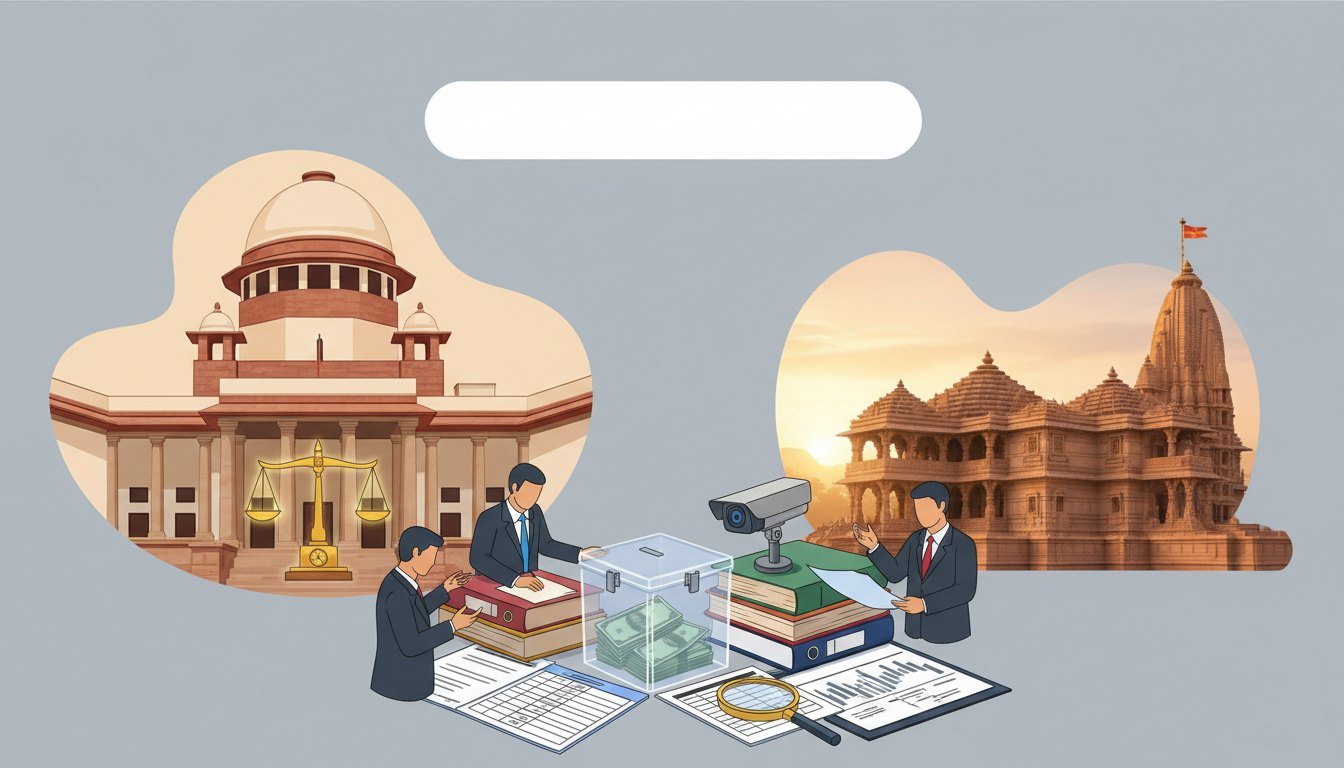
The Supreme Court has sought a status report from the Uttar Pradesh government-appointed Special Investigation Team and a response from the Shri Ram Janmabhoomi Teerth Kshetra Trust in connection with alleged embezzlement of donations at the Ayodhya Ram Temple. The court’s action on 13 July 2026 marks a significant new stage in a controversy that has already produced arrests, recoveries, leadership resignations and intense political debate. Petitions before the court have sought an independent or Central Bureau of Investigation-led inquiry, along with broader financial scrutiny.
The Ayodhya Ram Mandir donation case must be described with legal precision. The allegations concern the handling and counting of cash and valuables donated by devotees. Investigators have arrested eight people, according to reporting, and examined CCTV footage that allegedly shows counting personnel removing and concealing bundles of currency. These claims remain subject to investigation and trial. Arrest is not proof of guilt, and individuals accused of wrongdoing are entitled to due process. The court has not yet ruled that the trust or any specific office-holder committed an offence.
The Supreme Court SIT status report will allow judges to assess what the state investigation has found, what evidence has been secured and whether further directions are necessary. Courts typically look for the quality and independence of the investigation, preservation of records, the scope of asset tracing and whether potential supervisory responsibility is being examined. The court’s request for a trust response also recognises that the issue is not limited to individual alleged theft. It concerns the governance system through which large public donations were received, counted, recorded and deposited.
The Ram temple donation theft probe has already prompted institutional changes. Champat Rai, the trust’s former general secretary, and trustee Anil Mishra exited their positions after submitting resignations. Rai later called personal allegations against him baseless and promised a detailed response. Their resignations should not be treated as admissions of criminal liability. They do, however, demonstrate the scale of the accountability crisis facing the trust. The organisation has also moved to strengthen professional administration, including steps related to a chief executive role.
Reports on the SIT’s preliminary findings have pointed to serious procedural weaknesses, including inadequate frisking, poor monitoring and repeated opportunities for cash to be removed during counting. If confirmed, these failures would show why internal controls matter even in institutions built on public faith. Trust is not a substitute for verification. High-volume donation systems need segregation of duties, continuous camera coverage, controlled access, dual or multiple-person custody, tamper-evident containers, reconciled counting sheets and direct bank deposits under independent supervision.
Ayodhya temple trust transparency is especially important because the donations carry religious and emotional meaning. Devotees give money expecting it to be used for worship, maintenance, pilgrim services and charitable or institutional purposes approved by the trust. Any suspicion that offerings were diverted can cause harm beyond the amount allegedly stolen. It can weaken confidence in the institution and become a wider political and religious controversy. The correct response is not to suppress questions in the name of faith, nor to use unproven allegations to attack devotees. It is to establish facts through a credible process.
A strong forensic audit would examine more than cash recovered from suspects. It would reconcile daily donation records, bank deposits, CCTV logs, access registers and staff rosters over a defined period. Investigators may need to review bank accounts, major purchases and links between accused individuals, while respecting legal procedures. Digital records should be preserved in a way that proves they were not altered. If gaps are found, auditors should quantify them and explain the method. Public summaries can protect sensitive evidence while still showing that the process is serious.
The controversy has also reopened a broader debate about governance of religious institutions. Some temples are managed by government departments, while others operate through statutory or private trusts. Supporters of autonomy argue that religious communities should control their institutions. Critics respond that autonomy without transparent accounting can enable abuse. The Ayodhya case demonstrates that the real issue is not simply government control versus independent control. Any model handling substantial public donations needs professional standards, external audit, conflict-of-interest rules, whistleblower channels and enforceable consequences.
Political parties have demanded different forms of investigation, and the Uttar Pradesh government has reportedly considered transferring the matter to a central agency. Such decisions should be based on investigative necessity rather than political theatre. A CBI probe is not automatically superior if evidence is poorly preserved or terms of reference are vague. Conversely, a state SIT must show independence and follow the evidence wherever it leads. The Supreme Court’s oversight may help establish clear milestones and reduce suspicion that the inquiry is either being rushed or contained.
The public should also distinguish between alleged criminal acts and supervisory or governance failure. A person may not have personally stolen money but may still bear administrative responsibility for weak controls. Internal accountability can include removal, censure or reform even when criminal liability is not established. That distinction allows institutions to improve without prejudging a court case. It also prevents the entire debate from collapsing into the question of whether one prominent individual is guilty.
The next developments in the Ayodhya Ram Mandir donation case will likely include the SIT’s formal status report, responses from the trust and governments, and the Supreme Court’s decision on whether additional investigation or audit directions are required. Whatever the legal outcome, the governance lesson is already clear. Institutions that receive the public’s money and faith must operate with controls strong enough to withstand scrutiny. Transparency is not an insult to devotion; it is one of the ways devotion is protected.
You may also like to read

CBSE Three-Language Policy Reaches Supreme Court as Schools, Parents and Teachers Raise Practical Concerns
The Supreme Court is hearing challenges to CBSE's Class 9 three-language policy, balancing multilingual education with concerns over teachers, books, choice and implementation timelines.
Supreme Court Fines Chhattisgarh Rs 2 Lakh in Decades-Old Land Compensation Case
The Supreme Court has fined the Chhattisgarh government Rs 2 lakh and upheld compensation with interest for landowners whose plot was taken for a road in 1986 without payment.
Ayodhya Ram Temple Donation Probe: SIT Report Puts Fund Controls Under Scrutiny
A Special Investigation Team report into alleged irregularities in donations linked to the Ayodhya Ram Temple has placed fund-handling systems, receipts and local accountability under fresh scrutiny.
Supreme Court Issues Notice on Bail Plea in Zubeen Garg Death Case
The Supreme Court has issued notice on a bail plea tied to the probe into singer Zubeen Garg's death, reviving an emotionally charged case that has gripped Assam for months.