Rebel TMC MPs name Sudip Bandyopadhyay floor leader as Speaker Om Birla weighs contested NCPI merger
India's Supreme Court imposed Rs 3 lakh costs on Samay Raina, Ranveer Allahbadia and Ashish Chanchlani after finding non-compliance with directions in a disability-related case.
Commentary & Analysis ·

Verified key facts
- 20 of the TMC's 28 Lok Sabha MPs merged with the Tripura-based NCPI and met Speaker Om Birla on July 14
- Sudip Bandyopadhyay was named the group's floor leader and Kakoli Ghosh Dastidar its chief whip
- The group has sought separate seating in the Lok Sabha and declared support for the NDA
- The rebels plan to claim the Trinamool name and election symbol before the Election Commission in July
- The Speaker is yet to rule on whether the merger is valid under the Tenth Schedule
Twenty MPs, one letter and a new party label
Twenty of the Trinamool Congress's 28 Lok Sabha members have formally merged with the Nationalist Citizens Party of India, a Tripura-based registered party. On July 14, the group met Lok Sabha Speaker Om Birla and named veteran MP Sudip Bandyopadhyay as its floor leader, according to the Deccan Herald.
The rebels also told the Speaker that Kakoli Ghosh Dastidar would serve as the group's chief whip. They have asked to sit separately from the remaining Trinamool MPs in the House. The Quint reported that the group has declared support for the BJP-led National Democratic Alliance.
The Daily Pioneer reported that the NCPI is likely to be invited to the government's all-party meeting on July 19. That gathering precedes the monsoon session of Parliament, which opens on July 20. The seating question may therefore be settled, formally or informally, within days.
What the NCPI is and why it was chosen
The Nationalist Citizens Party of India is a registered but unrecognised party from Tripura, little known outside the state. It had a minimal national footprint before the merger announcement. Its sudden relevance flows almost entirely from the Trinamool rebellion in Delhi.
Outlook India described the move as a calculated legal manoeuvre built around the Tenth Schedule of the Constitution. The anti-defection law protects legislators from disqualification if two-thirds of a party's members agree to a merger. Twenty of 28 MPs clears that numerical bar.
The choice of a small party may also preserve the rebels' longer game. The Statesman reported that Bandyopadhyay has said the group will stake a claim to the Trinamool name and election symbol in July. That contest would sit before the Election Commission, not the Speaker.
The legal question before the Speaker
The dispute now centres on how a merger becomes valid in law. Outlook India noted two competing readings. One holds that two-thirds support among MPs is sufficient. The other holds that the original political party itself must first merge with another organisation.
The Tenth Schedule was added to the Constitution in 1985 to curb defections. A 2003 amendment removed the older defence that protected one-third splits, leaving mergers as the main exception. That history explains why the rebels needed a merger vehicle rather than a simple breakaway.
Speaker Om Birla has not yet ruled on separate seating or recognition. His decision could shape the rebels' future, the Trinamool's parliamentary control and the wider interpretation of merger rules, according to Outlook India. The parent party has already moved: Abhishek Banerjee filed 20 disqualification petitions with the Speaker on June 19.
Past rulings on splits and mergers have taken months and have often reached the courts. Whatever the Speaker decides is likely to be tested judicially. Timing matters, because floor arrangements for the monsoon session depend on who sits where and under which banner.
A party weakened before the revolt
The parliamentary rebellion follows the Trinamool Congress's defeat in the West Bengal assembly election. The BJP won 206 seats in results declared on May 4, ending 15 years of Trinamool rule, India TV reported. Mamata Banerjee lost the Bhabanipur seat to Suvendu Adhikari.
Since May, the party has faced pressure on two fronts. In Kolkata, a faction led by Ritabrata Banerjee has mounted an organisational challenge to the leadership. In Delhi, the parliamentary group under Bandyopadhyay and Ghosh Dastidar has now moved toward the NDA.
The Federal reported that the fight over the Trinamool's identity is far from over despite the NCPI merger. The remaining eight Lok Sabha MPs continue to sit as the recognised Trinamool contingent. Control of the name, symbol and organisation remains contested at every level.
What it means for the numbers in Parliament
If recognised, the NCPI bloc would add 20 votes to the NDA side of the House. That widens the government's cushion on contested legislation expected this session. The shift follows an earlier realignment in June, when six Shiv Sena (UBT) MPs joined Eknath Shinde's Shiv Sena.
For the opposition INDIA bloc, the arithmetic tightens. Fewer members mean fewer speaking slots, weaker division votes and reduced committee weight. The bloc's coordination plans for the session were drawn up before the full scale of the Trinamool split became clear.
Recognition also affects daily procedure. A recognised group gets defined seating, whip arrangements and a floor leader who is called to speak. Without recognition, the 20 MPs would technically remain Trinamool members, exposed to the party whip and to disqualification claims for defying it.
What to watch next
- Speaker Om Birla's ruling on separate seating and recognition for the NCPI group
- The rebels' expected claim to the Trinamool name and symbol before the Election Commission
- The Speaker's handling of the 20 disqualification petitions already filed against the rebel MPs under the Tenth Schedule
- Floor arrangements and party positions when the monsoon session opens on July 20
Each step carries precedent-setting weight for how party splits are treated in Indian law. The outcome will influence not just one party's fate but the incentives facing every divided party. The numbers have already moved. The legal argument over what those numbers mean has only begun.
Sources
- Deccan Herald - Rebel Trinamool MPs meet Speaker Om Birla; Sudip Bandyopadhyay to be floor leader (14 July 2026)
- Outlook India - When does a political split become official? The battle over 20 rebel TMC MPs (July 2026)
- The Quint - Rebel TMC MPs merge with NCPI, a regional party from Tripura; support NDA (July 2026)
- The Statesman - Rebel TMC MPs to merge with Nationalist Citizen Party; claim on Trinamool name, symbol likely in July (July 2026)
You may also like to read
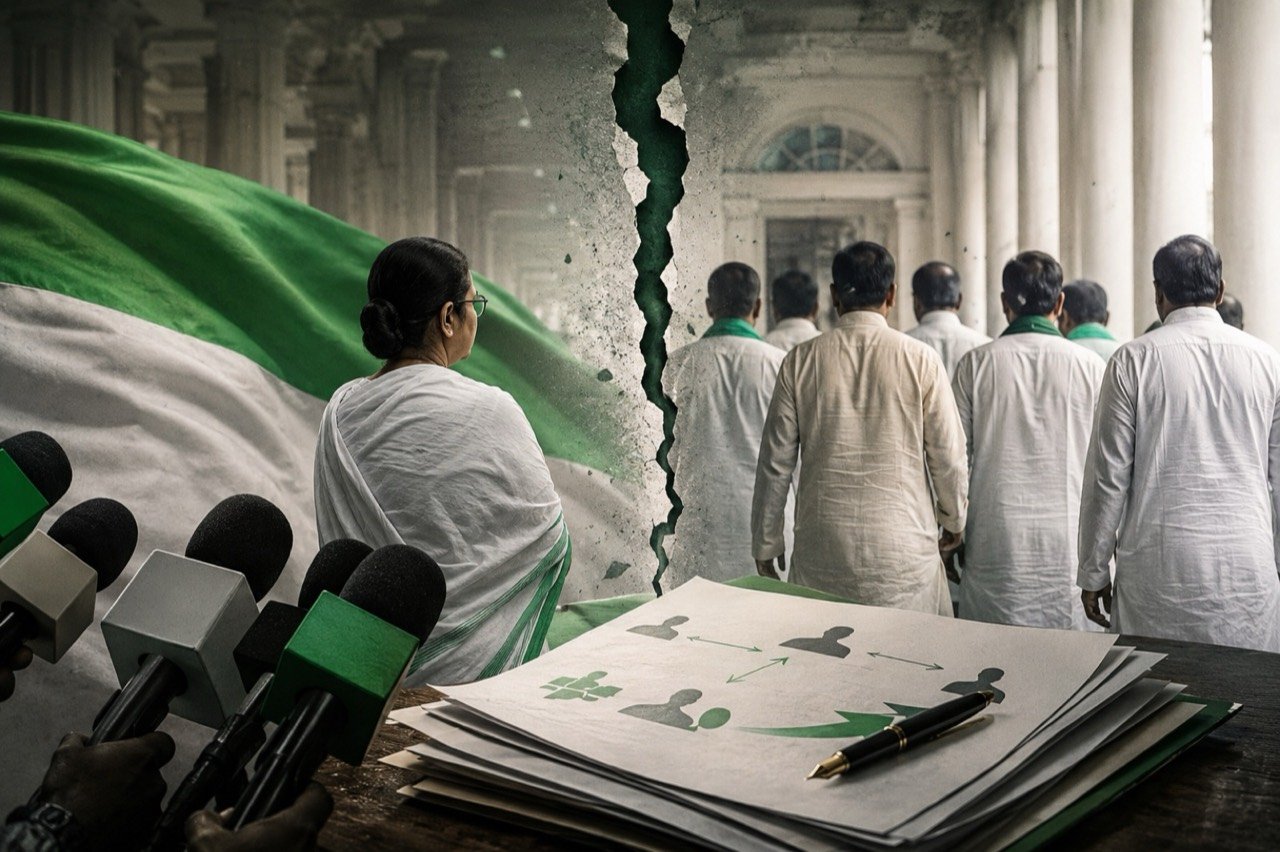
Rebel TMC MLAs Name Arup Roy Chairperson, Deepening Mamata Banerjee's Crisis
A breakaway group of Trinamool Congress legislators has declared Arup Roy chairperson of what it calls the 'real TMC', mounting an open challenge to Mamata Banerjee's leadership in West Bengal.

Madan Mitra Joins TMC Rebel Camp Led by Ritabrata Banerjee
Veteran MLA Madan Mitra has quit all posts in the Mamata Banerjee-led TMC faction and joined Ritabrata Banerjee's rebel camp, deepening the split before July 21.
K Kavitha Party Denied TRS Name by Election Commission
The Election Commission has refused to register K Kavitha's Telangana Rakshana Sena under the TRS acronym after objections, forcing a branding reset for the new party at a politically sensitive moment in Telangana.
Sena UBT Defections Await Speaker's Recognition in Fresh Maharashtra Twist
A reported bid by six Shiv Sena UBT MPs to be recognised as a separate group has opened a new front in Maharashtra's party-split politics, with the Lok Sabha Speaker's call now pivotal.