Microsoft unveils seven in-house MAI models at Build 2026, loosening its grip on OpenAI
With a reasoning model, a coding flash variant and image generators trained on its own licensed data, Microsoft is signalling it wants to build at the frontier rather than rent it.
The NE Times Technology Desk
Commentary & Analysis ·

Microsoft used its Build developer conference in San Francisco in early June to introduce a family of seven in-house artificial intelligence models under the MAI banner, a step the company framed as a move towards long-term self-sufficiency and a clear reduction in its dependence on outside providers, chiefly OpenAI.
The announcement caps a year in which Microsoft and OpenAI quietly renegotiated the terms of their landmark partnership. Microsoft has capped its revenue-sharing payments and given up the exclusive right to resell OpenAI's models, freeing it to develop and ship rival systems of its own. The MAI launch is the most concrete evidence yet of where that newfound latitude is heading.
The models on the table
At the centre of the lineup is MAI-Thinking-1, a reasoning model with 35 billion active parameters and a 256,000-token context window aimed at complex, multi-step problem solving. Alongside it sits MAI-Code-1-Flash, a compact five-billion-parameter coding model now rolling out inside Visual Studio Code and GitHub Copilot.
The rest of the family targets creative and productivity workflows:
- MAI-Thinking-1: a 35-billion-active-parameter reasoning model with a 256K context window
- MAI-Code-1-Flash: a 5-billion-parameter coding model live in VS Code and GitHub Copilot
- MAI-Image-2.5 and a flash variant: text-to-image and image-to-image generation, already in PowerPoint and rolling out to OneDrive
Built on licensed data
Microsoft says these are its first foundation models trained entirely on commercially licensed data, without leaning on OpenAI technology. That detail matters on two fronts. It addresses the legal uncertainty hanging over models trained on scraped web content, and it lets Microsoft claim a clean, independent technology stack it fully controls from training run to product.
Chief executive Satya Nadella cast the shift in strategic terms, arguing that the era of simply consuming a frontier model from a single supplier was ending. The framing positions Microsoft not as a customer of the AI frontier but as a participant building at it, a notable change in posture for a company that staked much of its early generative-AI lead on its OpenAI alliance.
A play for developers and margins
Cost is a recurring theme. By offering smaller, cheaper models such as MAI-Code-1-Flash for everyday coding tasks, Microsoft can lower the price of running AI features across its products and pass savings to developers, while reserving heavier models for jobs that genuinely need them. For the enterprises and independent developers who build on Azure and GitHub, more model choice at lower cost is the immediate, tangible benefit.
It also hedges Microsoft's exposure. Relying on a single external lab for the intelligence layer of Windows, Office and Azure was always a strategic risk; an in-house family gives Microsoft a fallback and a bargaining chip in any future negotiation.
What it means for the AI market
Microsoft's entry reshapes the competitive map. Where the conversation once pitted OpenAI against Google and Anthropic, the largest distributor of AI software is now also a model maker in its own right, joining a crowded field of frontier and near-frontier developers all racing to balance capability against cost.
For now, Microsoft is positioning MAI as complementary rather than a wholesale replacement for OpenAI's systems, which remain available across its platforms. But the direction of travel is unmistakable. The company that helped define the first wave of consumer AI is making sure it owns more of the stack in the next one, and developers will be the first to feel the effects in their tooling and bills.
The NE Times View
Microsoft building its own models rather than renting OpenAI's is the predictable end of a dependency that always looked uneasy. Owning the frontier means owning the margins, the roadmap and the risk. For India's developers and enterprises, more credible model providers means more competition, leverage and choice, which is healthy. The strategic takeaway is clear: in AI, the firms that control their own models will dictate terms to those that merely license them.
This article is original commentary and analysis by The NE Times. Background facts were referenced from CNBC and Windows Central.
You may also like to read

Anthropic puts a Mythos-class model in public hands with Claude Fable 5
The company is releasing its most capable widely available model yet, paired with a locked-down sibling reserved for cybersecurity work, in a careful balancing act between power and safety.

OpenAI Eyes Gigawatt-Scale India Data Centre As Local Users Cross 100 Million
With India now its second-largest market and weekly ChatGPT users past 100 million, OpenAI is scouting partners for a one-gigawatt facility under its Stargate infrastructure push.
OpenAI Makes GPT-5.5 the Heart of ChatGPT as Older Models Retire
OpenAI has rolled GPT-5.5 into ChatGPT as the new default and begun phasing out GPT-5.2, while pushing personalisation upgrades to free and lower-tier users in June.
Google's Gemini 3.5 Flash Powers Its AI Push as the OpenAI Race Intensifies
Google's fastest agentic model is now the default brain for over 900 million Gemini and Search users, claiming to beat last year's Pro tier on coding and multimodal tests.
More from this section
More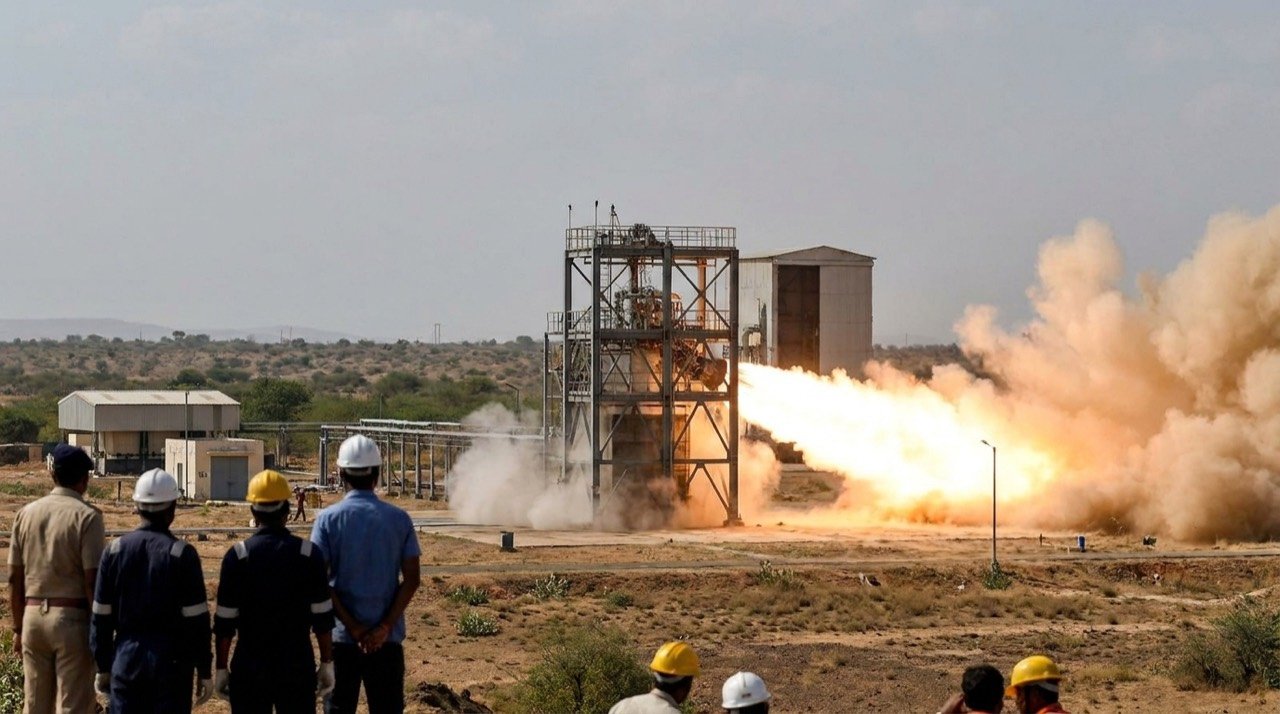
ISRO Fires Semi-Cryogenic Engine Power Head at 175 Tonnes in Landmark Hot Test
ISRO successfully ran its indigenous semi-cryogenic engine power head at 175 tonnes of thrust, clearing a key hurdle toward powering the LVM3 upgrade and the Next Generation Launch Vehicle.
India Tech Funding Climbs to $7.2 Billion in H1 2026 Even as Deal Count Slumps
Indian tech startups raised $7.2 billion in the first half of 2026, up 12 per cent year-on-year, but the number of funding rounds fell sharply as capital concentrated in a handful of mega-deals.
OnePlus N6 Headlines a Crowded End-June Gadget Calendar in India
The OnePlus N6, with its 8,000mAh battery and sub-Rs 25,000 price tag, leads a busy late-June run of smartphone launches in India spanning OnePlus, Oppo and Samsung.