Global smartphone shipments slide 6.7% as the memory chip crisis squeezes everyone but Apple and Samsung
India's Supreme Court imposed Rs 3 lakh costs on Samay Raina, Ranveer Allahbadia and Ashish Chanchlani after finding non-compliance with directions in a disability-related case.
Commentary & Analysis ·

Verified key facts
- Global smartphone shipments fell 6.7% year-on-year to 277.5 million units in Q2 2026, per IDC's Worldwide Quarterly Mobile Phone Tracker.
- It is the second consecutive quarter of year-on-year decline, driven by a global memory supply crisis.
- Memory costs are up nearly 300% from a year ago and exceed 65% of bill-of-materials at the low end, IDC said.
- Samsung shipped 62.7 million units and Apple 55.8 million; they were the only top-five vendors to grow.
- IDC expects India's smartphone market to shrink 12-15% in 2026 to around 132 million units, the sharpest fall since the pandemic.
The numbers: a shrinking market, again
The global smartphone market contracted 6.7 percent year-on-year in the second quarter of 2026, to 277.5 million units. The data comes from IDC's Worldwide Quarterly Mobile Phone Tracker, reported by Communications Today on 14 July. It marks the second straight quarter of decline.
The cause is not weak demand for phones. It is the price of what goes inside them. IDC says the memory crisis continues to disrupt the market with unprecedented costs and strained supply, as AI data centres hoover up DRAM and NAND production capacity worldwide.
Memory is eating the phone's bill of materials
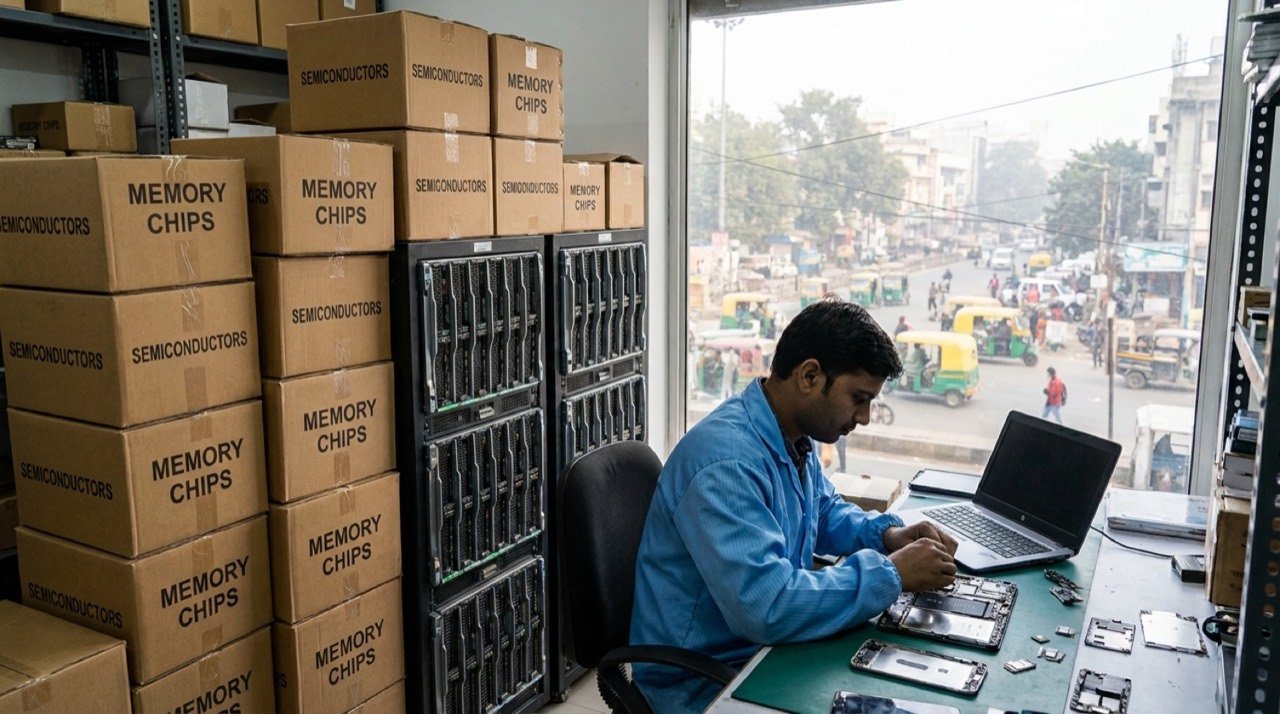
The scale of the input-cost shock is remarkable. Memory prices are up nearly 300 percent from a year ago, according to IDC's release. At the low end of the market, memory now accounts for over 65 percent of a phone's bill of materials. A budget phone is, financially speaking, mostly its RAM and storage.
The root cause sits in data centres, not phone factories. Memory makers have shifted production lines toward high-bandwidth memory and server DRAM for AI infrastructure, where margins are richer. Smartphone brands now bid against hyperscalers for what remains. In that auction, a Rs 12,000 handset loses to a GPU cluster every time.
That arithmetic is brutal for brands that live on thin-margin budget devices. Business Standard reported that the pace of decline accelerated among Chinese vendors, with most large players falling by double digits. Industry tracker XimiTime noted Xiaomi strategically cut low-end shipments, absorbing the largest drop among major brands.
Apple and Samsung pull away from the pack
For the second consecutive quarter, only two top-five vendors grew. Samsung led with 62.7 million units, while Apple shipped 55.8 million, according to IDC figures carried by Telecompaper. Premium players can absorb component inflation through pricing power and long-term supply contracts. Budget-focused rivals cannot.
Apple's performance stood out even within that pair. Coverage of the IDC data described record iPhone growth inside a shrinking market, as premium buyers proved indifferent to component inflation. The rankings below the top two held steady, but Xiaomi, Oppo and Vivo all saw declines accelerate from the first quarter.
The result is a market consolidating upward. Average selling prices rise, entry-level models vanish from portfolios, and the replacement cycle stretches. IDC analysts warn that survival is getting harder for any manufacturer whose portfolio leans on sub-$200 devices.
India: the sharpest fall since the pandemic
India, the world's second-largest smartphone market, is feeling this acutely. IDC expects Indian shipments to shrink 12 to 15 percent in 2026, to roughly 132 million units, NewsBytes reported. That would be the steepest annual contraction since Covid-19 disrupted supply chains. First-quarter shipments had already fallen 4.1 percent to 31 million units.
The pain concentrates exactly where Indian buyers live: the Rs 10,000 to Rs 20,000 segment. Memory-heavy spec sheets, once the favourite marketing weapon in India, are now the costliest part of the phone. Expect 8GB RAM at prices where 12GB was promised last year, and quiet cuts to base storage.
Make-in-India assembly offers no shelter here. Local factories still import nearly all their memory chips, so the cost shock passes straight through to Indian retail prices. The crunch strengthens the case for India's semiconductor mission, but domestic memory fabrication remains years away from relieving handset makers.
Brand strategies are already adapting. Companies are prioritising mid-range and premium launches, where memory costs can hide inside higher sticker prices. July's India calendar shows it: foldables from Samsung and Motorola, a premium Vivo relaunch, and conspicuously few budget announcements. The entry-level buyer, once the industry's obsession, is being quietly deprioritised.
What it means for buyers and brands
For Indian consumers, the practical advice is unusually clear. Prices are more likely to rise than fall through the festive season, because component contracts for the second half were signed at crisis rates. Buying a mid-ranger during early sales events may beat waiting for Diwali discounts that do not materialise.
Trade-in values are rising along with new prices. Old phones have become genuine currency, and exchange programmes now shape purchase timing as much as sale events do. A well-kept two-year-old flagship offsets more of a new device's cost than at any point in recent memory.
- Budget phones will see spec downgrades before sticker-price rises, especially in RAM and storage.
- Premium and foldable segments stay insulated; Apple and Samsung keep gaining share.
- Refurbished and open-box markets should grow as new-device prices climb.
- Extended EMI schemes and exchange bonuses will do the discounting that price tags cannot.
What happens next
Relief depends on memory supply, not phone demand. New DRAM capacity announced across Korea and the US arrives in 2027 at the earliest. Until then, IDC's tracker suggests the market splits in two: resilient premium volumes, and a squeezed mass market where every gigabyte is contested.
Watch India's Q2 country-level data, due later this month, for confirmation of the 12 to 15 percent contraction path. Watch, too, how brands reposition around the crunch. The vendors that redesign products around scarce memory, rather than simply repricing them, will own the recovery when it comes.
Sources
- Communications Today - Global smartphone shipments fall 6.7% to 277.5M units in Q2 2026 (14 July 2026)
- Business Standard - Apple, Samsung pull ahead as memory crisis hits smartphone market in Q2 (14 July 2026)
- Telecompaper - IDC records nearly 7% fall in Q2 smartphone shipments (July 2026)
- NewsBytes - India's smartphone market to shrink 12-15% in 2026: IDC report (2026)
You may also like to read
AI Chip Demand May Push Up Smartphone and Laptop Prices in India
Surging demand for memory and storage chips from AI data centres is squeezing global supply, threatening to make smartphones, laptops and gaming devices costlier for Indian consumers.

Airtel Leads Nifty as Jio IPO Nears: Telecom's Duopoly Test
Bharti Airtel led Nifty gainers on 14 July as Jio's Rs 30,000-52,000 crore IPO heads for an August-October window. Analysts see a listed duopoly reshaping telecom.

CERT-In AI War Room: India Tests Frontier AI Models for Threats
MeitY says CERT-In has built an AI war room that stress-tests near-frontier models in sandboxes, hunting vulnerabilities before Indian firms adopt them at scale.

Gemini 3.5 Pro Launch: Google Targets July 17 After Full Rebuild
Reports say Google will launch Gemini 3.5 Pro on 17 July after rebuilding its base model, with a rumoured 2-million-token context. Google has confirmed nothing yet.